
Washington’s inability to subjugate Iran is an example of how it is trying to preserve a regional order that no longer exists, argues RAMZY BAROUD


The Welsh elections: the disillusioned have had enough
On a tumultuous day in Welsh politics DAVID NICHOLSON looks at the key issues for progressives in Wales to grapple with the rise of the far right
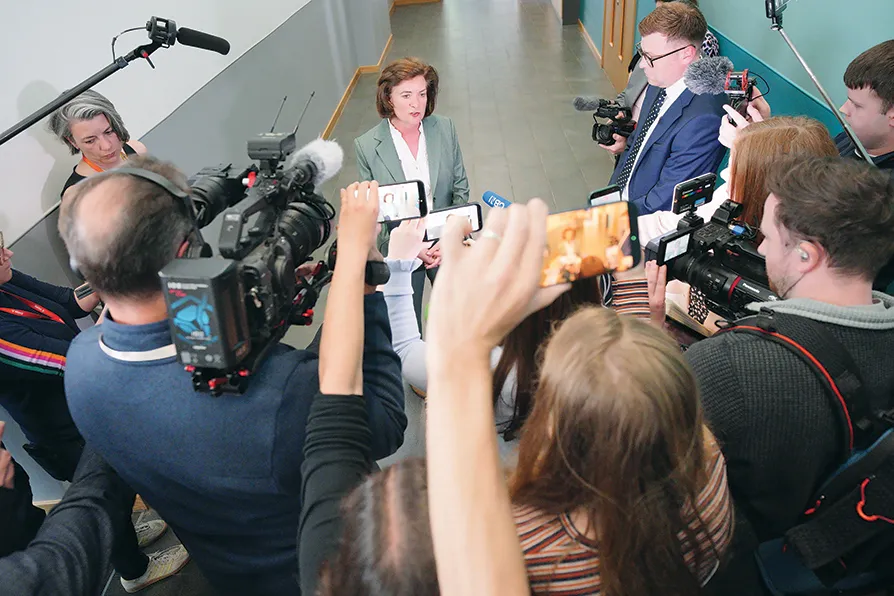
 LOGICAL CONCLUSION: Baroness Eluned Morgan speaks to the media yesterday after announcing her resignation as leader of Welsh Labour after her party suffered heavy defeats

US financial instability is exposing the limits of a dollar-dominated global economy — and giving the Global South a historic chance to build an alternative, says MURAD QURESHI
DOUG NICHOLLS says the parasitic finance markets must be challenged or another British government could be toppled
The late country singer’s Imagination Library has put hundreds of millions of books into children’s hands. We should build on that legacy by defending the libraries at the heart of our communities, says BRENDA AITCHISON
Deprivation is a fundamental factor in criminal behaviour that must be addressed but, KENNY MacASKILL argues, there needs to a major rethink in sentencing to tackle overcrowding
MML director MEIRIAN JUMP outlines the recently refreshed library’s busy autumn schedule that ranges from book sales, archival exploration, community work with online education and the ever popular site tours
TONY BURKE surveys the shifting political landscape and the challenges Labour needs to address if it is to prevail in the 2028 federal elections





THE 2026 Senedd election has been marked by the rise of the far right in Wales and especially in poorer, working-class traditional Labour constituencies.
How has this been allowed to happen? What does it mean for progressive politics in Wales, and how has the trade union movement, which has 365,000 members in a country of three million people, not managed to engage its members?
Star readers are well aware of the impeccable Thatcherite politics of Reform UK’s leader Nigel Farage and leading ex-Tory figures who have jumped ship to save their political skins.
But just how have these charlatans managed to convince poor people whose lives have been blighted by 30 per cent child poverty in Wales, that low taxes and more austerity to pay for it is the answer?
Partly it is the disillusionment with the ruling Welsh Labour government, which has led people to call for change, despite the direction that change might take the country.
But at the 2021 post-Covid pandemic Senedd election, the country was inspired by Professor Mark Drakeford as first minister and how his government had responded to the pandemic thoughtfully and sensibly, unlike the Tory chaos in Westminster under Boris Johnson’s premiership.
Despite governing the country for 22 years, the party under Drakeford almost reached a majority for the first time, winning 30 seats.
But when Drakeford stood down, the party became mired in a controversy after a businessman convicted of environmental offences supported Vaughan Gething with a £200,000 campaign donation for the contest to become first minister.
Gething also refused to resign after he lost a no-confidence vote in the Senedd, and the long-drawn-out saga damaged Welsh Labour’s reputation for probity and trust built up by successive first ministers.
Despite Gething denying that he had broken any rules, the controversy played out for his short tenure as first minister, and only ended after several of his senior ministers resigned from his cabinet.
The episode damaged Welsh Labour, not least as Gething’s colleagues had to defend the indefensible.
Ongoing concerns in Wales about how the country has been underfunded and treated by successive Tory governments, and for the last two years by an unpopular Keir Starmer Westminster Labour government, have not led to a sharp contrast in the powers sought by Welsh Labour.
Despite Baroness Eluned Morgan’s trumpeting of a Red Welsh Way in which she sought to draw a distinction between her government and Starmer’s, this did not lead to a muscular call for the powers that might have enabled a Welsh government to properly plan and manage the Welsh economy.
For example, Wales does not have the power to set income tax bands, unlike Scotland, and has less borrowing power than a single Welsh council.
Westminster refuses to allow Wales to carry over significant sums of money from any savings it makes at the end of the financial year, which leads to poor planning and unseemly spending to ensure the money is not lost in the next budget round.
Why didn’t the party and the trade union movement campaign for these powers, which would enable Wales to try to tackle endemic unemployment and 30 per cent child poverty?
Any strategy now by the left in Wales has to identify how it has lost many of its voters to a far-right party that shouts about immigration in areas of Wales where only 2 per cent of the population comes from abroad.
The trade union movement will also need to look at how it engages its members and how its social solidarity was lost to a Reform party trumpeting nonsensical economic strategies based on lower taxes, which do not impact in any way on poor people.
In fact, the squeeze on public spending that Reform would need to finance its tax cuts would adversely affect those poorer people most dependent on public services.
Well-known far-right activists in Wales have supported Reform in Wales and have been seen campaigning for the party.
Far Right Watch Wales has documented how Voice of Wales (VoW) co-founder and convicted fraudster Dan Morgan set up and managed a Reform supporters’ group in Swansea under a fake profile.
It also exposed how Morgan and VoW cronies carried out banner stunts on bridges around Swansea last year in support of Reform.
Also, even more disturbingly, Joe Marsh, a convicted criminal who attacked a woman, and Welsh organiser of neonazi group Patriotic Alternative, carried out banner stunts in support of Reform.
Marsh was even in Caerphilly on the same day Nigel Farage was launching Reform’s by-election campaign in the Welsh town, while Dan Morgan bagged an interview with Farage on the day of the vote itself.
At Reform’s Senedd manifesto launch, the Morning Star, Welsh news website Nation.Cymru and investigative political reporter Will Hayward were banned by the party.
But interviewing the Reform great and the good at the manifesto launch was the discredited far-right Voice of Wales.
The soul-searching after the Senedd election will be far-reaching in the trade union and progressive movement, and the Morning Star is organising an all-day conference at Unison Cymru’s Cardiff office on June 27 to lead that fightback and discussion.
David Nicholson is Morning Star correspondent for Wales.
