Councillor SAM WHEELER says there’s a tangible shift in mood on the left in the city whose mayor has recently become PM — but there’s no room for complacency



Cracks in the Tripartite Alliance? The ANC, SACP and South African elections
ROGER McKENZIE says the ANC needs to respect South Africa’s Communists and their decision to stand independently at elections
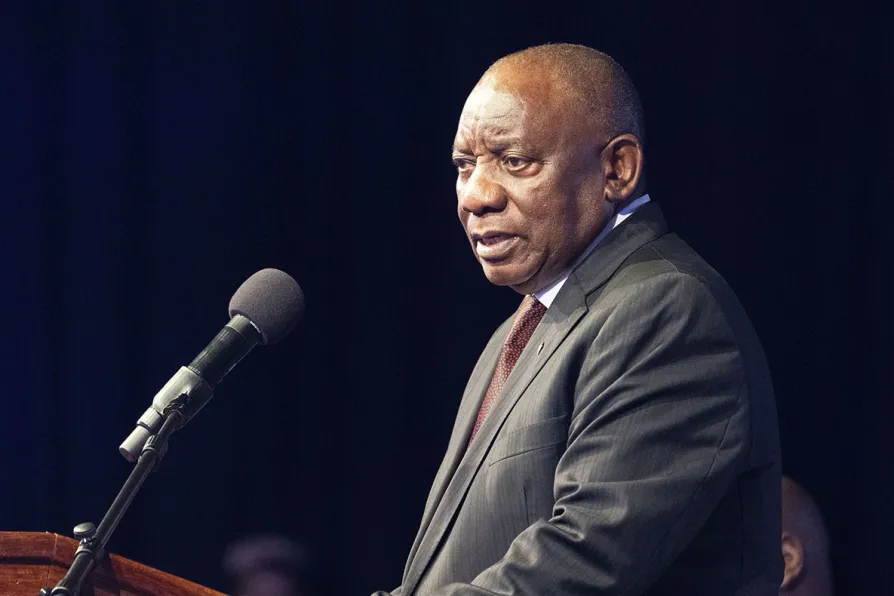
 South African President Cyril Ramaphosa addresses the opening session of the G20 foreign ministers meeting in Johannesburg, South Africa, February 20, 2025
Communist Party leaders Alex Gordon and Lorraine Douglas deliver vital medicines in trip to besieged socialist island
TUC Cymru is playing a leading role in tackling far-right ideas in the workplace, says LAURA DOEL
A New Delhi press conference in which Sheikh Hasina and her son implied the new order in Bangladesh is a security threat to India has sparked fears she is planning a comeback. SIAM SAROWER JAMIL reports on the fallout
Two months of student unrest have forced out India’s education minister and rattled the BJP regime. Could this be the beginning of the end for Modi, asks Communist Party of India (Marxist) general secretary MA BABY
MAT COWARD says the heatwave is a testing time for gardeners — but he has some tips





WHILE debates rage in Britain’s left circles over the rights and wrongs of dual membership of political parties, a long standing arrangement of this kind has been placed under severe threat.
The South African Communist Party (SACP) was the backbone of the African National Congress (ANC) for the entirety of the fight to defeat the racist apartheid white colonial settler regime that had subjugated the majority black population.
But the ANC has now decided to issue an “ultimatum” to communists who are members of this strategic alliance that was forged in the bitter and deadly fight for liberation.
This comes after the SACP decided to independently fight this year’s local government elections.
The ANC appears to accept the existence of the SACP as a political party, but only if it subordinates itself. In what appears to be a communist witch-hunt the ANC has now demanded declarations from members of the SACP and threatens action against those it believes are acting for the party’s campaign.
This move, which threatens the future of the historic alliance, is far from a minor procedural disagreement. It amounts to an attempt to reinterpret the alliance and dual membership in narrow electoral terms.
It seeks to reduce a historic strategic relationship into a one-sided demand for subordination and permanent support from an ally.
The SACP has always supported the right of the ANC to contest elections in its own right.
The SACP has never regarded the ANC as an enemy for contesting elections in its own right and has never disciplined or threatened any of its members for participation in building, voting for and campaigning for the ANC.
In fact, the SACP has not only embraced the ANC contesting elections in its own right but has also supported the ANC’s electoral contests.
But, in doing so, the SACP has never given up the right to contest elections directly instead of simply voting for and campaigning for the ANC.
The strategic alliance with the ANC has never meant the liquidation of the Communist Party.
Dual membership never meant abolishing the SACP’s right to think, organise, campaign and lead struggles and develop tactics on any question as an independent party of the working class.
The problems now confronting the national democratic forces in South Africa did not arise because the SACP chose to contest elections.
There are far more deep seated issues facing South Africans.
The ANC has failed to make the radical economic changes required to make liberation tangible and meaningful to the working class of South Africa.
There has been a lurch towards neoliberalism by the ANC which has seen an increase in the control of the country’s economy by monopoly capital.
The ANC has also failed to deliver on promises over housing, jobs as well as issues such as the common ownership of the land and the wealth beneath the people’s feet.
These are the factors that have led to a slump in support for the ANC and them being forced to form a coalition government with the National Party.
No amount of communist witch-hunting can alter these fundamental problems.
The decision of the SACP to run independently in the local government elections comes as the support of the liberation movement has slumped in working class communities and as corruption has risen locally and nationally.
Poverty levels in South Africa remain high.
According to official statistics released earlier this year, in 2006, the poverty headcount using the Lower-Bound Poverty Line (LBPL) stood at 57.5 per cent (approximately 27.3 million people), which declined to 37.9 per cent (roughly 23.2 million people) by 2023.
This 19.6 per cent drop in poverty over 17 years translates to an approximately 1.15 per cent drop per year.
Overall, the figures show there are 4.1 million fewer people living below the LBPL in 2023 than there were in 2006.
KwaZulu-Natal, the Eastern Cape, North West and Limpopo are the poorest provinces in the country, reporting the highest poverty levels, with poverty disproportionately affecting children, black Africans, women, and those living in rural areas.
Roughly 60 per cent of all poor persons reside in one of those four provinces, with KZN alone home to approximately one out of every four poor persons in South Africa.
While Gauteng recorded the second-lowest levels of poverty after Western Cape in 2023 and has seen its poverty levels drop over time, the province’s poverty share has increased notably since 2015. Roughly one out of every five poor persons in South Africa live in the WC.
But black Africans continue to carry the highest levels of poverty.
Poverty amongst black Africans decreased from 67.3 per cent in 2006 to 43.8 per cent in 2023. But despite the reduction, black Africans still had the highest poverty levels compared to the other population groups.
Coloureds experienced a steady and significant decline in poverty levels, dropping from 42.8 per cent in 2006 to 24.6 per cent in 2023.
Indians/Asians had very low levels of poverty throughout the period, declining from 10.5 per cent in 2006 to 2.8 per cent in 2015, before rising to 5.8 per cent in 2023.
Poverty levels amongst whites remained the lowest among all population groups across the series; but even that more than doubled, increasing from 0.6 per cent in 2006 to 1.4 per cent in 2023.
Throughout the period, women suffered higher poverty levels than men. The poverty headcount for men decreased from 54.7 per cent in 2006 to 36.0 per cent in 2023, while that for women dropped from 60.3 per cent to 39.7 per cent over the same period.
The report also said children are still being hit hard, making up 43.1 per cent of the poor population in 2023, while the 65 years and above category saw the largest improvement in their poverty status, dropping by 54.8 per cent (a 30.6 per cent drop) between 2006 and 2023.
The unemployment rate in South Africa was 32.39 per cent in 2025. Between 1991 and 2025, the unemployment rate rose by 9.25 per cent.
There are also concerns over whether South Africa, a land of abundance, is actually able to feed its population.
The South African Human Rights Commission (SAHRC) said recently that it plans to convene a national investigative hearing into how food is produced in the country.
It said that whilst the country has the capacity to feed the entire population, millions of people are still going to bed hungry every night.
There is no way that the SACP could ignore the desperate plight facing many working-class black South Africans. In fact the considerable efforts the party must have gone through over many years to help set the ANC on the right path must be applauded.
The path they have chosen for this year’s local elections is not an easy option but it seems to me to be entirely necessary.
The ANC must stop the witch hunts against communists in its ranks and, instead, concentrate on standing up for the working class rather than monopoly capital.
Roger McKenzie is international editor of the Morning Star.
