
The US administration is endangering lives by reversing environmental protection laws, CHAUNCEY K ROBINSON argues

Helen MacFarlane: unsung pioneer of British communism
KENNY MacASKILL remembers the woman who first translated The Communist Manifesto into English
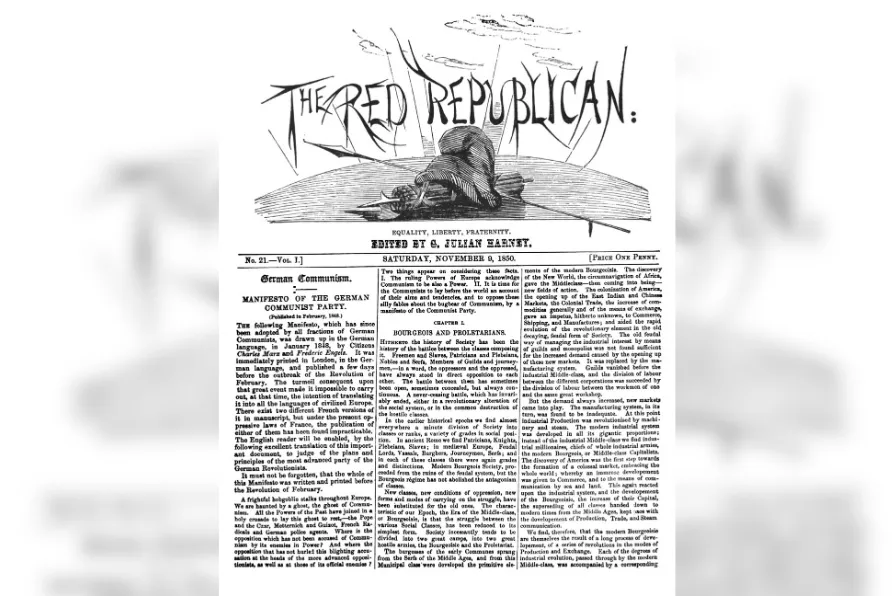
 Front page of the Red Republican November 1850 edition. Pic: Public domain

It’s time to stop retreating and go on the offensive to promote working-class interests, argues DOUG NICHOLLS
Marco Rubio wants to defeat socialism in Nicaragua, not restore ‘democracy,’ writes JOHN PERRY
Believe it or not, there was a time when the US government built beautiful homes for working‑class Americans to deal with a housing shortage, writes ERAN BEN-JOSEPH
DIANE ABBOTT provides an analysis of the reasons for EU and British voters’ dramatic swing to the right
Train drivers’ union Aslef general secretary DAVE CALFE speaks to Ben Chacko about his hopes that Burnham’s devolution agenda will include the importance of the railway





HELEN MACFARLANE was the first person to translate the Communist Manifesto into English.
Though she knew Marx and Engels well hers is no longer the version used today and sadly neither does she get the recognition which her efforts on that and in other fields deserve.
Besides her venture into early communism she was a leading Chartist, though she would end up buried a Christian having married an Anglican minister. A remarkable life for a woman denied formal educational opportunities.
Born in 1818 to a prosperous calico printer in Barrhead, outside Glasgow, she was the youngest of 11. Her gender shamefully limiting her education and which seems to have largely been through others in the family.
However, as her life would show she was obviously very bright and a gifted linguist.
Disaster though befell her and the family in 1842 when her father’s business collapsed, driven under by new technology with which he was unable to compete.
The family home in a leafy part of central Glasgow was sold along with business and mills with Helen requiring to find employment as a governess, initially in England before moving to Vienna.
There’s some suggestion that she had already gained some knowledge of German through her father’s business with machinery and products purchased there. But she obviously immersed herself in the language in Austria not just within the family she was working for.
Living in Vienna in 1848 she experienced the revolution and tumult which convulsed not just the city but far more widely in Europe.
That appears to have had a profound effect upon her even if her radical sympathies existed back in Scotland. But a spark had been lit within her by those events, as with many others, and she was excited by the different world which now seemed possible.
Her contribution to the cause would be through her writings, which she set to with a will on her return to Britain after the continent settled down after those first attempts for radical change had faltered. Many other European revolutionaries would also join her in heading there, including none other than Karl Marx.
A brief stay in Lancashire then saw MacFarlane move to London where her literary works soon started to appear in radical papers.
It was no doubt an exciting as well as challenging time as a fledgling movement sought to develop and organise. Socialism joining the push for democracy and the franchise under the wider ambit of reform. Marx having written the Communist Manifesto with its German edition first published in February 1848, just as the revolutions erupted.
As with her lack of a formal education the all-pervasive sexism of the time saw her required to use the male pen name of Howard Morton for her contributions. Her groundbreaking translation of the Communist Manifesto appearing in the aptly named Chartist Paper “The Red Republican,” over four editions in November 1850.
Much of her text is the same as the standard edition that appears today. But her introduction has been changed, and it would now perplex many though it had a basis, as well as logic, at the time.
The opening clarion call of “A spectre is haunting Europe, a spectre of Communism” was narrated by her as “A frightful hobgoblin stalks throughout Europe. We are haunted by a ghost, the ghost of Communism.”
Nowadays “hobgoblin” is more likely to conjure imagery of Harry Potter or other such novels but back then it was a phrase which had been used by the Chartist leader Feargus O’Connor. Given ongoing debates, including between physical and moral force Chartism, it may well have seemed apt to MacFarlane, and its use and context would certainly have been understood by the readership. Some things though never change down through the ages and Macfarlane’s translation was denounced by The Times (for its content, rather than style).
Marx was not her only venture into the world of translation and she would also be the first person to provide an English edition of Hegel. Interpretation into a different language is never easy even with the simplest of works and to have completed two such heavyweight philosophers as Marx and Hegel is really quite outstanding given her lack of formal education. She also wrote extensively quoting widely from literary and philosophical works. Confirming not just her appetite for literature and learning but her intellect and talent.
Her involvement in the Chartist movement was to prove all too brief when she had a falling out with George Harney, the editor of The Red Republican as 1850 ended. Little’s known about the reason though it appears to have been an argument between MacFarlane and Harney’s wife. It saw her cease contributing to the paper and end her political activities. Something which Marx was to regret and chastise the editor for.
Her later years were to be marked by tragedy. In 1852 marrying a radical exile, Francis Proust, they decided to move to South Africa where some of her family had gone. But there was to be no new life together as her husband died before the ship had even departed British seas and a daughter born of the relationship shortly upon arrival.
Understandably given those tragedies she never settled in South Africa, returning to Britain where in 1854 she met and married an Anglican vicar.
A widower with 11 children, they had two children together as she settled down to the role of a vicar’s wife in Nantwich. But this was to prove no retiring idyll though it seems a happy marriage. Contracting bronchitis, MacFarlane died in 1860 and is buried in St Michael’s Church there. Her headstone narrates “Sacred to the memory of Helen, wife of the Rev John W Edwards, who fell asleep in Jesus, March 29th 1860, aged 41 years.”
MacFarlane had written of Christianity’s basis in communism as well as fulminating against the established church. Perhaps, as with her version of the Communist Manifesto, it was an interpretation of the people and the context of the time.
