ROB WARZYNIAK recalls the emblematic 1906 book, The Jungle, in its analysis of the crisis presently engulfing the US Food and Drug Administration


 Latest editorial

Defending Iran against US and Israeli aggression will be a prolonged struggle
It is too early to assume a US defeat in Iran — we must prepare for a long anti-war struggle, argues JOHN ROSS
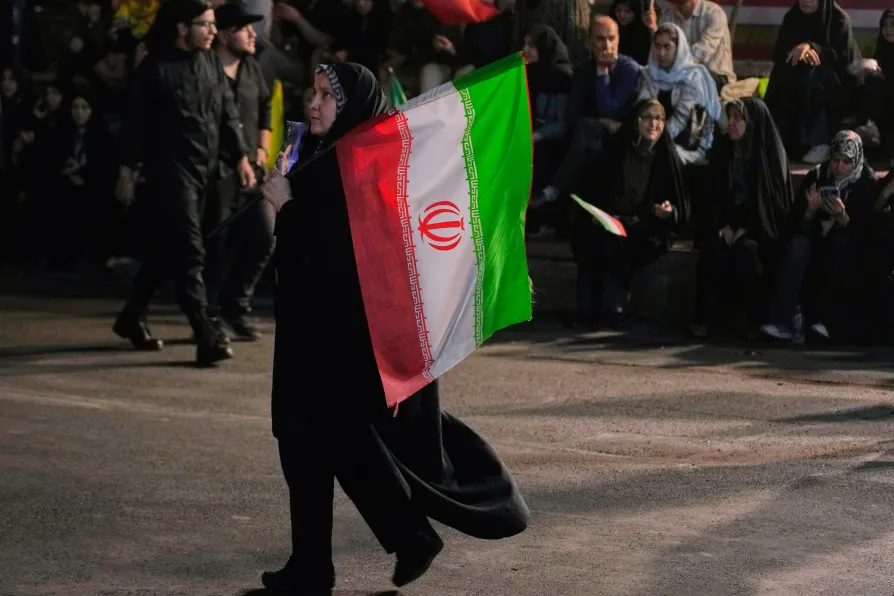 A woman carries an Iranian flag during a pro-government gathering at Enqelab-e-Eslami, or Islamic Revolution, square in Tehran, Iran, May 4, 2026

Welsh wanderings showcase fiery destruction, alternative water ways and revive memories of a local mining legend, writes MARK SEDDON
As thousands die in the eastern DRC, a global health emergency is being starved of funds, says S KRISHNASWAMY
MAT COWARD explains how in the 17th century a row over whether to kneel at communion became a battle over religion, class and royal power
Renewed illusions in social democratic reformism are sprouting as a result of Andy Burnham’s rhetoric, but material conditions are already intruding into the debate, argues NICK WRIGHT
Andy Burnham could learn a few lessons from a previous Labour government in the pre-privatisation era on how to tackle water shortages, writes KEITH FLETT





THE entire peace movement opposed the US/Israeli war against Iran. Opposition went well beyond those normally opposing US actions. It is widely understood that resistance by the peoples of Iran, Lebanon and Yemen, together with the war’s unpopularity in the US, led to Trump losing the first rounds of the conflict.
Even the Wall Street Journal, a fervent supporter of the war, admitted this: “Trump screamed at aides for hours. The Europeans aren’t helping, he said repeatedly. Gas prices averaged $4.09. Images of the 1979 Iranian hostage crisis… had been looming large in his mind, people who have spoken to him said. ‘If you look at what happened with Jimmy Carter…with the helicopters and the hostages, it cost them the election,’ Trump had said in March. ‘What a mess.’”
But it is a misjudgement to believe that because the US and Israel lost the first battle, therefore they have lost the war and are resigned to this. Instead, the peace movement must prepare for a prolonged struggle to defeat US and Israeli attacks on Iran.
Some genuinely taking the right side in this war have written that the US has already suffered its biggest defeat since Vietnam, or even that this is a bigger defeat.
Unfortunately, this is a misanalysis. To prepare for the prolonged anti-war tasks to come, the situation must be seen accurately.
Precisely because if the US loses the war against Iran it would be its biggest defeat since Vietnam, it has no intention of giving up because it lost the first battle.
US ruling circles understand perfectly that US loss of the war would mean significant erosion of the credibility of its international threats, significantly weakening its global position.
They therefore simply conclude that the wrong tactic was chosen, and the US must change this to win the struggle. Even some forces in the US who believe launching the war was a tactical mistake believe that now it has started it must be won.
The Institute for the Study of War put it specifically: “Any US settlement or resolution of the conflict that enables Iran to control traffic through the Strait of Hormuz would represent a major US defeat.” As the Wall Street Journal summarised: “As the president said in his first term, the US shouldn’t start a war it doesn’t intend to win. His challenge now is to prove to Iran’s regime he meant what he said.”
The new US tactics to attempt to win the war can be clearly grasped if it is understood why it lost the first battle. Prior to the first military attack on Iran in June 2025, and the widespread assault launched in February, US policy under Trump had been to force Iran to capitulate to US demands by prolonged economic sanctions.
The US has now intensified this attack, after its defeat in the first round of the war, via its blockade of Iranian ships, with Trump claiming: “Iran is collapsing financially! They want the Strait of Hormuz opened immediately… Starving for cash!”
Such sanctions genuinely damaged Iran’s economy, creating a priority for Iran to attempt to break out of them, while the US can return to bombing anytime it chooses.
Israel, and some in the US, considered sanctions strategically inadequate. Iran is a huge country, 80 times Israel’s size geographically, larger than the EU’s four largest countries put together. Iran’s population is 90 million, compared to Israel’s 10 million. In real economic terms, parity purchasing powers (PPPs), Iran’s GDP is three times Israel’s.
Faced with larger states, Israel’s policy has been, where it is unable to help create governments favourable to itself, to attempt to disintegrate and weaken them — as shown in Iraq and Syria.
Israel, judging it unlikely there will be a compliant Iranian government, has long sought to disintegrate that country. Therefore, Iran faces an existential threat from Israel.
The US itself turned to a military assault on Iran, as opposed to sanctions, because of its and Israel’s victories in its genocidal attack on Gaza and also in Syria — where reactionary forces, which Israel and the US supported, came to power.
Israel and the US miscalculated that they could now achieve the same in Iran. The US supplied thousands of Starlink systems and, as Trump publicly admitted, guns to demonstrators in Iran in December and January.
But not only did this fail to overthrow Iran’s government but when the US and Israel launched their full-scale military attack on Iran in February, as even Western media admitted, there was a “rallying around the flag” in Iran — in political terms, the great majority of Iran’s population, whatever their differences on other issues, or their attitude to Iran’s government, united in opposition to the US attack. This was the basis of the US defeat in the first round of the war.
But the US cannot retreat from this conflict due to the role west Asia plays in its strategy. A mistaken analysis was put forward a few years ago that because, due to fracking, the US has become self-sufficient in oil, it would be less interested in controlling west Asia.
The facts show the opposite. The US has waged more wars in the region — against Iraq, Syria, Yemen, Lebanon and Iran.
The US is no longer being itself dependent on West Asia, but constantly waging wars there, has led some to claim that this is because Israel controls US foreign policy — that the tail wags the dog. Any analysis of the relation of forces between the two makes clear this is untrue. Israel cannot produce the weapons it relies on to carry out military terror; the US merely has to threaten to cut off arms and Israel would immediately be brought to heel.
This reality was made clear for all to see when Trump, for short-term tactical reasons, openly enforced an end to Israel’s bombing of Beirut, declaring: “Israel will not be bombing Lebanon any longer. They are PROHIBITED from doing so by the US.” The US does not support Israel because it is controlled by it but because the US finds Israel useful for its own strategy.
Although the US does not need west Asia’s oil for itself, its strategy is to be able to deny it to others, particularly China.
Because this is key for the US, it will not give up its attack on Iran, only the forms will change. Therefore, the peace movement must prepare for a prolonged struggle against US aggression against Iran.
John Ross is senior fellow at the Chongyang Institute for Financial Studies, Renmin University of China, and a member of No Cold War Britain.
