ROB WARZYNIAK wades knee deep through a pile of ‘dead canaries’ of Trumpist policies which exacerbated the horrors of US capitalism domestically


 Latest editorial

May Day reflections – remembering two trade unionist lives
The life of a modest Norfolk organiser contrasts with the dramatic rise and disappearance of a controversial figure in US labour, says MARK SEDDON
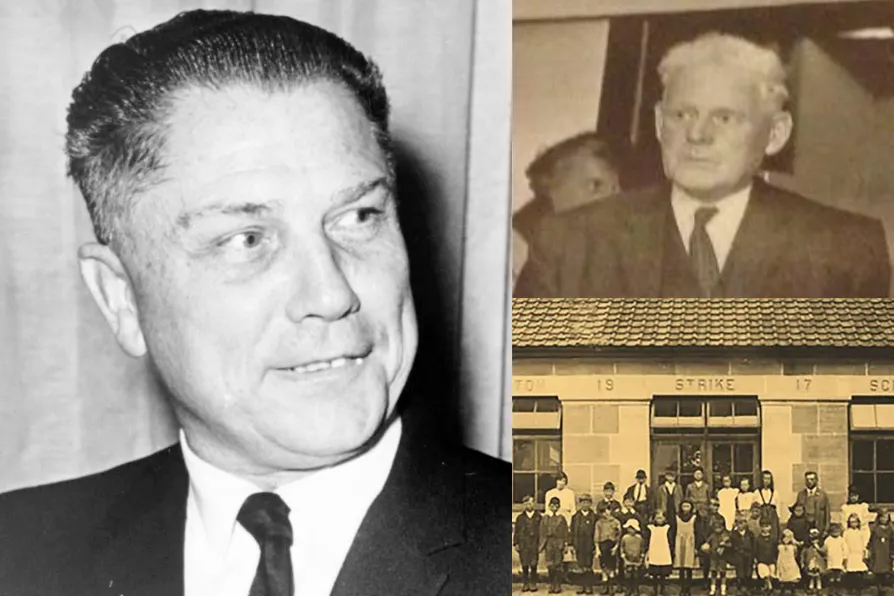 REMARKABLE LIVES: (Left) Jimmy Hoffa, of the Teamsters Union (above) Arthur Amis of the Agricultural Workers Union; and (below) the Burston Strike School where Tom and Annie Higdon taught
Without evidence or Nato consultations Berlin’s answer to the Leipzig incident is a rupture of relations. SEVIM DAGDELEN examines why
FRANCISCO DOMINGUEZ introduces the background to a conference on defending Latin America’s sovereignty
The glacier collapse in Nepal is yet another warning that a warming planet is making Himalayan disasters more frequent and destructive – but the countries facing the greatest risks are often those least responsible, says LI YANG
Nick Blair is set to benefit from a hugely lucrative contract to ‘virtually’ train the British army for its next war. Like father, like son, writes SOLOMON HUGHES
Even when tragedy strikes, Western media cannot resist the opportunity to turn it into a sordid propaganda opportunity, as the Nepal-China border tragedy shows, writes CARLOS MARTINEZ
Trade unions should be at the heart of the anti-racist push for reparations for the historic legacy and continuing impact of slavery, writes ROGER McKENZIE





SINCE it is May Day, this is as good a time as any for me to recall two trade unionists, one who I was privileged to meet and the other whose disappearance has never been solved, which prevented me from ever doing so.
One was very well known, a North American, and possibly one of the most famous union leaders of all time. The other was a quiet, unassuming individual, who had started working the land with a horse-drawn plough sometime in the 1920s in rural Norfolk.
It was springtime in 1983 and as a young student who had volunteered to organise meetings with visiting speakers for our Labour Club at the University of East Anglia, I was waiting for an elderly man to arrive by bus from a village called Mundesley, not far from Trunch in deepest, rural Norfolk.
His name was Arthur Amis and I can still remember seeing him for the first time to this day. Arthur had never been much out of Norfolk and had most certainly never been to London. He arrived wearing an ancient black three-piece suit replete with fob watch.
These were not affectations; they were Arthur’s Sunday best. He must have been in his late seventies even then. In all honesty I don’t think that he had been to Norwich either and here we were standing outside the Sainsbury Centre for Visual Arts on the University of East Anglia’s campus, and Arthur was blown away with it all.
Mind you, as I recall we were blown away by his stories of growing up in a tithe cottage with his family always fearing being evicted by the local farmer. Of being loaded as a family into a big spluttering charabanc on election days and then off to the polling booth, where his parents were supposed to vote for the bigwig local Tory on pains of being evicted.
“Ah, but the ballot boxes were secret!” said Arthur. He had been an early member and organiser in the National Union of Agricultural and Allied Workers Union (NUAAW) whose badges and banner carried the symbol of two heavy horses hauling a plough, and which is now part of Unite.
This had been Arthur’s world and he was proud of the fact that his union banner still made it each year to the annual Burston Strike School Rally in Suffolk, commemorating the longest ever strike in Britain which lasted from 1914 to 1939.
It was Arthur who told us the story of the brave teachers Tom and Annie Higdon who lost their teaching jobs after a dispute with the school management committee and about the amazing decision of the schoolchildren, led by Violet Potter, to go out on strike in support of them.
There was still a Potter family member on the local parish council.
The intransigence of the Church of England, which ran the school, and the extraordinary solidarity of the local community led to funds being raised to build a new school by the trade union movement on the village green, a building that still stands proudly to this day, with individual carved bricks commemorating support from, among others, the National Union of Railwaymen and the Miners Federation of Great Britain.
Tom and Annie are buried right next door to the school in which they had taught and each September trade unionists come from all over the country to parade their banners and bands to commemorate and celebrate these remarkable people.
Burston village was in the early 1980s a “nuclear-free zone” and the annual rally would typically include other greats on the platform from the NUAAW including union leader, Jack Boddy, Wilf Page (also from Trunch who edited the Country Standard) and the redoubtable Joan Maynard MP, who had been active in the NUAAW in North Yorkshire.
In 1984, I remember giving Joan a record titled: “We’ve got to win this strike!” which largely consisted of her voice being dubbed and set to rap. The record was a remarkable effort towards fundraising for striking miners, although I am not sure that it was Joan’s scene.
If only I could remember who the artists were. Perhaps Attila the Stockbroker may, as he was certainly around.
Fast forward a few decades, and I was in our small TV studio in Times Square, New York, when the phone rang. It was my producer and she proceeded to inform me that the police might just have located the body of Jimmy Riddle Hoffa, the legendary leader of the Teamsters Union whose relationship with the mob had eventually taken him to jail yet whose determination to take back his union from the mob led to his killing (after having been released from jail by president Nixon).
It is widely believed that Hoffa’s murder was ordered by “Fat” Tony Salerno of the Genovese crime family in New York, who in the 1980s had business links with Donald Trump and who both shared the same lawyer, the notorious Roy Cohn. (Salerno’s mob-controlled companies supplied the concrete needed for the building of Trump Tower).
Al Pacino famously played Hoffa in the film The Irishman, and yet it is amazing to think that many younger Americans would now struggle to put a name to this most famous and arguably most effective of union leaders.
Needless to say, upon hearing the news that Hoffa’s body may at last be about to be found, my cameraman and I immediately headed off in an old Lincoln Town Car to the Giants Stadium in East Rutherford, New Jersey, which was being demolished and where the police had erected a tent in order to begin digging for Hoffa.
As history records the police didn’t find the remains of Jimmy Hoffa and his whereabouts remains as much as a mystery today as it did when he originally disappeared outside a diner in Detroit, Michigan, back in 1975.
