
PETER MASON applauds the revival, 39 years later with the same team and cast, of Manfred Karge’s version of Brecht’s 100-year-old play, Mann Ist Mann

‘Be thankful I don’t take it all’
DAVID YEARSLEY has fun recalling George Harrison’s mischievous Taxman, which was released 60 years ago
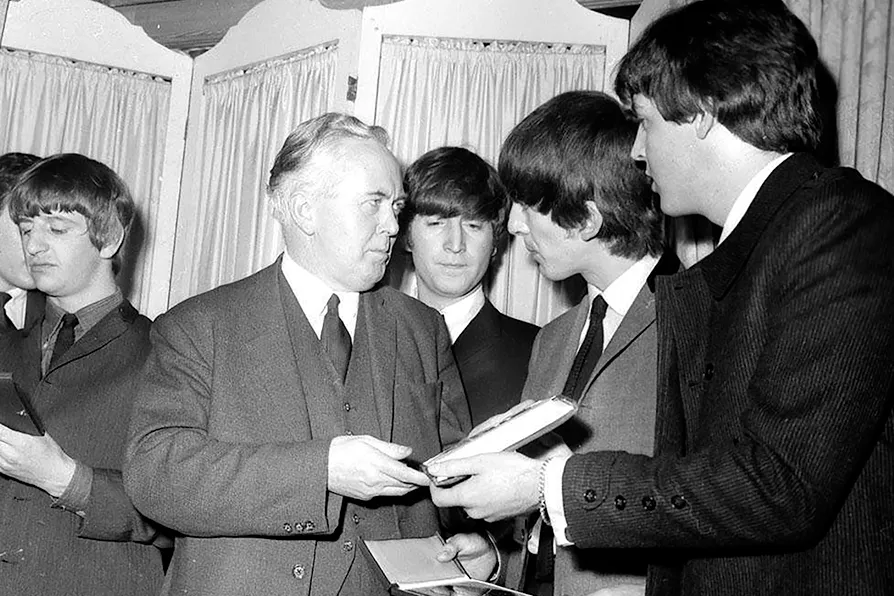
 TAXING MOMENT: Harold Wilson, leader of the Opposition, fields questions from George Harrison in March 1964
New releases from Biita Houdei, The Mary Wallopers, and The Tubs
New releases from Biita Houdei, The Mary Wallopers, and The Tubs
MAYER WAKEFIELD applauds a fearless attempt to bring to the stage the 1984 toxic gas disaster in Bhopal, India
ALEX HALL applauds the account of a dogged, traumatic and punishing campaign for justice that has lasted from 1998 to the present day
NICK WRIGHT laments the political bias of an epic attempt to tell the history of the liberation of France from the Nazis, that excludes both the decisive contribution of the Soviet Red Army, and of the French communist party itself





THE opening track of the Beatles’ 1966 album Revolver, George Harrison wrote the song not just out of self-interested anger at the supertax passed by Harold Wilson’s Labour government that year, but also because the money went to financing arms research and production.
It is especially hard to pay taxes — even when far below the eye-watering 95 per dent rate faced by the high-earning Beatles — when bombs are falling. The levy had driven half of the Fab Four to the brink of bankruptcy.
Taxman was among Harrison’s first songwriting triumphs, crowded out as he had been as a contributor to the Beatles’ repertoire by his bandmates, John Lennon and Paul McCartney.
Taxman is the only Harrison song ever to be the first track of one of the group’s albums. With it, the so-called “Quiet Beatle” created a musical forum for seething tax resentment, if not outright resistance.
In place of the crushing servitude to the military-industrial complex, Harrison offered a New Age vision of a tax-free utopia. Sparked by biting, brilliant sarcasm, the song’s glowing anger was stoked by the musicians around him and, as always, by the interventions of the Beatles’ producer, George Martin.
The opening count-off mocks itself: Harrison’s voice is apparently slowed down by the tape and is heard with a nasal fustiness, as if he were counting money.
The deadeningly accurate enunciations of the taxman are an accounting of time, not an animation of it. It is a brilliant lead-in, simultaneously parodying the idea of the count-off while also creating a vision of the auditor, who seems to surveil a song so resistant to his ways and wants. The tone is set before a note is played or sung.
As Harrison counts out his 1-2-3-4, impolite musicians warm up in the background. A cough is heard, a lick on a guitar. The accountant’s count-off starts into a second bar but gets only as far as the number two before a shout of “four” from one of those musicians (McCartney) prevents the bean-counting voice from even getting to three. The slow pace seemingly set up by the adenoidal count-off is overturned as the band breaks out into a much faster opening tempo implied in McCartney’s single number, “four.”
McCartney is credited with devising the bass line he plays to kick-start the song and that first chases away Harrison’s metrical accounting. The figure is the thematic underpinning of the song in every sense: it provides the harmonic basis throughout, unchanging in melodic profile in almost every bar, even when transposed from the home key of D major (though one ringing with discontented D minor) to one of the song’s other two chords.
Ostinato means obstinate, and there is gritty resistance in McCartney’s bass line, one powered by the electric urban energy that gives funk its menacing bite. Urged on both by the punches of Ringo Starr’s bass drum and the rhythm guitar’s stinging off-beat chords, the bass exudes inner-city discontent, though even this, like the remorseless count-off, is a pose, even if a perfect one.
When Harrison’s lead vocal enters at the end of the second bar of this bass riff, he sings in recalcitrant syncopations as the lyric lays out the cruel reality: “Let me tell you how it will be: There’s one for you, nineteen for me.”
Though what the Beatles actually paid goes uninvestigated.
The initially unexpected harmonies retain something of the shape and colour of the 12-bar blues form, yet, here too, things are seditiously altered, with a 13th bar thrown in to make the whole edifice seem more unstable.
The creative imagination cannot be squared by the auditor’s metrics. The second pass through the refrain is more bitter still: “Should five per cent appear too small,/ Be thankful I don’t take it all./ ’Cause I’m the taxman,/ Yeah, I’m the taxman.
Unusually, the ensuing bridge does not depart from the home key. One might want to assign this to the inescapability of the taxman’s menace.
Foregoing harmonic variety, the bridge is instead marked by increased agitation in McCartney’s bass lines and Harrison’s introduction of a dialogue between the backup and lead vocals: “(if you drive a car, car;) – I’ll tax the street;/ (if you try to sit, sit;) – I’ll tax / your seat;/ (if you get too cold, cold;) – I’ll tax the heat;/ (if you take a walk, walk;) – I’ll tax your feet.”
This then gives way to another oft-praised moment: a wild guitar solo, also performed by McCartney, that pleased Harrison for its Indian inflections, though I hear much more of a blues-scale frenzy.
Rounding back into the refrain, Harrison sneers at the British prime ministers of the period, doling out sarcasm in equal measure to the Labour and Conservative parties — “Ha-ha Mister Wilson” and “Ha-ha Mister Heath.” These targets were updated by Harrison in live performance over the years with the likes of John Major and George Bush.
Soon after the break-up of the Beatles, and six years after Revolver, Harrison organised the 1971 Concert for Bangladesh at Madison Square Garden. He did not sing Taxman at the event. The ticket receipts, recording, film, and merchandising raised some fifteen million dollars. The IRS (Internal Revenue Service) demanded more than a million of the proceeds in tax.
Harrison eventually paid the bill himself.
This is an abridged version of an article that was first published by Counterpunch.
David Yearsley is a long-time contributor to CounterPunch and the Anderson Valley Advertiser. His latest albums, In the Cabinet of Wonders and Handel’s Organ Banquet are now available from False Azure Records.
