
Washington’s inability to subjugate Iran is an example of how it is trying to preserve a regional order that no longer exists, argues RAMZY BAROUD


Has Trump met his match in Pope Leo XIV?
The Pontiff has expressed outspoken opposition to war and ‘inhuman’ policies on immigration, undermining the president’s credibility among both allies and supporters alike, says GEOFF BOTTOMS
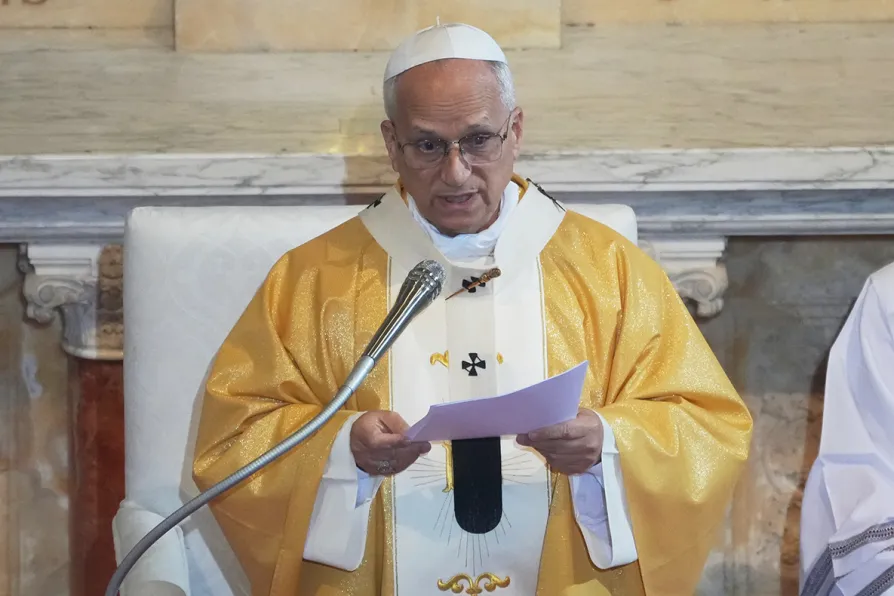
 Pope Leo XIV delivers his speech as he celebrates a Mass in the Saint Augustine Basilica in Annaba, Algeria, April 14, 2026
US financial instability is exposing the limits of a dollar-dominated global economy — and giving the Global South a historic chance to build an alternative, says MURAD QURESHI
DOUG NICHOLLS says the parasitic finance markets must be challenged or another British government could be toppled
The late country singer’s Imagination Library has put hundreds of millions of books into children’s hands. We should build on that legacy by defending the libraries at the heart of our communities, says BRENDA AITCHISON
Deprivation is a fundamental factor in criminal behaviour that must be addressed but, KENNY MacASKILL argues, there needs to a major rethink in sentencing to tackle overcrowding
MML director MEIRIAN JUMP outlines the recently refreshed library’s busy autumn schedule that ranges from book sales, archival exploration, community work with online education and the ever popular site tours
TONY BURKE surveys the shifting political landscape and the challenges Labour needs to address if it is to prevail in the 2028 federal elections





IF PRESIDENT Donald Trump ever thought that he would have an ally in a Pope born in the United States, then recent events would come to show that he was seriously deluded.
While Pope John Paul II and Benedict XVI opposed the Iraq war both privately and publicly, they never referred to president George Bush by name, and even Pope Francis in criticising the Trump administration’s mass deportation plans diplomatically stated that anyone who “thinks only about building walls” and not “building bridges” is “not Christian.”
Leo XIV has no such inhibitions, and while he has issued several pointed critiques of the Trump administration and its policies, without mentioning the president by name, there have been a few notable exceptions leading to the present spat.
It all began when Pope Leo questioned the “pro-life” credentials of the Trump administration’s immigration policies, asking if it is possible to be truly pro-life while supporting what he described as the “inhuman treatment of immigrants.”
He then went on to condemn the “desire for dominion” and the use of force after US strikes on Venezuelan ships by releasing a statement on X about the “zeal for war” spreading, though he did not name Trump directly in that specific post.
The gloves came off when the illegal and unprovoked US and Israeli attacks on Iran began on February 28. On March 29 during the Palm Sunday Mass in St Peter’s Square, the Pope said the conflict between Iran, Israel and the US was “atrocious” and that Jesus could not be used to justify war.
Two days later at Castel Gondolfo, the Pope’s Summer Palace, Leo first named Trump by urging him to find an “off-ramp” to end the Iran war.
Yet it was only when the Pontiff condemned Trump’s threats to destroy Iranian civilisation as “truly unacceptable” on April 7, and spoke against “that delusion of omnipotence that surrounds us and is becoming increasingly unpredictable and aggressive” at an evening prayer service in St Peter’s Square on April 11, that the backlash was immediate.
On April 12 2026, Trump posted on Truth Social that Leo was “WEAK on Crime and terrible for Foreign Policy.” He later described the Pope as “a very liberal person” who was not “doing a very good job” accusing him of being “weak on nuclear weapons.”
According to Trump, Leo was “catering to the Radical Left,” and called on him to “focus on being a Great Pope, not a Politician.” He even claimed credit for the Pope’s election, stating: “If I wasn’t in the White House, Leo wouldn’t be in the Vatican.”
Confronted with criticism from Trump, Leo did not retreat. He made his position explicit by saying that he had “no fear of the Trump administration,” and that “I don’t think that the message of the Gospel is meant to be abused in the way that some people are doing.”
When asked by journalists about Trump’s posts on his social media platform Truth Social, Leo remarked: “It’s ironic — the name of the site itself. Say no more.”
Following his attacks on the Pope, Trump then posted an image of himself as a Christ-like figure healing the infirm. Speaking to reporters several hours after it was quickly removed, Trump said he believed the image depicted him as a doctor next to a Red Cross worker.
Continuing his pointed criticism of the Trump administration, Pope Leo on April 16, during a visit to Cameroon, said that the world was “being ravaged by a handful of tyrants,” and blasted those who had manipulated “the very name of God” for their own gain, while turning “a blind eye to the fact that billions of dollars are spent on killing and devastation, yet the resources needed for healing, education and restoration are nowhere to be found.”
Meanwhile the backlash against Trump continued as Archbishop Paul Coakley, president of the US Conference of Catholic Bishops, stated that he was “disheartened that the president chose to write such disparaging words about the Holy Father.”
Iranian President Masoud Pezeshkian took the opportunity, “on behalf of the great nation of Iran,” to condemn Trump’s insults and to “declare that the desecration of Jesus (peace be upon him), the Prophet of peace and brotherhood, is unacceptable to any free person.”
An outlier among European political leaders, Pedro Sanchez, prime minister of Spain, wrote on X that “while some sow the world with wars, Leo XIV sows peace, with bravery and courage,” while Roberta Metsola, president of the EU Parliament, was the first major EU leader to publicly back the Pope, calling him a “symbol of moral courage.”
What is striking is that some of the criticism of Trump is coming from loyal, conservative Catholic allies who are unhappy, not just because of Trump’s public friction with Pope Leo, but at a much deeper level over the Iran war. And this in a country where 55 per cent of Catholics voted for the president.
The uproar over Trump’s lengthy social media attack on the first US-born Pope, together with the narcissistic AI image, has crystallised a shift in opinion among many Catholic conservatives since the war began seven weeks ago. A few of the president’s former allies in the “Make America Great Again” political movement have also taken to social media to criticise him.
“On Orthodox Easter, President Trump attacked the Pope because the Pope is rightly against Trump’s war in Iran, and then he posted this picture of himself as if he is replacing Jesus,” wrote former US Rep Marjorie Taylor-Green, a conservative Republican from Georgia who has broken with Trump on a host of issues.
Even Prime Minister Giorgia Meloni of Italy, a practising Catholic who has positioned herself as an ally of Trump, described the comments as “unacceptable.” She continued: “The Pope is the head of the Catholic church, and it is right and normal for him to call for peace and to condemn every form of war.”
Matteo Salvini, leader of the League party and a coalition partner, distanced himself from the tone of the remarks, saying that “attacking the Pope … doesn’t seem like a useful or intelligent thing to do.”
An erstwhile Trump ally, Bishop Joseph Strickland, who only last year participated in a prayer event to “consecrate” the president’s Mar-a-Lago home, broke ranks by saying: “I pray that all of this will clarify for people that we don’t look to a national leader, we don’t look to those who have the most money or the most weapons. We look to Christ.”
Pope Leo’s opposition to the Iran war is not political in origin. It is moral and theological. While Catholic social teaching, with its “preferential option for the poor,” is critical of class struggle, liberation theology engages with left and progressive movements with the working class as agents of their liberation, yet because of its alignment with Marxist analysis it incurs Vatican disapproval.
Having said that, Pope Leo is following in the footsteps of his predecessor, Pope Francis, and speaking truth to power in a way which is unprecedented for the papacy, and in the process undermining President Trump’s credibility among both allies and supporters alike.
In raising his voice for peace, humanity and social justice at a time when not just conservative but liberal and social-democratic politicians have been complicit in war crimes and failed to deliver on the needs of the people, Trump seems to have met his match.
