A California union’s decision to host a meeting about US policy towards Cuba has prompted a congressional probe and renewed attacks on international solidarity, writes CAMERON HARRISON



Germany becomes premium partner in the Ukraine war
By signing strategic defence agreements with Ukraine, the German government has reached a new dimension of war involvement, says SEVIM DAGDELEN
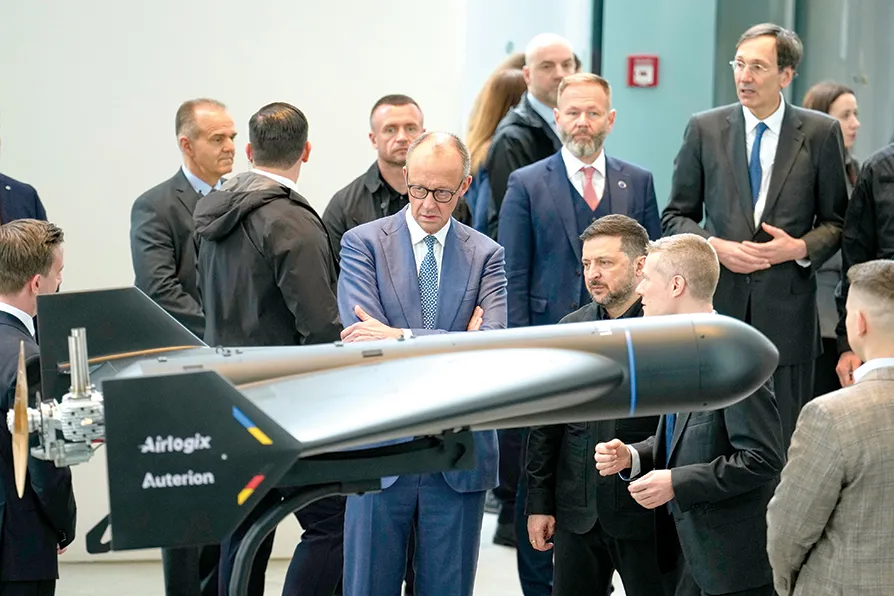
 DRONING UP: German chancellor Friedrich Merz and Ukraine's President Volodymyr Zelenskyy inspect drones made in German-Ukrainian cooperation in Berlin on Tuesday

The Baltic state is set to reverse its constitutional prohibition on nuclear weapons and foreign bases as part of accelerated Nato war preparations, warns TOM UNTERRAINER
Long-term underfunding and state neglect, while simultaneously probation services have been undermined, have intensified the prison crises, argues SOLOMON HUGHES
Holyrood incompetence has cost jobs and put the future of Clydeside’s Ferguson Marine shipyard into jeopardy. Its future should have been assured, argues KENNY MACASKILL
With the agitated debate now raging in the media about the early release schemes, Prison Officers Association general secretary STEVE GILLAN gives the view of those who work in the sector
The hounding of the late Jason Arday is an all too familiar experience for many black people. ROGER McKENZIE calls for collective action to combat what can feel like personal isolation





THE German-Ukrainian agreements mark a real turning point in time. For the first time, the German government has concluded a strategic partnership with a country that is at war.
Germany is already by far the largest financial supporter of Ukraine, after the US has largely withdrawn. However, the so-called defence agreements signed with Ukraine have a new dimension. Ukraine is to become Germany’s premium partner in military and arms issues.
The multilateralism constantly invoked by the German government is now giving way to bilateral agreements with Ukraine. The aim is to be able to wage war against Russia together and to act as a tandem challenging Russia even beyond a possible end to the war. In doing so, the German government is trying to take the place of the US.
In the new dimension of arms co-operation, however, it is by no means just about money. The signed agreement on defence co-operation contains a clear roadmap for the joint production and procurement of weapons systems, drones and long-range weapons in Ukraine. In this way, the German government bypasses what it sees as the tiresome discussion about German weapons that are to be supplied to Ukraine and are intended to strike deep into Russia.
The joint manufacture of medium- and long-range drones leaves the decision on deployment targets solely to Ukraine.
What was agreed in Berlin is far more serious than the postponed decision on a possible delivery of Taurus cruise missiles. Volodymyr Zelensky tellingly called it the “biggest deal of its kind in Europe.”
In addition to new commitments on arms deliveries and the financing of US weapons purchases, the agreed interlocking of the German and Ukrainian arms industries stands out in particular. One must speak of the formation of a German-Ukrainian military-industrial complex under German hegemony.
Added to this is the declaration of intent by Federal Chancellor Friedrich Merz and Zelensky to return Ukrainian men liable for military service who are staying in Germany back to Ukraine.
With this bilateral strategic partnership, which is clearly aimed at war with Russia, the German government is fulfilling the dream of German militarists of achieving a revanche in the east after the defeat against the Soviet Union in 1945.
Camouflaged as “defence co-operation,” nothing other than a policy of systematic challenging of Russia is being put into practice. The joint arms production of Germany and Ukraine represents an existential threat to Russia.
The risk of heading towards an apocalypse by de facto declaring war on the nuclear power Russia stems from a mindset that fatally recalls the policy of the two world wars.
From now on, it is Germany’s war that Ukraine is waging against Russia. This war is being fought primarily with German weapons, German money and also with soldiers from Germany — for now they are still Ukrainians — and aims to ruin Russia.
From a proxy war of the US and Nato, a German proxy war has emerged — with a massively increased risk of direct German war involvement.
It could, however, prove to be a grave miscalculation that one sees oneself protected by Nato. Nato is neither a values-based nor a defence alliance, but an alliance that is intended to support global US hegemony — as both US President Donald Trump and Nato secretary-general Mark Rutte have recently pointed out.
If Germany comes into the crosshairs because of its war policy against Russia, one can be almost certain that the US will not lift a finger.
In the end, the perfidious argument of Merz remains that arms aid and joint arms production are about compliance with international law.
The German government’s silence on the genocide of the Palestinians by Israel as well as its complicity in the unprovoked, illegal war of aggression by the US and Israel against Iran make any credible speech from Berlin about compliance with international law appear as mere clownery.
The fatal decision of the German government on April 14 2026 to actively risk war with Russia exposes the population in Germany to the highest risk. The formula of Merz that no peace settlement may be concluded “over the heads of the Europeans” effectively secures Germany a veto right in the continuation of the war against Russia.
What Washington and London were in Istanbul in spring 2022 is now Berlin with a self-proclaimed veto right — in a war that is apparently to be waged to the last Ukrainian.
The social costs of arming the Bundeswehr to become Europe’s largest army are already becoming increasingly tangible. In healthcare provision, a real cull is threatening. Entering the war against Russia goes hand in hand with the social war against its own population.
One should not say, however, that the German government is not also concerned with a social dimension. In the joint German-Ukrainian declaration under the heading “Affordable and Social Housing,” “co-operation in the creation of affordable social housing with the guarantee of the inclusion of vulnerable groups and the establishment of municipal housing companies, also with German funding” is agreed.
It almost seems like a historical joke: while more and more people in Germany have existential worries due to rising rents and energy costs and over a million affordable homes are lacking, the focus of the German government is on the “creation of affordable social housing” in Ukraine.
This passage too already shows clearly that the German government sees itself at war with Russia. Sending as many resources as possible to Ukraine is the top maxim — while the welfare state is being systematically dismantled in Germany.
