PCS general secretary FRAN HEATHCOTE explains why opposing war is inseparable from defending jobs, wages and public services – and why readers should come to the London Peace Conference on Saturday June 20


 Latest editorial
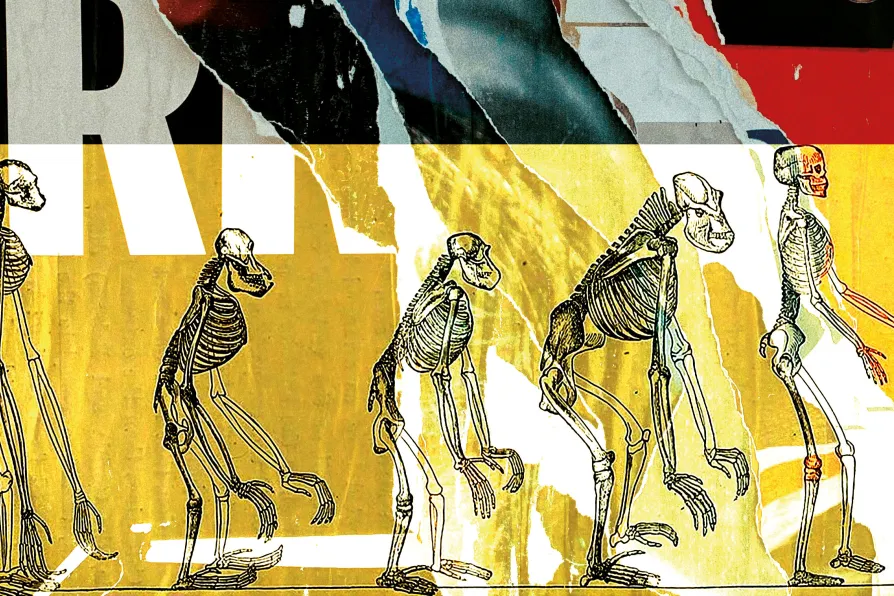
Is Engels’ The Part Played by Labour in the Transition from Ape to Human still relevant today?
Engels’ essay on our origins and distinctiveness built on Darwin’s own exploration of human evolution and has provided a framework for exploration and research which has stood the test of time, declares the Marx Memorial Library and Workers’ School

As protests erupt over Henry Nowak’s murder, ANDREW MURRAY argues that anger is being exploited to advance a wider racist and anti-immigration agenda
CARLOS MARTINEZ explains the sound case for car manufacturing co-operation with China
The National Emergency Briefing outlines the need for urgent action to address environmental crisis, says PAUL DONOVAN, warning that there’s no time to indulge the arguments of the fossil-fuel-funded climate-change deniers
Campaigners say criticism of Labour MP Stephen Morgan’s position on Gaza has been met with police intervention and cancelled opportunities for debate. HESTER WOLFE reports
The Committee for the Defence of Iranian People’s Rights warns of escalation danger in Iran war





FRIEDRICH ENGELS’S essay on the origins of our species is today recognised as a foundational text, not just of Marxism, but of today’s physical and social anthropology.
Like most of Engels’s theoretical works it was written in German, titled “Anteil der Arbeit an der Menschwerdung des Affen.” “Menschwerdung” means “incarnation” or “becoming human,” though older translations used the gendered term “Man.” At around 5,000 words (in most editions between 15 to 20 pages) it is a short though unfinished essay: it is also one of his most readable.
Context
The Part Played by Labour was written in 1876, soon after the appearance of Charles Darwin’s The Descent of Man in 1871. Engels planned it as the introduction to a larger synoptic work on human origins, history and future which, like his introduction (which breaks off in mid-sentence) was never finished.
It was only published 20 years later in the German socialist newspaper Die Neue Zeit (New Times) and in English as a pamphlet in 1896, the year after Engels’s death. It was later included as the ninth chapter of a collection of Engels’s other writings on contemporary science and technology, published in Russian and German in 1925 and in English in 1939 as The Dialectics of Nature.
In addition to incorporating increasingly accepted evolutionary theory The Part Played by Labour develops and extends Engels’s and Marx’s materialist conception of history including the role of economic factors and productive forces in shaping social and political development. It integrates their thinking around consciousness, language and socialisation, arguing that labour is not just the source of value but also the motor of human evolution, challenging the still prevalent idealist philosophy which attributes human development to mental or spiritual forces.
Content
The text builds on the recognition by earlier classical economists such as Adam Smith and David Ricardo that alongside nature itself, human labour is the only source of value; an analysis that was developed by Marx in Capital. But Engels takes this further: human labour is central to the origin of our species and of our subsequent social development; and it underpins our relation to the rest of nature.
Engels then goes on to summarise what was then known about human evolution, including material from The Descent of Man. The account starts with our pre-human ancestors. Labour itself, declares Engels, “begins with the making of tools” when they developed bipedalism and an upright stance. This freed their hands to become progressively more dexterous and capable of crafting rudimentary implements. The hand, with its opposable thumb and forefinger, he declares “is not only the organ of labour, it is also the product of labour.”
Alongside labour came an ever more developed brain, capable of conceptual thought and phonetically dynamic mouths — and language. As subsistence developed beyond foraging, so too did collaboration and mutual support. In parallel, fishing, hunting and dietary changes were accompanied by the development of new tools, the use of fire, domestication of animals and the colonisation of new environments.
Eventually came the activities and institutions associated with human civilisation: humans no longer occupied what we today would call a particular ecological niche; they had become distinct from all other animals in their ability to manipulate nature in multiple ways. Nature itself becomes transformed.
That “mastery” however has its contradictions, declares Engels. He cites flooding and desertification caused by deforestation; agricultural monocropping and its role in the Irish potato famine, Columbus’s “discovery” of America and the slave trade; the spread of disease, and the role of the steam engine in facilitating the concentration of wealth and power in the hands of a few, dispossessing the many but also accentuating the class struggle.
Contemporary reception and impact
At the time of its first publication in 1896 interest was largely limited to Marxists and socialists for whom it provided a materialist explanation for human evolution rooted in labour and social organisation, directly contradicting prevailing idealist explanations that attributed human development solely to the mind or to divine intervention. The essay had little or no impact on mainstream anthropology which generally held (with Darwin) that intelligence and a large brain evolved first, leading to other adaptations. Engels’s core argument that upright posture, freeing of the hands and subsequent tool-making (labour) were the primary drivers of brain and language development was a minority position.
Following its later publication in the Soviet Union in Dialectics of Nature (together with Engels’ writings on physics, electricity and magnetism — and the paranormal) the essay became a primary text for Soviet anthropology. By the time of its publication in English, science had developed beyond Engels’s ideas.
For example, human evolution was recognised not as a linear progression from “ape” to human but a branching “tree” (with other hominin species coexisting) and with the different elements — upright stance, cranial capacity, tool making etc — developing in tandem. But Engels brilliantly prefigured what are today core ideas in evolutionary biology such as gene-culture coevolution and niche construction. Species don’t just adapt to their environment, they also change it, sometimes to their detriment.
Relevance today
Beyond its value as a read in itself, The Part Played by Labour demonstrates key elements of Marx and Engels’s thinking regarding the nature of humans and human relations with nature. Engels integrates evolutionary theory with a socialist understanding of human development, emphasising the crucial role of labour in shaping human biology, society, and our relation to the natural world. His conclusions are broadly though often implicitly accepted in fields such as palaeoanthropology, anthropogeny (the study of human origins), human phylogeny (our evolutionary “tree” and relationship to other primates) and linguistics today.
Importantly, today it is understood that the distinctive features which characterise our species developed in tandem and were driven not by genetic but by developmental changes. One mechanism (among others) may be neoteny, the retention of juvenile traits into adulthood and a prolonged parental dependency. Human intellectual capabilities develop through a dialectical relationship with the human body, both individually and historically in the context of the social production of the necessities of life.
Though never completed, The Part Played by Labour remains an outstanding pioneering example of the contribution of Marxist theory to today’s understanding of “human nature” and (particularly in the context of today’s planetary environmental crisis) the relationship of our own species to our planet. It synthesises Darwinian evolution, socialist thought, and a materialist interpretation of history, challenging the still prevalent philosophy of Cartesian dualism, which draws a division between mind and body and sees humans as separate from nature.
The human mind, body and the rest of nature are intrinsically related, connected through labour as part of a long and continuing historical process.
Tomorrow, Tuesday April 14, at 7pm there’s an online discussion of this foundational work of Engels. Register at www.marx-memorial-library.org.uk where you will also find details of the next full online course Capital, Crisis and Imperialism which starts on Tuesday April 21. The full text of Engels’ pamphlet can be read at tinyurl.com/TransitionApeHuman and it can be downloaded from tinyurl.com/DialecticsOfNature-pdf as part of Engels’ Dialectics of Nature.
