

 Latest editorial

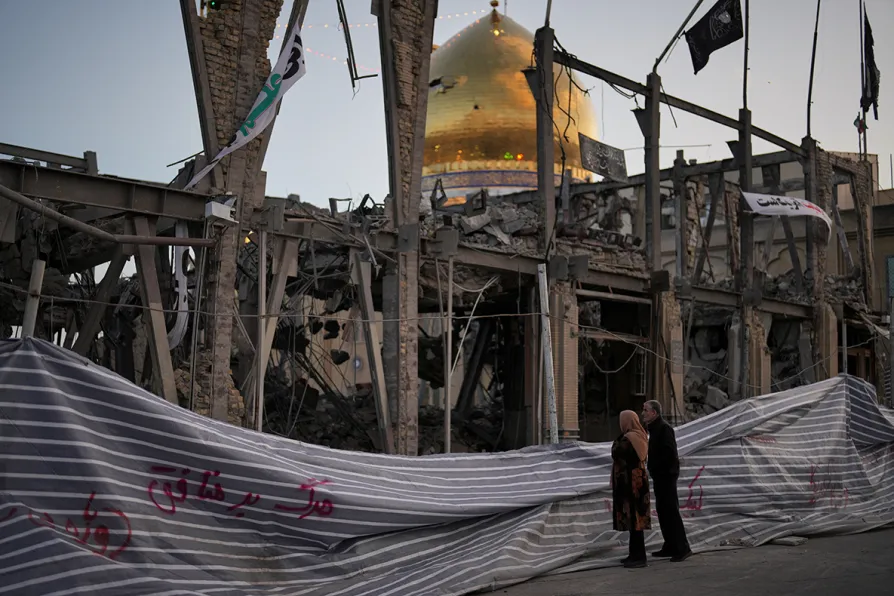 Pedestrians look at a destroyed building within the Grand Hosseiniyeh, with the mosque visible in the background, which officials at the site say was hit by US-Israeli air strikes in Zanjan, Iran, April 4, 2026





IRAN rejected the latest ceasefire proposal today and said that it was insisting on a permanent end to the war, following Israel’s bombing of a major petrochemical plant.
The state-run Irna news agency said Tehran had conveyed its response through Pakistan, a key mediator.
“We won’t merely accept a ceasefire,” said Mojtaba Ferdousi Pour, the head of the Iranian diplomatic mission in Cairo. “We only accept an end of the war with guarantees that we won’t be attacked again.”
Egyptian, Pakistani and Turkish mediators had sent Iranian Foreign Minister Abbas Araghchi and US Middle East envoy Steve Witkoff a proposal calling for a 45-day ceasefire and the reopening of the strait, two US officials said on condition of anonymity.
Iran’s closure of the Strait of Hormuz to most vessels has caused oil prices to surge and shaken the world economy.
Mr Ferdousi Pour said Iranian and Omani officials were working on a mechanism for administrating the Strait of Hormuz.
US President Donald Trump threatened on Sunday to destroy power plants and bridges and send the country “back to the stone ages” if Tehran failed to reopen the strategic waterway to all shipping. His deadline for Tehran to do so is set to expire on Tuesday.
Former Iranian foreign minister Ali Akbar Velayati urged Arab countries to discourage Mr Trump from striking power plants, warning on social media that the entire region would go “dark” if that happened.
The Iranian rejection of the ceasefire proposal came after Israel struck a petrochemical plant in Iran’s massive South Pars natural gas field and killed two commanders of the paramilitary Revolutionary Guard.
Israeli Defence Minister Israel Katz described “a powerful strike on the largest petrochemical facility in Iran.” Iranian state media confirmed the attack.
Across Iran, at least 25 people were killed in air strikes.
Among the dead was Revolutionary Guard head of intelligence Major General Majid Khademi, according to Iranian state media and Mr Katz.
Israel’s military said it had also killed Asghar Bakeri, the leader of the Revolutionary Guard’s undercover unit in its expeditionary Quds Force.
Meanwhile, air defences in Kuwait, the United Arab Emirates and Saudi Arabia intercepted Iranian missiles and drones.
In Israel, Iranian missiles hit the northern city of Haifa, where four people from one family were found dead in the rubble of a residential building.
On Sunday, the US military rescued the second crew member from a fighter jet shot down by Iran two days before, plucking the pilot from deep inside the country.
