ANGUS REID, ANDY HEDGECOCK and MARIA DUARTE review On The Sea, A Useful Ghost, Brunello: The Gracious Visionary, and Pinocchio Unstrung


 Latest editorial

‘With a smile outside there’s so much we hide’
CHRIS SEARLE speaks to Nepali jazz drummer ANMOL MOHARA about tradition, culture, identity, migration and belonging
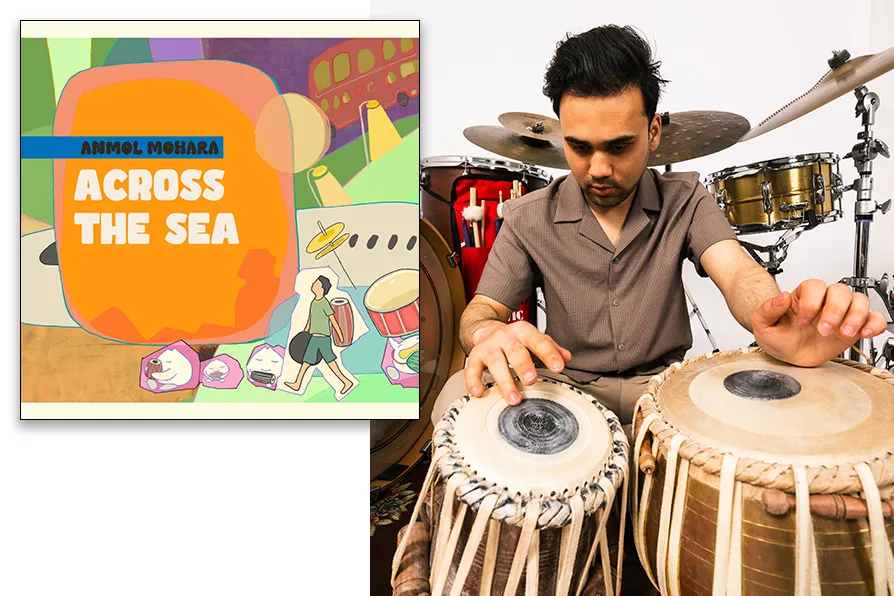 Anmol Mohara [Pic: Kshitij Rana]

RON JACOBS enjoys a great tale, told by a US communist, of the lives of working-class New Yorkers
BRENT CUTLER searches a new history of contemporary Iran for an understanding of the Islamic Republic, finding both interesting detail and glaring omissions
MARIA DUARTE recommends the true story of the remarkable woman who sued Donald Trump for sexual assault not once, but twice
KENNY MacASKILL is disappointed by a polemical, rather than factual, account of the Lone Star State and its political path since the civil war
PAUL DONOVAN is fascinated by the lives of Charles and Mary Bagot, and the insight this biography shines on the morals of pre-Victorian society
GORDON PARSONS appreciates fine performances and a feel for ambiguity, but misses the music of the dialogue





I NEVER thought I’d be reviewing a jazz album birthed in the foothills of the Himalayas, but Nepali percussionist Anmol Mohara’s Across the Sea, is certainly that and plenty more.
“My music is deeply rooted in Nepali culture and tradition, but I blend these roots with my love for the improvisational element of jazz and the wide range of musical influences that have shaped me,” he asserts.
Born in Dharan, Nepal, in 2000, he grew up in an urban setting, with his father in the military, his mother a cleaner. “I started playing conga at five with my uncles in cultural festivals,” but in 2009 he began to study at the Nepal Music Centre in Kathmandu, taking lessons on drums — tabla and madal, a two-headed cylindrical hand drum. “As a teenager I liked many different styles, particularly rock, fusion and funk.”
“I arrived in England in 2015 because of my family’s Gurkha background. We lived in Aldershot. There’s a strong UK Nepali community here in places like Woolwich and Plumstead in London, Colchester, Reading, Bracknell and Aldershot. The older generations who grew up in Nepal love the traditional music, but the younger generation aren’t so exposed to it.”
“I was always curious about jazz. There’s a small jazz scene in Nepal, which is getting stronger,” but Anmol’s studies at the Royal Academy of Music (2016-2018) took him further into the music. “Early inspirational albums were Miles Davis’s Nefertiti, Joe Henderson’s Page One and Michael Brecker’s Tales from the Hudson.”
But it was his later studies at the Guildhall School of Music and Drama that inspired Across the Sea. In a cosmopolitan musical setting with young Guildhall musician friends from Nepal, Romania, Brazil and Britain, its songs’ lyrics are in both English and his first Tharu language: Sakhiye Ho, for example, celebrates Naghi, a major Nepali festival, and Silu is a traditional song about a pilgrimage to Lake Gosaikunda, with a beautifully delicate tenor saxophone solo by Simeon May.
Mohara sees his song Migrant as “the album’s heartbeat, with a bittersweet feeling,” and the closest sound to a Nepali blues. With a tone of lamentation, he sings: “Where do I fit? I ask myself/ Where do I fit?/ It’s so hard to breathe/ With a smile outside there’s so much we hide.”
Yet this doleful tone is not typical of the more exuberant air of most of the album. “It’s a joyful record that explores themes of tradition, culture, identity, migration and belonging,” he affirms. “I started composing my own music a few years back while I was studying at Guildhall, so the album’s music is the first I’ve ever composed or arranged. My time at Guildhall helped boost my confidence as composer and performer.”
It is the evolving multirhythmic virtuosity of Mohara’s percussive skill that creates the very distinct ambiance of the album’s rhythmic bloodstream. Just listen to the track called A Rhythmic Guy for evidence of this. “I’m stimulated by traditional Nepali rhythms and those from other cultures. So it’s quite varied. I enjoy putting traditional rhythms on the drum kit.”
As an ever-expansive musician he is looking forward to creating more musical collaborations and in-depth musical stories, and has already played them at venues like Ronnie Scott’s and the Vortex. So look out for him and hear the rootsy sounds of Nepal across the heart of Britain.
Across the Sea is released by Lomna Records
