Growing instability in the US economy and financial markets could have serious consequences worldwide because of the central role of the US dollar and financial system, argues MICHAEL BURKE


 Latest editorial

German school strikes challenge Merz’s war agenda
Tens of thousands of students left their classrooms and took to the streets against conscription and rising military spending. NICK WRIGHT reports from Berlin
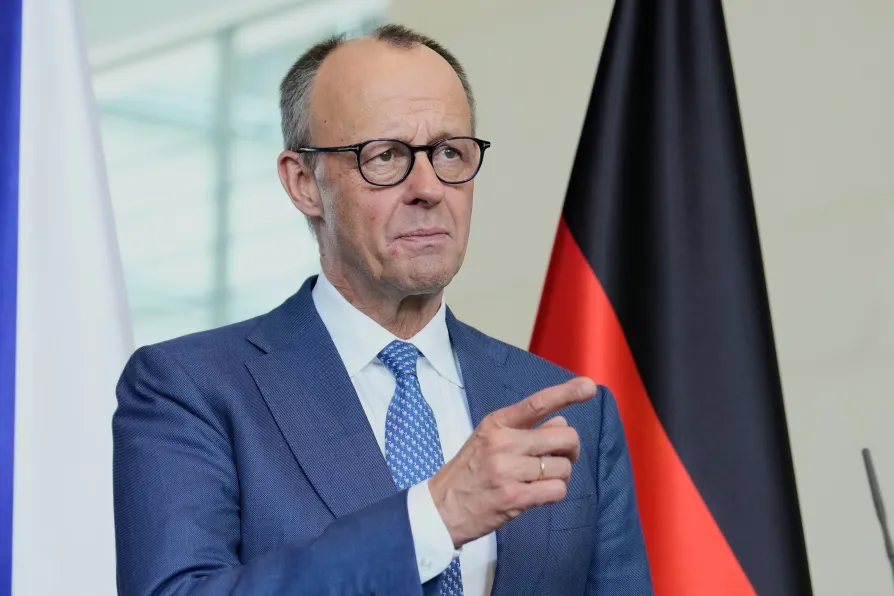 German Chancellor Friedrich Merz attends a press conference in Berlin, Germany, March 10, 2026

Despite Andy Burnham’s declaration defending the continued partition of the island, all major international and internal trends are converging to make Irish reunification inevitable
The left needs a bold energy vision – because if it fails to provide one, others will shape the future in their own interests, argues ALAN SIMPSON
From Margate to Deal, mining memories are being kept alive. National co-ordinator for General Strike 100, HENRY FOWLER continued his nationwide tour of partner organisations in the Garden of England
Humans are part of the ‘animal kingdom’ – and of nature in general – but also distinct from it and labour (work) is part of what makes us unique, declared Engels. His insights 150 years ago into how our species came to be and how we differ from the rest of nature, are as important today as they were then, says the MARX MEMORIAL LIBRARY
Boxes of books, family photos and heirlooms, labour movement anniversaries, along with nostalgic memories of glorious childhood days on the Ayrshire coast still leave room for a wistful MATT KERR to hope for a better future





A WEEK ago, on March 5, more than 50,000 German school students went on strike. In more than 130 cities the strikes — organised by a coalition, School Strikes Against Conscription, including the Green Youth, the communist SDAJ (Socialist German Working Youth), Jusos Young Socialists, the Falken and several trade union youth organisations — filled the streets with protesters against the war preparations of the German government. It followed an earlier school strike last year.
In some cities schools were cordoned off to prevent walkouts by students. In Munich secondary school students carrying signs reading “Merz, why don’t you die on the front?” were taken back to the school, and their personal details recorded by the police.
In Berlin demonstrators were arrested for “insulting the chancellor,” and a solidarity campaign was immediately launched.
More were arrested for insulting Germany’s increasing violent and repressive police. The pretext were signs carried by the students — “Merz Leck Eier” (Merz Lick Eggs) — and accordingly the Left Party’s youth organisation, Linksjugend [’solid], and the other left-wing youth groups have taken the campaign in defence of the freedom of expression directly to the Federal Chancellor Merz and for messages of solidarity to be recorded and published on the website merzleckeier.de.
Anjo Genow, the Berlin state spokesperson for the Left Youth [’solid], describes the action as an “open, participatory event” and invites everyone to send their opinions about Merz in the form of video or text messages to friedrich@merzleckeier.de or to contact their local strike committees on Instagram to discuss collaborations.
“We want to launch a campaign for the students, showing solidarity with those affected and simultaneously supporting their demands and the next strike on May 8. Because we are not alone against conscription and war — we are the majority! In particular, the police crackdown makes it clear to us what potential the movement has when it is met with this kind of response. Friedrich Merz and his henchmen in the police clearly see the students as a threat to their war plans,” said the Berlin Left Party’s spokesperson.
It is not yet mandatory conscription but the government is clearly intent on softening up opinion. It introduced a new military service law last December. The law obliges all 18-year-old men to answer a questionnaire and detail their motivation and suitability for the military and “informing” them about volunteering for the military.
Seventeen-year-old Shmuel Schatz, spokesperson for the School Strike Committee, told German Radio: “I don’t think I’ll be dying for my friends, relatives or acquaintances, in the worst-case scenario, rather, in the end, only for those who are put into the trenches for the interests of large corporations like Rheinmetall, ThyssenKrupp, and others, so they can line their pockets at the expense of war.”
If this campaign — closely linked to Merz’s aggressive posture towards Russia and a strident media campaign about the vast increases in military spending that the newly militarised European Union has sanctioned — fails to recruit more willing volunteers to the Bundeswehr, the government’s scheme is to reintroduce full conscription. The government says it aims to reach a total of around 260,000 soldiers — from a current 180,000 — plus some 200,000 reservists.
While the right-wing Christian Democratic Party of Chancellor Merz is gung-ho for the scheme it is clear that Bundestag MPs are far from confident that German youth are willing.
In a report presented last week, the Bundestag’s parliamentary commissioner for the armed forces, Henning Otte, of the ruling party, was doubtful “about the prospects of success of the voluntary principle.”
This compares to the position last year when a Hamburg University study of 2,279 people in Germany between the ages of 18 and 70 asked whether they would be interested in voluntary, six-month basic military training and whether they would be prepared to defend Germany with weapons in the event of war.
Getting on for a third rejected any form of compulsory military service. Just over 40 per cent favoured as model which entails one year of service for both men and women, and would allow them to choose service in the Bundeswehr or in social institutions.
Interestingly the Hamburg survey was not a one-off but comes from a routine Monitoring System and Transfer Platform Radicalisation (Motra) research network funded by the German government which investigates the impact of international political events and social developments on attitudes and the realities of life in Germany.
The data is collected through regularly repeated, standardised online surveys, which are conducted at intervals of two to three months among representative samples of the adult population in Germany.
This survey across a wide age range is at variance with a study last June of 15 to 30-year-olds which showed 81 per cent unwilling to die “for their country,” while nearly seven out of 10 also did not want to defend it with weapons.
Germany’s “grand coalition” of right-wing Christian Democrats (CDU/CSU) and Social Democrats (SPD) initiated a federal debt programme that entailed a €500 billion special infrastructure fund, exempted military spending from the country’s “debt brake” law which regulates public expenditure and empowered the powerful administrations in the “lander” (states) a bit more wriggle room to incur debt.
Germany’s economy is faltering and there is a clear contradiction with what is needed to be done in terms of infrastructure renewal and the economic cost of maintaining “social peace,” including subsidising energy costs ramped up by the sanctions war on Russia. But the major factor is the drive to step up war spending.
On the train from Berlin to Hamburg this week, I saw a long train of railroad flat cars loaded with armoured military vehicles still in bright factory paint on their way to who knows what conflict.
The Merz government will quadruple the military budget to €153bn by 2029. This war drive, enthusiastically supported by Germany’s Greens, goes ahead alongside a massive tax break for business and threatened cuts in welfare, health, education and social spending.
Merz says that Germany’s welfare state is no longer affordable. The Christian Democrats in the Bundestag echo Keir Starmer in proposing “structural reforms” — code for cuts — and social security contributions are to be capped with a planned future decline in their role in financing social spending.
This is causing strains in the coalition, with the social democratic SPD worrying that this will further erode their electoral base which, although not quite as disastrous as Labour in Britain, is a big fall from the previous era.
No-one is confident that the SPD is either willing or capable of challenging their coalition partners, and the finance minister has already strong-armed other ministers to cut back their plans.
Germany’s version of “military Keynesian economics” is predicated on the assumption that “dead” capital spending on “defence” is a necessary stimulus to the economy.
This stuff is familiar to people in Britain. It comes from Establishment economists and politicians who argue the exact opposite in relation to investment in health, education, housing and other sectors.
Meanwhile the profits of the big German arms manufacturers — Rheinmetall, Diehl, Hensoldt and others — are on the up. Rheinmetal up 7 per cent, Hensoldt up between 3 and 5 per cent. Shareholder dividends have quadrupled, with share prices rising as the paint dries on these tanks, armoured cars and artillery.
And behind the high-powered hype and the spectacular profits for German arms companies much of the tax-funded state expenditure lands also in Donald Trump’s backyard. The majority — eight out of 10 euros — goes to non-European destinations, with the US firms Boeing, Northrup Grumman and Lockheed Martin the big winners as a consequence of the hopeless deal struck by the European Union with the US administration.
Britain is in a similar kind of economic mess, with an even more parasitical and unproductive economy — less based on manufacturing than Germany’s — and Starmer both emulates Merz and wants British soldiers to be guinea pigs in the European Union scheme to put Nato boots on the ground in Ukraine.
