ANGUS REID urges us to understand the persecution of Jason Arday from a political and historical perspective, and to see the victim in human terms



How western capital weaponises art against Chinese socialism
PAUL FOLEY steps gingerly through an exhibition that purports to show east and south-east Asian culture, and questions its intentions
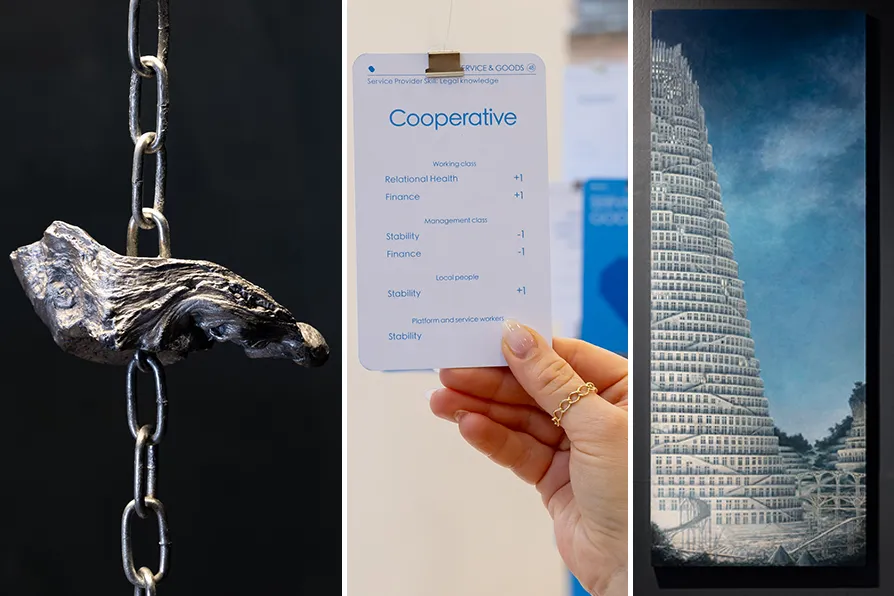
 (L - R) Nicole Coson, Some Place Within Here; Yin Aiwen, Liquid Dependencies; Minoru Nomata, Resonance-1 [Pic: Jules Lister]
Re-releases of the classics Gypsy Rhumba and Buena Vista Social Club, and a stunning album by Palestinian artist Faris Ishaq
Nothing, says ANDY HEDGECOCK, can rescue this undistinguished amalgam of ponderous melodrama and shallow philosophical speculation
JAMIE BRITTON invites readers to visit 3,500 locals as part of a marathon artistic pub crawl
JOHN GREEN welcomes a valuable and incisive analysis of a world become hyperpolitical but without the mass movement institutions to represent it





Thresholds of Becoming
ESEA Contemporary Art centre
Manchester
★★☆☆☆
ESEA CONTEMPORARY is a non-profit art centre in Manchester which presents and platforms artists that identify with and are informed by east and south-east Asian culture.
It formed in 1986 initially as part of the “Black Arts Movement” but quickly concentrated its focus on art and culture from China and Chinese communities, particularly in the north-west of England. In 2013 the centre repositioned itself and became the “Centre for Chinese Contemporary Art.” This proved a troublesome transition as accusations of institutional racism arose leading to a schism between the leadership, the board and prominent artists. Following a damning report the centre closed in 2021.
At the point a new leadership was installed, there was a significant shift in Britain-China relations. The reborn centre decided to drop reference to China and Chinese art and to expand the centre’s remit to showcase art and culture from the east and south-east Asian diaspora.
The centre’s current exhibition, Thresholds of Becoming, is billed as a celebration of its 40 years in Manchester. How much of the original ethos remains from its days as part of the “Black Arts Movement” is open to question.
The current show is curated by ESEA Director Xiaowen Zhu. Although born and raised in Shanghai, Zhu has spent most of the last decade in the US and Europe.
The exhibition purports to showcase the work of six artists who are influenced by their connection with south and east Asia. The overarching theme of the exhibition is “The ‘architectures of transition and the fragile ecologies of the in-between.”
The artists consider transition, how it is lived and how the inevitable turbulence caused can lead to reorganisation and hope. Instability and transition create tensions and uncertainties which should not be seen as failure but as a generative process where a new world might be glimpsed. Through the artists’ work we are asked to think about the architecture of contemporary life, and how it will transition towards an uncertain future.
In the Communal Project Space, through a combination of interactive HD videos and card games, Yin Aiwen’s Liquid Dependencies, speculates on the future of a decentralised caring society and possible changes to human relationships. Although an interesting introduction to the exhibition, it lacks any context and is ultimately bemusing and ethereal.
Moving into the gallery, your eye is caught by Nicole Coson’s sculpture Some Place Within Here. A constellation of aluminium oyster shells hanging from the ceiling linked by metal rings, it is described as a “subtle, ecological and temporal drift drawing inspiration from aqua farming in the Philippines.” This is an aesthetically pleasing piece but the ecological message may be a little too obscure.
Image
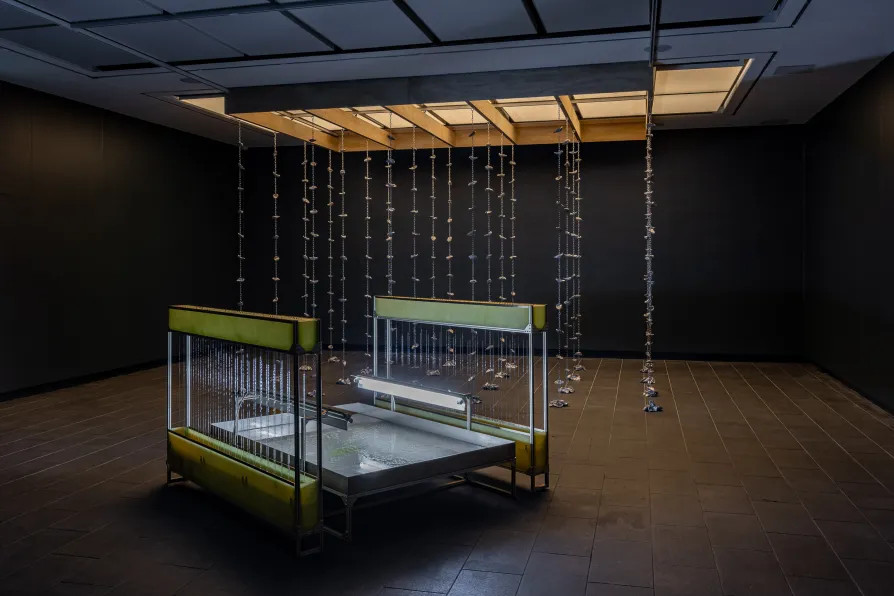
Insomnia is London-based artist Xin Liu’s rectangular tank with two towers raining down a thick viscous fluid into a reservoir where, apparently, duckweed is growing. Duckweed is not only highly invasive, it strangles all other living species. As it grows it cuts off light and oxygen so that only it survives. However, despite the desire to root it out, recent research has shown it may be a highly rich source of food and fuel for the future, especially in space. The exhibition guide explains that the piece “balances the tension between the cost of overproduction with the possibility of discovery and renewal.” This is a clever construction but I’m not sure it delivers the artist’s message.
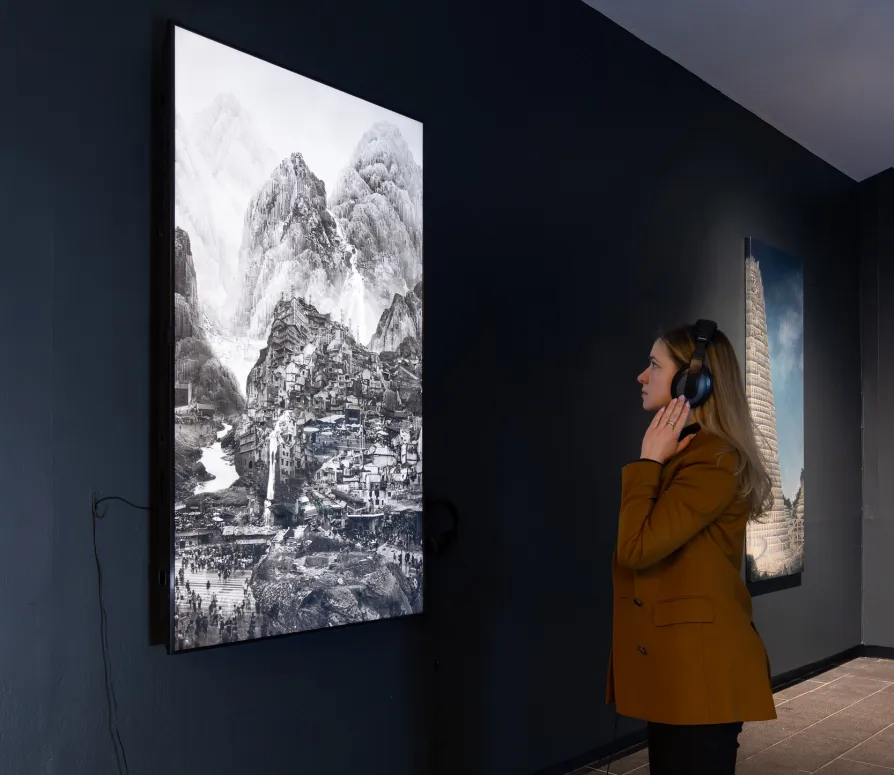
New York-based Chinese artist Yang Yongliang adapts a traditional style of ancient Chinese painting, Shan-Shui, which depicts mountains and waterfalls created with brush and ink. In Mountains Of Crowds Yongliang recreates the style through a digital montage. Mountains emerge in lattice skylines while ink dissolves into grids of light. The image creates a haunting landscape highlighting the instability of the modern architectures of contemporary life. This is the most interesting exhibit. It reflects Chinese artistic culture and creates an emotional response.
Image
Through the medium of multi-channel video, Charmaine Poh’s The Moon Is Wet draws on narratives from Majie domestic workers, queer south-east asian caregivers and the sea goddess Mazu. Their stories trace the tensions between survival, desire and infrastructural power. Video installations like Poh’s have become such an integral part of contemporary art that they can feel like an annoying distraction.
Resonance-1 and Resonance-2 by the Japanese artist Minoru Nomata meditates on architecture shaped by vulnerability and uncertain futures. The works capture the perilous state of a landscape collapsing through erosion. Nomata’s two fine paintings do allow you to contemplate the impact of landscape erosion and collapse.
Apart from Nomata, all the other artists are no longer working from their homeland. They are based exclusively in Western countries. Perhaps this is why most of the exhibits seem familiar and universal. Apart from Yang’s reference to ancient Chinese painting we learn little about south and east Asian culture.
Given that the mission of ESEA is to platform artists connected to east and south Asia, it would have been a more interesting and rewarding show if artists currently living and working in the region were asked to exhibit.
Part of the problem is that the contemporary art world has become just another commodity of global capitalism. It is both conservative and conformist with huge rewards for artists who comply with market tastes.
This is not a new phenomenon in the art world. After the second world war, the CIA, big business and power brokers like the Rockefellers ploughed money into abstract expressionism, thus weaponising art in the fight against Soviet art and culture. In the 21st century contemporary art has become part of global capitalism’s front-line attack on socialist and, in particular, Chinese culture.
Runs until May 17. For more information see: eseacontemporary.org
