ROB WARZYNIAK wades knee deep through a pile of ‘dead canaries’ of Trumpist policies which exacerbated the horrors of US capitalism domestically


 Latest editorial

The eternal hunger for oil: how the West has been strangling Iran for 100 years
From the colonial oil plunder of 1909 to the current threat of a regional inferno: Western interference in Iran forms a chain of coups, puppets, and cynical geopolitics centered on oil, says MARC VANDEPITTE
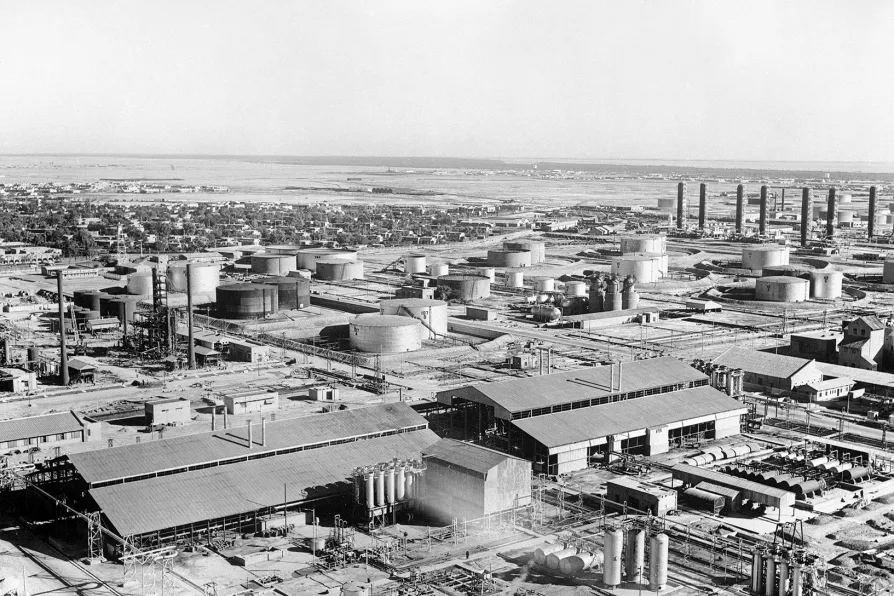 The Anglo-Iranian oil refinery at Abadan, Iran, March 18, 1951
Without evidence or Nato consultations Berlin’s answer to the Leipzig incident is a rupture of relations. SEVIM DAGDELEN examines why
FRANCISCO DOMINGUEZ introduces the background to a conference on defending Latin America’s sovereignty
The glacier collapse in Nepal is yet another warning that a warming planet is making Himalayan disasters more frequent and destructive – but the countries facing the greatest risks are often those least responsible, says LI YANG
Nick Blair is set to benefit from a hugely lucrative contract to ‘virtually’ train the British army for its next war. Like father, like son, writes SOLOMON HUGHES
Even when tragedy strikes, Western media cannot resist the opportunity to turn it into a sordid propaganda opportunity, as the Nepal-China border tragedy shows, writes CARLOS MARTINEZ
Trade unions should be at the heart of the anti-racist push for reparations for the historic legacy and continuing impact of slavery, writes ROGER McKENZIE





IT ALL BEGAN in 1909 with the establishment of the Anglo-Persian Oil Company under the wing of the British empire. For decades, Iranian wealth flowed directly to London while the local population lived in poverty. This colonial model was brutally disrupted in 1951 by the rise of Mohammad Mossadegh.
Mossadegh was a secular democrat who was elected prime minister by the Iranian parliament. He introduced a number of progressive social and political reforms, such as social security, rent protection and land reform.
But his most remarkable act was the nationalisation of the Iranian oil industry. The creation of the National Iranian Oil Company (NIOC) was a historic moment of self-determination that the West would not tolerate.
The reaction was not long in coming. In 1953, the CIA and MI6 organised the notorious coup, “Operation Ajax.”
Mossadegh was deposed and placed under house arrest until his death. Democracy was sacrificed to secure the oil supply to the West. It was the de facto recolonisation of a sovereign country.
The Shah as frontman for capital
After the coup, the monarchy was restored under the Shah, Mohammad Reza Pahlavi. He was the perfect puppet for Washington and London. In 1954, he signed a consortium agreement under which Iranian oil was divided among five major US companies, British Petroleum, and Shell.
Under the Shah’s rule, Iran became a military police state financed by the United States. While the elite bathed in luxury, every form of opposition was ruthlessly suppressed. This 25-year period laid the foundation for the deep resentment the Iranian population harbours toward Western interference to this day.
Murky manoeuvring around the Islamic state
The massive popular movement of 1977-79 was essentially an attempt to restore the democracy that had been stolen in 1953. But once again, the intelligence services played a double game. As the Shah fled abroad, a new player appeared on the stage: Ayatollah Khomeini.
From his exile in France, Khomeini maintained good contacts with the US government. He made promises regarding the protection of US interests. The Carter administration saw in an Islamic state a means of neutralising the region’s leftist movements, which were mostly secular.
It was a cynical game of destabilisation. The “Great Satan” rhetoric concerning the “regime” in Tehran served as a smokescreen for a geopolitical understanding at the expense of the ordinary Iranian population.
Furthermore, it was no coincidence that the 1979 revolution quickly took on a strictly Islamic character. Under the Shah, political parties, trade unions and left-wing or liberal opposition were harshly repressed. Arrests, censorship and infiltration made sustainable organisation almost impossible.
The mosques and the network surrounding the clergy remained relatively “sheltered” because they performed religious and social functions that the regime could not simply ban without a major social backlash.
Moreover, clerics had a ready-made organisational apparatus at their disposal, ranging from sermons to religious holidays, charity and local networks. With this, they could spread messages quickly and mobilise the masses. The mosque was not only a place of faith but also one of the few remaining spaces where the opposition could gather, co-ordinate and build legitimacy.
Shortly after the Islamic revolution, a bloody war broke out between Iraq and Iran (1980-88). The US played both sides against each other with the aim of the total destruction of both countries. While Iraq was openly armed, Washington secretly sold weapons to Iran through the “Iran-Contra” operation to keep the war going.
Nicaragua and the export of terror
The profits from those secret arms sales to Iran were used by the Reagan administration for another criminal project: financing the Contras in Nicaragua. This mercenary army was intended to overthrow the democratically elected Sandinista government.
Honduras served as a base of operations for this terror, co-ordinated by figures such as John Negroponte and Oliver North. Whether in the streets of Tehran or the jungles of Central America, the US objective remained the same: breaking any government that refused to bow to the neoliberal dictatorship.
Meanwhile, the rhetoric against Iraq and Iran intensified. In 1991, US secretary of state James Baker promised to push Iraq back to the “pre-industrial age.” It was an open announcement of the genocide that would be carried out in the following years through sanctions and bombings.
The lie factory of the ‘war on terror’
After the attacks of September 11 2001, the war machine shifted into a higher gear. The invasion of Afghanistan was sold as self-defence, despite the fact that al-Qaida was a creation of the CIA from the 1980s. In those years, the US had invested millions of dollars in extremist textbooks full of jihadist propaganda, intended to fuel resistance against the left-wing government in Kabul.
In 2003, the illegal invasion of Iraq followed, based on fabricated evidence regarding weapons of mass destruction. Colin Powell presented false reports to the UN. The world was lied to in order to clear the way for full control over Iraq.
The “Arab Spring” of 2011 was the next step. Washington sent Frank Wisner Jnr to Egypt to steer the popular uprisings in a direction favourable to the West. Wisner Jnr was, notably, the son of the man who led the 1953 coup in Iran. The result was the destruction of Libya and Syria under the pretext of “humanitarian intervention.”
The road to the abyss in 2026
The crisis is reaching a boiling point today. In hindsight, the genocide in Gaza was the starting point — or the catalyst — of a much larger conflict. The attack by Hamas on October 7 2023, gave Benjamin Netanyahu the opportunity to, in his own words, “reshape the Middle East.”
And that is exactly what happened. In addition to the genocide in Gaza, over the past two years, Israel has waged a war of attrition against Hezbollah in Lebanon and intensified air strikes in Syria on weapons routes, Iranian installations and command posts.
The results are clear: the Syrian government fell and Hezbollah was severely weakened militarily and organisationally. These were two of Iran’s most vital allies. As a result, Iran stands weaker than ever.
With the current attack by the US and Israel against Tehran, we are witnessing a repetition of 1953, but on a much larger scale. The US and Israel, supported by their Western vassals, are prepared to set the entire region ablaze to maintain or strengthen their hegemony.
At the beginning of January, the US struck in Venezuela; today, it is Iran’s turn. It is no coincidence that both countries are major oil producers.
The history of the past 100 years shows a recurring pattern of economic greed, geopolitical manipulation and contempt for sovereignty, with disastrous consequences for local populations.
Since 2001, US-led wars have resulted in more than $8 trillion in costs, more than one million direct deaths, and millions of indirect victims. It is up to the international community to break this imperialist scenario before history repeats itself in its bloodiest form.
