The tournament leaves Saudi Arabia amid sportswashing accusations and ongoing conflict in the Middle East


 Latest editorial
‘People powered’: How Lewes FC built more than a football club — Part 2
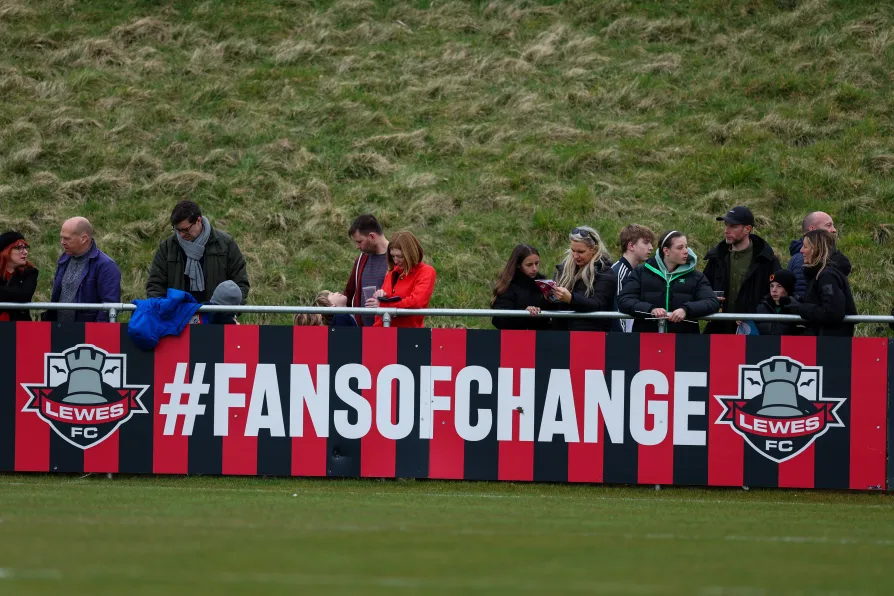 General view of fans watching during the Women’s FA Cup quarter-final match at The Dripping Pan, Lewes






Find part one of this article here
WE ARE situated in the Philcox Terrace. Behind the goal are well-tended steps, grey blocks and barriers steep enough for all to view the game under a functional but elegant curved corrugated roof.
Underlining the fact we are a successful set piece away from the sea, along from the standing area, at the top of the grass bank are colourful beach huts, hubs for advertisers and their guests, including the purple and white sweep of shirt sponsors Who Gives A Crap.
There is also a clubhouse called The Rook Inn. For a moment I thought it was called the Book Inn, after Duncan told me that a collection of football books had been donated by a journalist who used to be sent review copies of the latest releases.
Duncan also offered left-wing literary book recommendations, including The Roaring Red Front, which explores global left-wing, anti-fascist and anti-racist football clubs. I thank him for his suggestion, and promise to make it the next tome I read.
Later, I look it up, and note it includes a visit to Bohemians Praha 1905, which I had actually visited for a game in the Czechia capital when covering a Sparta Prague Champions League clash last November.
“It’s not just about obvious left-wing sides like St Pauli, it also covers Clapton FC,” Duncan explains about the East London club renowned for anti-fascist, anti-sexist and anti-homophobic stances, who also exist with a strong community focus. “We had a great day out there,” he said.
I thank Duncan for his suggestions and promise, having lived around the corner in Hackney and Bethnal Green many moons ago when I was much younger, to also pay a visit to Clapton FC, delighted that my trip to Lewes has also produced left-wing book and football club recommendations — while silently shuddering to think of the repercussions such a conversation would provoke from right-wing fans of certain football clubs I have encountered over the years.
I enter the Rook Inn and immediately note Lewes FC also used to produce matchday posters here at The Dripping Pan. A real shame they don’t anymore as it’s such a creative idea in print as they looked so uniquely elegant.
With the warm welcome I have received, I thought it would be appropriate to buy a set of raffle tickets from the white-haired lady busy selling strips. With all funds channelled back into the club, I ask the forthright senior what the prize is. “Booze,” the delightful lady replies emphatically.
As the clock ticks down towards kick-off, printed teamsheet in hand — the programme is sustainably digital, even if, as a print lover, I miss the tangible presence of its pages — a female steward shuts the gate to ensure the players passage onto the pitch.
After the woman clad in high vis reopens it to allow fans through to the stand, I notice, on a steep soil terrace, what appears to be a garden full of daffodils and other flowers in bloom.
I ask the bespectacled woman what it is. She replies: “It’s for people in flats. They come here to grow and tend plants and flowers.” She nods to the far corner of The Dripping Pan, saying: “Past the chip stand there is also an allotment.
“It’s for the community,” she says with pride.
Duncan later tells me that the community garden was started from scratch — no mean feat in what is essentially a medieval chalk pit, full of flinty stones, and centuries-old rubble, in what some say was a site for spoil brought forth during the building of the nearby 1,000-year-old Lewes Castle.
As I locate a surprisingly plump former Wembley seat in the Rookery Stand, under a bright moon, the match starts, with 15th hosting fifth.
Billericay Town underline their good form with a goal on 13 minutes through Alfie Cerulli, who slots home with panache past home keeper Louis Rogers. The dashing number 11 opening his chest up ala Thierry Henry-style before powering the ball low into the corner, as his teammates and the smattering of visiting fans clad in blue and white scarves erupt in joy.
Six minutes later, the visitors double their lead through a penalty scored by the confident Cerulli for his second of a profitable evening. The 25-year-old journeyman sending Rogers the wrong way, after the Rooks keeper fouled Town’s Elliot Long in the box, amid a myriad of impassioned vocal appeals from the Essex side.
The visitors could have doubled their lead shortly afterwards when number 17 Tyler-Miller Rodney was put through but drills his effort low but narrowly past the far post.
In a spirited encounter, The Rooks went close with number nine George Nunn’s effort forcing a save from visitors keeper James Holden on the half hour mark.
As we towards half time the blue shirts of Billericay swept forward, as Frankie Merrifield unleashed a powerful drive that keeper Rogers was equal to, the Billericay number 10 sent through with a surprisingly deft touch by colleague Charlie Ruff.
The domination was to tell shortly afterwards when Merrifield emphatically fired home to make it 3-0 on the stroke of half time, before running off to celebrate near the corner flag. And of course, the statue of Bonny and Read, the celebrated bisexual pirates that look down on proceedings.
On a chilly evening, the welcome south coast sunshine of the afternoon alas long gone, at the interval I head up to pie hut and order a mouth-wateringly succulent steak and ale production. Appropriately enough at The Dripping Pan it is covered in lashings of gloriously savoury beef dripping gravy.
Behind the pie counter I spy a Trainspotting style poster that reads “Choose life. Choose football. Choose a team. Choose the Rooks.” On the whiteboard on wall of the hut the numbers of the winning raffle are listed, none of which, sadly, I chose.
I then head to the Harvey’s Brewery bar, serving a splendid selection of their ales, the hut a welcome addition to the ground. I order a refreshing Rooks Pilsner from the steadfastly local enterprise that still operates a working brewery dating back to 1730 in the heart of this beguiling town.
Intriguingly, the 1885-founded club — older than most Premier League sides — can also lay claim to hosting cricket matches dating back to the first recorded instance in August, 1730, the same year the brewery began.
As the teams head out for the second half, I return to my seat, while noting the numerous football scarves at the back of The Dripping Pan’s main stand. To my delight I also note not a single half and half among them.
Lewes battle gamely and nearly score through their lively substitute Devonte West, but the damage was done in the opening 45 minutes, in front of an official attendance announced as 351.
After the final whistle as Billericay celebrate their 3-0 victory, I catch up with friendly Duncan, who says: “it wasn’t the result we wanted but coming here is more than that,” before he adds with pride: “We’re about community as much as anything.”

Related articles
From pirate statues to surplus Wembley seats, The Dripping Pan offers a reminder that the game’s soul survives beyond the Premier League glare, writes LAYTH YOUSIF