Supporters from both sides prepare to stand together against season ticket threats and exploitation, writes JAMES NALTON


 Latest editorial
The scaffolder who fought Muhammad Ali
Richard Dunn’s remarkable journey took him from Yorkshire building sites to boxing’s biggest stage amid the upheaval of the 1970s, writes JOHN WIGHT
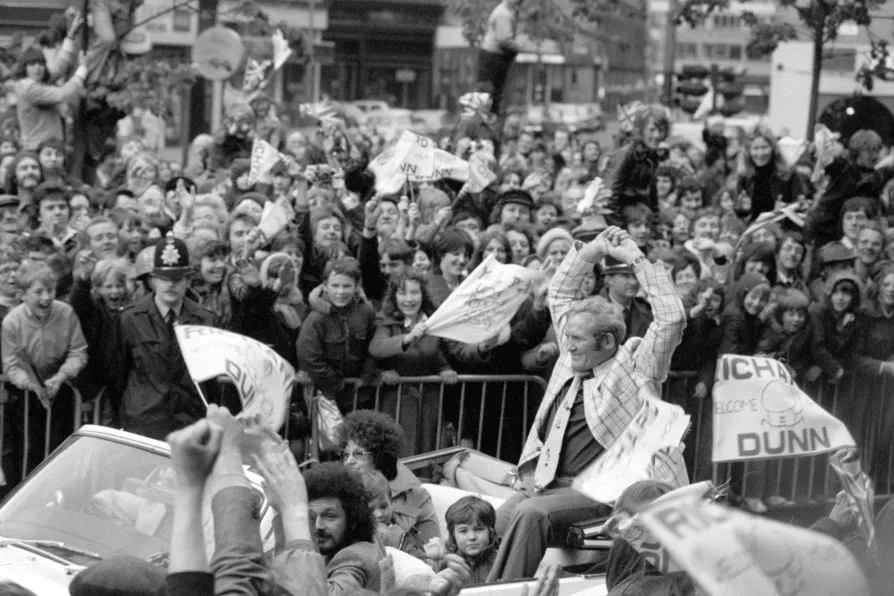 British and European Heavyweight champion Richard Dunn rides in an top car, responds with a boxer's salute to the Bradford crowds giving him a hero's welcome after his unsuccessful bid to win the world title from Muhammad Ali in Munich, May 26, 1976

French federation withdraws support as pressure mounts on Fifa president





THE journey from scaffolder in Bradford to challenging Muhammad Ali for the heavyweight world title in Munich seems about as far-fetched as any imaginable. It is, though, the one that was taken by Richard Dunn in the 1970s.
Born in Halifax in January 1945, when the most cataclysmic war in human history had just entered its last tempestuous year, rugby league was his preferred sport for much of his youth. Boxing stepped into the picture in the early sixties, when he began his foray in the amateurs. A southpaw (left-handed), Dunn carried significant natural power and uncommon stamina, both of which ensured that he was destined for the pros. The month and year in which he made his professional debut in London — July 1969 — major events both near and far unfolded one after the other.
This, after all, was the month and year in which Neil Armstrong became the first man to walk on the moon — on July 20 1969 to be exact — four days after the Apollo spaceship launched from Cape Kennedy in Florida. Armstrong’s famous statement, “One small step for man, one giant leap for mankind,” was beamed into living rooms in grainy black and white all over the industrialised world. David Bowie’s iconic single Space Oddity had been recorded and released just over a week earlier to coincide with the moon landings. It cemented Bowie’s status as a musical and artistic genius.
Earlier that month, on July 7, the first withdrawal of US troops from Vietnam began under the Nixon administration. Though the Tet Offensive of January 1968, unleashed by the Vietnamese resistance, left no doubt that US military forces would not and could not prevail, the conflict would rumble on until 1975 at the cost of around 2 million Vietnamese and nearly 60,000 US lives.
Richard Dunn, as anticipated, emerged victorious in his first pro fight, which was held at the old World Sporting Club in Mayfair against Del Phillips. Inexplicably he fought again just two weeks later, losing this time to Danny McAlinden at the same venue.
Though officially a professional, for Dunn money was an object to the point where he could not afford to hire sparring partners and was forced to continue his day job as a scaffolder, hauling metal tube around on construction sites for eight hours a day before hitting the gym in the evenings. Such a gruelling schedule would have been beyond the capabilities of most, but within him resided the fierce desire to attain boxing honours, and so on he ploughed, undeterred.
British heavyweight boxing in the 1970s was dominated by Joe Bugner. Wisely, Dunn’s management team avoided Bugner during this period. This on the understanding of their man’s limitations. Bugner possessed a fast, accurate jab and in the early seventies at least, was fleet footed. Both of these qualities were antithetical to Richard Dunn, who plodded more than he danced, and whose idea of a fast jab was one that arrived via the overnight train from Inverness.
1975 was a good year for the Yorkshireman, but not so good for everybody else. Margaret Thatcher replaced Edward Heath as leader of the Conservative Party on February 11 in what would prove a grim harbinger. Economically, inflation in 1975 peaked at 24.2 per cent, while in that year’s referendum on Britain’s continuing membership of the European Economic Community on June 5, 67 per cent voted to remain.
Three victories on the bounce in 1975, from which he emerged the British and Commonwealth heavyweight champion, set the stage for Dunn’s date with destiny against Ali in West Germany. The previous year in October, Ali had faced and overcome his nemesis Joe Frazier in the brutal finale to their trilogy of fights in the sweltering heat of Manila. Evidence of decline in the champion during the Frazier clash was clear. Thus if ever there was a good time to face him, so the logic went, it was now.
Elsewhere, at the start of that month, Second Division Southampton succeeded in defeating First Division Manchester United 1-0 to lift the FA Cup in glorious sunshine at the old Wembley Stadium in front of 99,000 fans. A goal in the 83rd minute by Bobby Stokes kept the traditional romance of the FA Cup alive. On May 10 1976, meanwhile, Jeremy Thorpe resigned as leader of the Liberal Party over matters pertaining to his personal life. His permanent replacement, David Steel, would go on to lead the Liberals until their merger with the Social Democratic Party (SDP) in 1988.
Further afield, on May 9 Ulrike Meinhof — founding member of the West German Marxist militant group Red Army Faction — was found hanged in her prison cell in Stuttgart, with allegations that she’d been murdered by the state lingering long thereafter. Meinhof it was who once famously declared: “Protest is when I say I don’t like this. Resistance is when I put an end to what I don’t like.”
Munich’s Olympiahalle is where Richard Dunn met the legend that was Muhammad Ali in the centre of the ring. Nobody gave the British contender a chance, but Dunn had prepared for this the biggest fight of his life undaunted, regardless.
Watching the fight back today is like watching the swaying branches of two tall trees bumping against one another in a strong wind. Dunn did his best, but his best was not good enough against a ring legend who by then was way past his own best. The result was never in doubt from the opening bell, and mercifully the referee saved the British challenger from further punishment, when he stepped in to stop the fight in the fifth round.
Two fights later, one of them a crushing first-round defeat to Joe Bugner, Richard retired from boxing. A failed hotel business venture forced him back into scaffolding, from which he retired in 1989 after breaking both legs in a fall while working on an oil rig in the North Sea.
Today, he lives in care in Scarborough, fighting a different opponent in the form of dementia. Of such men an empire was forged and fascism in Europe defeated. Such is the contradictory character and legacy of the British working class.
