Latest editorial
From pirate statues to surplus Wembley seats, The Dripping Pan offers a reminder that the game’s soul survives beyond the Premier League glare, writes LAYTH YOUSIF





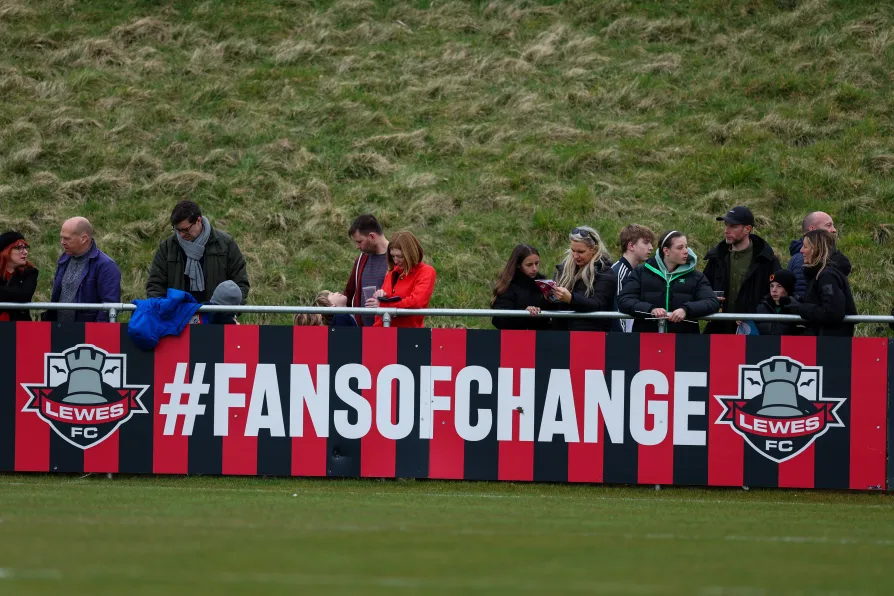
A WONDERFULLY warm welcome awaits at The Dripping Pan, home ground to the progressive Lewes FC.
I’d wanted to pay a visit for a while to this agreeably forward-thinking club, situated the next train stop along from Brighton & Hove Albion’s ground at Falmer in Sussex by the sea.
As I’d heard so many good things about The Rooks — Lewes FC’s nickname due to the large number of black birds that nest around their stadium, not to mention the team’s historical association with the nearby Lewes Castle that overlooks the town — I thought I’d head down to the south coast a day early before the Seagulls hosted Arsenal.
With Lewes Castle — building of which began shortly after 1066 — perched high above the town’s beguiling medieval streets, featuring a raft of independent stores as well as a working brewery, I stroll from the train station to evocative Dripping Pan.
Said to be named for its unconventional sunken shape, the bowl-like structure resembling a traditional cooking pan used to catch meat drippings, The Dripping Pan is a joy to behold.
In an era of bland, soulless, identikit stadiums that loom large in our consciousness through the all-consuming reach of the Premier League, Lewes’s enjoyably singular stadium is certainly one for football fans, stadium aficionados and groundhoppers alike.
A wooden match board above an ancient, and listed, flint wall proclaims the fixture, an Isthmian League clash with Billericay Town.
I loiter outside the main entrance, hoping to avoid the gaze of non-league jobsworths who, in my experience, and perhaps understandably, care not a jot for Premier League-accredited journalists.
The approach is open, so I wander up to the gate, and thankfully meet the affable Duncan, an unsung but tireless volunteer with a ready smile, who waves me in after I explain the nature of my humble visit.
The sense of community is tangible here at The Dripping Pan.
The club facilitates and promotes many worthy initiatives, from upgrading 3G pitches, to supporting mental health and wellbeing, as well as helping foodbanks, not to mention advancing charitable projects that benefit so many deserving programmes near and far.
“Money’s poisoned the Premier League,” says Duncan, adding: “We’re about community as much as anything.”
Duncan tells me that The Dripping Pan is one of the biggest community assets in Lewes, and requires constant maintenance. A group of volunteers meet every week, nicknamed the Thursday Club, who chip in with “fixing, painting, mending and bending” all parts of the ground. “The football is part of why we’re here,” Duncan says, “but it’s also about coming down and meeting new people and making friends.
“It’s fun, but it’s also nice to help out,” he shares with heartening modesty.
Duncan also tells me about their walking football team, “we’re all old codgers but it’s still nice to have the feel of kicking a football,” he says, as we swap jokes about the state of our knees from a lifetime of playing football, badly.
Duncan introduces me to Jo, who issues a hearty hello as she scurries past to open the club shop, a portacabin packed with brightly coloured Lewes FC merchandise, situated at the top of the grass bank overlooking a corner flag.
“We’re fan owned and people powered,” the engaging Jo tells me.
Jo, who is a teacher in her day job shares a number of the worthy initiatives the club are involved with, including offering flexible, supported volunteering roles in coaching, administration and ground maintenance for local people, while helping those looking to build confidence or skills while out of work.
“We also try and empower disabled adults through meaningful workplace activity, to attempt to build futures for adults with disabilities,” Jo explains.
Among the colourful offerings in the club shop Jo so engagingly presides over, it is hard to escape the playful fact Lewes FC shirts are sponsored by “Who Gives A Crap,” having signed a two-year deal with the sustainable toilet paper brand at the start of last season.
With a smile, we avoid the very obvious joke about keeping clean sheets, while Jo tells me 50 per cent of profits are donated to Wash (Water, Sanitation and Hygiene) initiatives around the world, including helping people access clean water and toilets.
Not having water and good levels of sanitation disproportionately affects girls and women across the globe, not least because in communities where water sources are located away from their homes, women and girls are primarily responsible for water collection in many households. Meaning inadequate Wash services put women and girls at increased risk of violence for women who walk long distances to access water, while a lack of sanitation means girls are more likely to miss school when menstruating.
Volunteer Jo says with feeling, and no little pride: “We’re proud of what we’re trying to achieve here at Lewes.”
Across the terrace, over in Lewes FC prominent unisex toilets — “Putting the loo in Lewes” reads the sign on the purple public convenience, also notable for its brightly coloured interior — it is also instructive to note sanitary products are supplied free by the Lewes FC Supporters Club.
Outside Jo’s cabin, which also sells “Football Against Homophobia” T-shirts, The Dripping Pan boasts an eight-foot-tall bronze sculpture depicting 17th-century pirates and lovers, Anne Bonny and Mary Read, called “Inexorable.”
Next time your Premier League club pays lip service to the LGBTQ+ community through vacuous slogans invariably fuelled by craven advertisers seeking to establish gossamer-thin diversity credentials, why not ask them if they have installed a bronze statue celebrating LGBTQ+ trailblazers. Lewes have. Underling their reputation for equality, while challenging stereotypes.
Created by designer and artist Amanda Cotton, who specialises in contemporary sculpture, Inexorable commemorates the female bisexual pirates Bonny and Read from three centuries previously.
Fleeing poverty, Bonny, originally from Ireland, and Read, English, but escaping grim plantation life in America, both independently dressed as boys to join pirate ships, where they were to meet and fall in love.
Artist Cotton explained the sculpture was a metaphor for the women’s personalities of Fire and Earth, and while the duo were “strong, independent individuals … when they combined [they became] unstoppable. Together Inexorable.”
Club volunteers Duncan and Jo also both shared with me The Dripping Pan has seats from Wembley, deemed surplus to requirements at the national stadium.
Without hesitation, the pair helped unload the padded, bright red seats, and install them into the stand alongside many in the Lewes community who also assisted with such back-breaking work. “That was a day and a half,” Jo confides with a smile. People powered indeed.