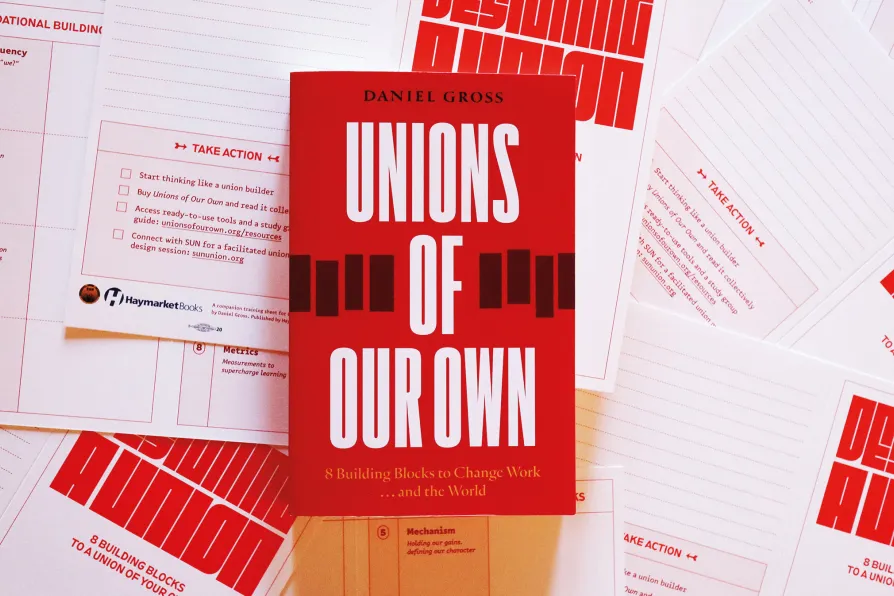
US-based labour and social movements authors and organisers Robert Ovetz and James Tracy interview DANIEL GROSS about his new book, Unions of Our Own: Eight Building Blocks to Change Work and the World


 Latest editorial

Energy prices set to soar
Oil and gas prices are rising due to the illegal war against Iran, but new nuclear power plants will only make things worse as their costs also escalate, writes LINDA PENTZ GUNTER
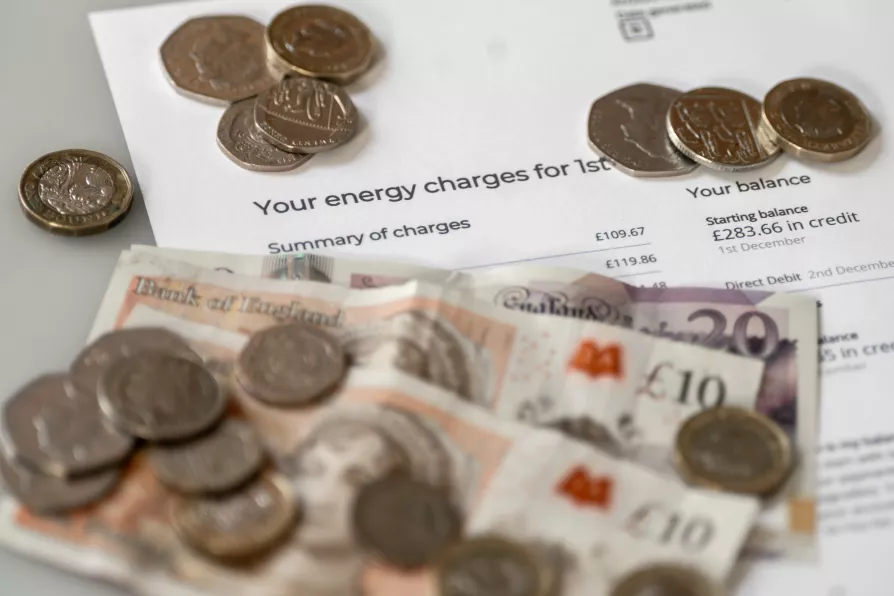 Money stacked on top of an energy bill
JOHN CALLOW introduces the work of Geoffrey Trease, who placed ordinary people at the centre of his historical fiction for children, creating adventurous stories to inspire the possibilities of social change
The Isle of Wight’s Victorian holiday boom drew visitors from across Europe, including the founders of scientific socialism, writes KEITH FLETT
The campaign against the Bank of England’s ongoing theft of Venezuelan gold is gaining support across the labour movement and beyond, writes MATT WILLGRESS
Unless ministers match reform with investment, the profession and the people it serves will continue to bear the cost, says KATE RAMSDEN
Claims that Nicaragua has abolished elections followed a headline that stripped Daniel Ortega’s remarks of their historical and political context. The full speech tells a different story, says BECCA RENK FOSTER





AS OIL and gas prices soar in Britain as a result of the illegal attacks on Iran by the US and Israel, two domestic energy projects are stumbling forward with new delays and ever-escalating costs.
The two-reactor nuclear power plant project at Hinkley Point C under construction in Somerset was first approved in 2007. It is still unfinished. A similar two-reactor project on the Sussex coast — Sizewell C — proposed in 2010, still remains on paper.
Last September, the Starmer government, tripping obediently in President Donald Trump’s gilded wake, announced a “golden age” of nuclear with claims that new nuclear power plants “will drive down household bills in the long run.”
The “new ‘golden age’ of nuclear,” they said, would “drive forward the government’s energy superpower mission to take back control of Britain’s energy for good.”
While Starmer is probably wishing he had a superpower or two about now, “taking back control” does not appear to be in his playbook and his nuclear claims are unsupported by evidence on the ground. Britons will be paying more for energy thanks to the war against Iran and, in all likelihood, due to persistence with nuclear power, whose track record demonstrates it is among, if not the most expensive ways to generate electricity.
Far from driving down consumer costs, the Hinkley Point C project, consisting of two 1,630 MW French Evolutionary Power Reactors (EPR), could see the original agreed strike price of £92.50 per megawatt — already considerably higher than the price Britons were paying at the time it was set in 2012 — soar even higher by the time the plant is finished, since prices are designed to increase annually in line with the consumer price index.
The original estimated cost of £18 billion for the two Hinkley C EPRs has now almost tripled, having sky-rocketed to almost £50bn as announced last week, along with new delays.
In 2007, when EDF first proposed its Hinkley Point C scheme, an officer with the company predicted locals would be cooking their turkeys using electricity from Hinkley C by Christmas 2017. That’s the same year — in March — that construction eventually began.
The Hinkley C completion date has now been pushed to at least 2030, another deadline extension it probably won’t meet. If the plant does show up in 2030, it will have taken 22 years, 13 longer than planned.
“Working people will benefit from jobs and growth as companies in the UK and United States sign major new deals that will turbocharge the build-out of new nuclear power stations in both countries,” said the government’s September announcement. But working people in both countries will have to wait a very long time for any such promises to materialise.
Several days after announcing the new cost hikes at Hinkley, news broke about similarly soaring electricity prices predicted for the Sizewell C nuclear power plant, another French twin EPR plant targeted for the steadily eroding and submerging Suffolk coast.
The Sizewell C project was first proposed in 2010 but there are still no shovels in the ground for the plant itself, only site preparation (for that, read tearing up countryside and precious habitat.)
As revealed in an article in the Daily Telegraph, electricity generated from Sizewell C is likely to cost “almost double today’s prices.” The prediction is a staggering £120 per megawatt hour, and that’s according to the government’s own new report.
Incredibly, despite the track record at Hinkley C, with identical reactor designs to Sizewell, this same government report “assumed no escalation in costs” for the Suffolk project. Such an outcome is, to put it mildly, highly unlikely.
In an recent analysis for OilPrice.com, Leonard S Hyman, an economist and financial analyst, and William I Tilles, a senior industry adviser and speaker on energy and finance, predicted that “the prospects for new nuclear (both big and small) are deader than the proverbial doornail.”
They viewed the outlook for the so-called small modular reactors that the British government is poised to green light as even bleaker. (At around 490MW the favoured design from Rolls-Royce isn’t actually that small.) Small reactors will have “projected costs that are much higher than gigawatt-scale reactors, making them even less relevant economically,” they wrote.
And yet, the Starmer government presses on, which seems to be the modus operandi at No 10 these days no matter how damning the news on pretty much any front.
Linda Pentz Gunter is a writer based in Takoma Park, Maryland. Her book, No to Nuclear: How Nuclear Power Destroys Lives, Derails Climate Progress And Provokes War, will be published by Pluto Press in March.
