KEN COCKBURN traces the one original language – that of the Yamnaya pastoral nomads – from which all European and Indian languages derive


 Latest editorial
Comfort food for Guardian readers
MARJORIE MAYO is disappointed by the lack of class analysis in an all-too-plausible account of progressive causes
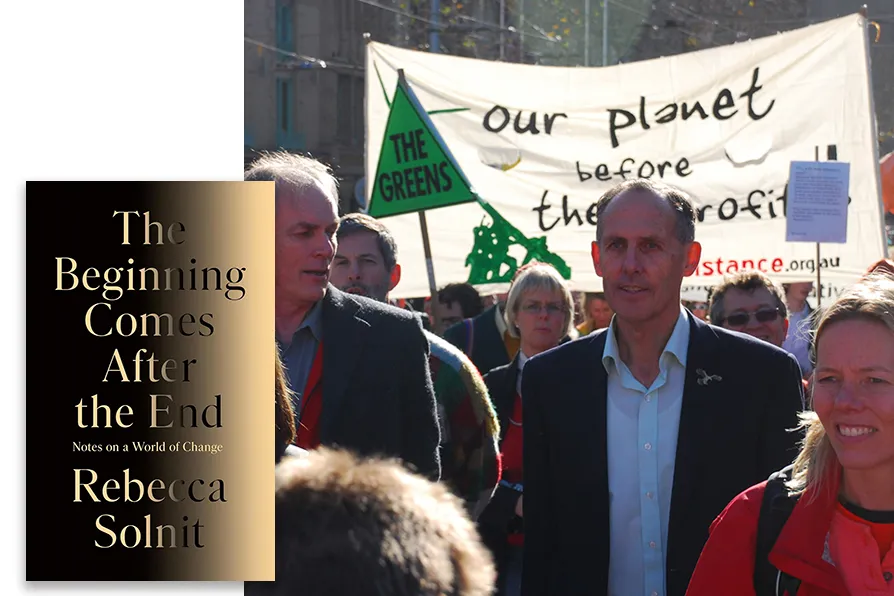 POP ENVIRONMENTALISM?: Senator Bob Brown at a climate emergency rally in Melbourne, 2008 [Pic: Peter Campbell]

PAUL DONOVAN is fascinated by the debunking of the iconic British war hero
ALEX HALL recommends a searing panorama of our global predicament
Comics are not just superheroes and spandex – it can be public art, telling public stories, suggests HARRIET EARLE
ALEXEI SAYLE speaks to Angus Reid about a lifetime of protest, how to hone political art – and what to do now
The bard serenades the Diggers of Wigan and their festive followers





The beginning comes after the end: Notes on a world of change
Rebecca Solnit, Granta, £14.99
THIS latest book by Rebecca Solnit reflects on her many years of activism across different arenas of struggle. The author of over 20 books and numerous articles, she has been described as a feminist who has engaged with environmental issues, politics and the arts, an activist who has remained hopeful, despite the challenges of the far right, including the challenges of Trump’s second term as president of her native US.
The title, “The beginning comes after the end,” chimes with the author’s references to Gramsci’s famous statement: “The old world is dying. The new one is slow in appearing. In this light and shadow, monsters arise.” Pushback from the far right may indeed have monstrous aspects, in other words, but a new world is struggling to be born.
This is a book that should have particular relevance then, pointing to hopeful signs in difficult times. As the quotation on the front cover opines: “You can take rights away, but you can’t so easily take ideas away, including people’s belief in their own rights and the rights of people they care about. You can cut down the flowers, but you can’t stop the spring.”
Subsequent chapters focus on the achievements of previous decades, as progressive ideas spread through social movements; feminism, anti-racism, civil rights and environmental justice.
Quoting from Martin Luther King Jr, Solnit emphasises the interconnectedness of the challenges to be faced. As he wrote in his letter from a Birmingham jail: “We are caught in an inescapable network of mutuality, tied in a single garment of destiny. Whatever affects one directly, affects all indirectly,” pointing to the links between struggles to challenge sexism, misogyny and racism, and working for a society in which everyone matters and every voice can be heard.
The Beginning Comes After the End explores a wide variety of issues and themes, from the ways in which people interact with animals to the ways in which they interact with each other. Whether they interact in oppressive, hierarchical ways – the logic of colonialism and capitalism — or whether they interact in more co-operative ways, respecting different (including indigenous) cultures in the process.
Of course there has been pushback from the far right, but Solnit concludes on a hopeful note: “Utopia is available to us.” The future can be made differently and the future will prevail, in her view.
So far, so good then? What’s not to like? How to disagree with Solnit’s support for movements for equalities and social justice along with her support for human rights and environmental justice?
Solnit has her critics, however, and not only from the right of the political spectrum. She has been described as a “pop feminist,” a writer and activist who confirms feminists in their general beliefs, without actually engaging in more controversial debates. A feminist version of “motherhood and apple pie.”
Similar criticisms could be applied to other aspects of this book, “pop environmentalism” for example, or “pop progressivism” more generally.
Although Solnit quotes Marx as well as Gramsci, this is absolutely not a Marxist analysis of the current situation. Marxists would start from a structural analysis of the forces of reaction, taking account of the class interests involved, both nationally and internationally. Such an analysis would form the basis for developing progressive alliances to challenge these morbid symptoms, taking account of the material interests involved.
This is not Solnit’s approach. In her view, beliefs and ideas will win out, despite the underlying structural challenges. Is this simply “optimism of the will” then, without the accompanying analysis, the “pessimism of the intellect”, to paraphrase that well-known quotation (erroneously) attributed to Gramsci?
