
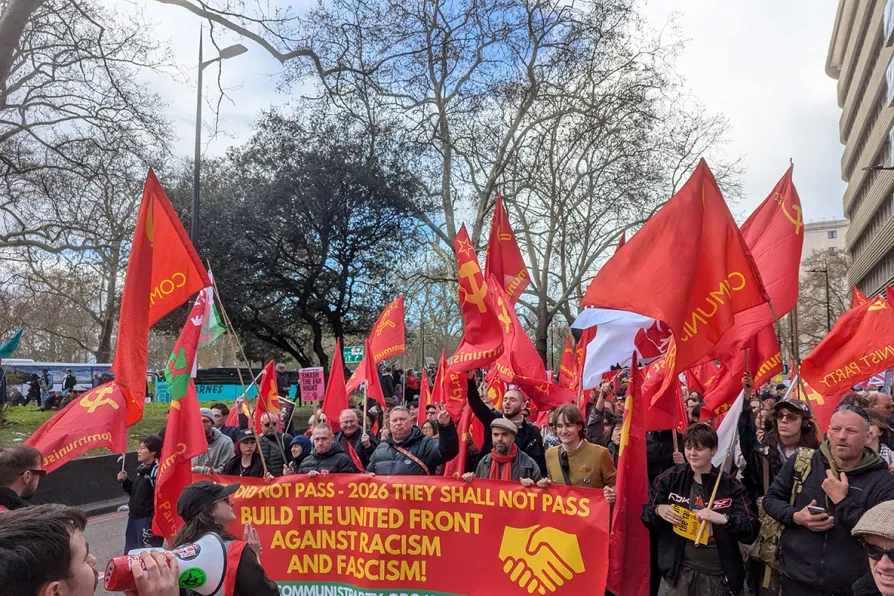
Working people across Britain are fighting back against austerity, war, repression and exploitation. The challenge now is to unite those struggles, says Communist Party of Britain assistant general secretary JOHNNIE HUNTER

Gorton and Denton: can the Greens beat not just Labour, but labourism?
For most on the left the Greens’ distance from the labour movement is a problem. But what if it’s why they can escape the labourism trap, asks JAMES MEADWAY
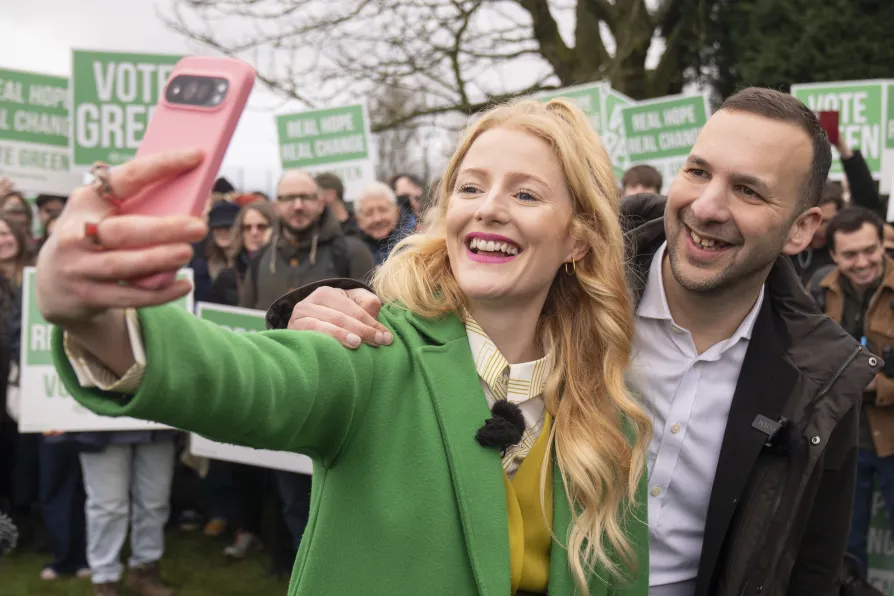
 Green Party leader Zack Polanski with the Green Party Gorton and Denton by-election candidate Hannah Spencer taking a selfie with Green Party volunteers at Granada Park in Denton, February 7, 2026
Train drivers’ union Aslef general secretary DAVE CALFE speaks to Ben Chacko about his hopes that Burnham’s devolution agenda will include the importance of the railway
DIANE ABBOTT provides an analysis of the reasons for EU and British voters’ dramatic swing to the right
Some of the review’s proposals could make the benefits system less cruel and dehumanising. But its vague plans for services and non-cash support revive the threat that disabled people will lose control over the money we need to survive, writes DYLAN MURPHY
Believe it or not, there was a time when the US government built beautiful homes for working‑class Americans to deal with a housing shortage, writes ERAN BEN-JOSEPH
MAT COWARD has heaps of good advice on recycling garden and household waste over the winter





THE Gorton and Denton by-election is the first major electoral test of a new Green Party: one that is now best-placed to represent the new politics of class in an age of permacrisis and insecurity. The party’s meteoric rise under its new “eco-populist” leader Zack Polanski has crowbarred open the political space for the left. And it has done so because the Greens are a clear rupture with the politics and institutions of Labour and social democracy that have become a barrier to building a genuinely popular, mass party of the left.
We won’t know the final result from Manchester until well after polls close on Thursday. However that lands, the Greens have ably demonstrated that they can run a big, disciplined campaigning operation in a working-class and historically Labour-voting area. If the party’s canvassing returns are close to accurate, and last-minute constituency polling reasonably accurate, the Greens will be getting a thumping big vote – and may even be on course for a truly historic win.
To their huge credit, the various organisations of the left have put aside their differences and rallied behind the Greens as the candidate most likely to win the vote for the left in Gorton and Denton. This is an essential step in building the anti-Reform coalition that we will need to defeat Nigel Farage’s party at the ballot box in (most likely) three years’ time.
However, many on the left still see the Greens as a sort of consolation prize for Your Party’s failures — a second-rate substitute for the real workers’ party that the 800,000 initial sign-ups promised. They point to the Greens’ historic roots as party of middle-class environmental protest, and its lack of attachment to working-class communities and working-class institutions — primarily meaning the trade unions.
Put all this together, runs the argument, and what you have is a party that won’t be able to break through in working-class areas or represent working-class interests. Your Party or perhaps some other left vehicle would therefore be better placed to win over the millions disaffected from Labour.
Labour, the historic party of the British working class, has been back in government for 18 months but with a widely despised leadership and few achievements to its name. Places like Gorton and Denton were once party strongholds. Today, decades of declining votes and decaying institutions — from closed labour clubs to withered trade union branches — are being reinforced by the shock of the Starmer government. Even before entering office, Starmer’s response to the horrors in Gaza had chewed up the party’s support; in office, a succession of disastrous domestic policy decisions, from removing the Winter Fuel Allowance onwards, fatally undermined its support. The scandals now engulfing its leadership are the final blow.
Starmer’s leadership has compounded long-term decline to produce what is the deepest crisis in the party’s history, as its national polling plummets and places that have in some cases voted Labour for a century are at risk of falling to its opponents.
Up until the end of 2025, they seemed destined to fall to Reform. This time last year, Nigel Farage seemed dead-set on creating a new, populist hegemony, stretching from the traditional Tory right to one-time Labour voters in its heartland seats. Farage could be found dashing to union protests outside steelworks in Scunthorpe, promising renationalisation for British Steel, or telling voters in former Welsh mining areas how he always rather admired Arthur Scargill. Weeping crocodile tears, Farage would even pledge to remove the two-child benefit cap.
It was nonsense — Farage is a long-time Thatcherite. But in alienated, declassed Britain, after long years of austerity and longer years of economic decline, where the online politics of culture wars had replaced the real-world institutions of the labour movement, it could achieve some plausibility. With immigration as the rhetorical glue, Reform could glom together Tory voters — including those in historically Labour areas — with a layer of former Labour or never-voters into a potent electoral bloc. Reform’s stellar polling rise and its successes in the last local elections reflect this.
Crucially, Reform could achieve that because it was, for the right, a hard break with two-party politics, its political institutions and traditions. Reform might rhetorically wallow in nostalgia for the past, but in practical terms this is a party closely attuned to British society today. Farage would talk up the nobility of manual work and trade unionism knowing full well his actual audience was retirees and insecure white collar workers, and that his real hard core of support were the most online of the online, consuming 24/7 far right ragebait and GB News clips.
A radical, populist break in the party system to the left had to learn to perform the same trick: to understand the realities of life in Britain today, including the reality of the left’s core base of support: the young and disenfranchised, often insecurely employed, often university educated, often to be found in the major towns and cities. This is part of a new working class, but one that has little to no attachment to the history or the institutions of the labour movement.
Trade unionism is, increasingly, a minority pursuit in Britain, with total membership continuing to decline, even with the brief uptick in strikes over 2022 to 2023. So if the Greens’ candidate in Gorton and Denton isn’t in a union, this should not be at all surprising. The number of women, in their mid-thirties, working in the private sector now in a trade union is tiny: less than 10 per cent and most likely well below that figure. If Hannah Spencer comes across as a candidate close to the people and the constituency she wants to represent, it is at least partly because she has not had to climb into the role via the eroded tracks of the labour movement. Don’t misunderstand me: unions remain a fundamental defence for workers. But politically they have limited reach into wider society, and this isn’t going to change any time soon.
This has produced an obvious sectionalism. For all the annual pantomime of calls to disaffiliate from Labour, on key issues unions are often in lockstep with the government: on Heathrow expansion or increased arms spending, for example. Both reflect sectional interests within their memberships rather than a wider class interest. The unions have always had this tension. But when unions themselves have increasingly limited reach into broader society, their sectionalism starts to dominate.
There was a key moment in Zack Polanski’s speech at the Green Party conference last year when he said the party would speak for the “plumber and the hairdresser.” When a Labour leader would have found a nurse or a teacher or a doctor to speak for, all safely counted amongst our six million unionised and public-sector employees, Polanski went for two occupations that exemplify the self-employed and the small businesses that make up the economy of daily life in Britain. It’s a striking contrast, since it tells us exactly why Labour are a party in fundamental decline and the Greens are presently cresting a wave.
And why Your Party has failed to take off. It can’t make the hard break with Labourism. This is not only the product of the obvious attachment that both Jeremy Corbyn personally, and those close to him, have to the organisational forms and practices (good or ill) of the Labour Party and the unions. It is also their factional opponents, who have not been able to escape the orbit of Labourism but instead are increasingly coming to define themselves solely in opposition to it.
The pattern has repeated across Europe. In Belgium, the Workers Party, with its pre-history as a Maoist sect, now polls around 18 per cent with rock-solid bases of support in the country’s industrial heartlands. France Insoumise, an organisation formed by a sharp break not only with the Parti Socialiste but also the once-mighty Communist Party and even France’s significant Trotskyist currents, commands the left space. Sinn Fein, with its roots in the Irish liberation struggle to the North, is now the largest single party in the Republic of Ireland. In each case, it is parties formed without reference to the historic traditions and organisations of social democracy that are the most dynamic in the continent’s left.
Ballots in Gorton and Denton open in a few hours’ time. Labour’s much-feared electoral machine has rumbled into action, reliant as it now is on party full-timers to door knock. Its online campaign has been a disgraceful barrage of smears, directed exclusively against the Greens. Reform entered as clear favourites, but has faced a closely fought contest. A breakthrough for the Greens could be a truly transformational moment: the long-delayed arrival of a left politics fit for the 21st century.
