


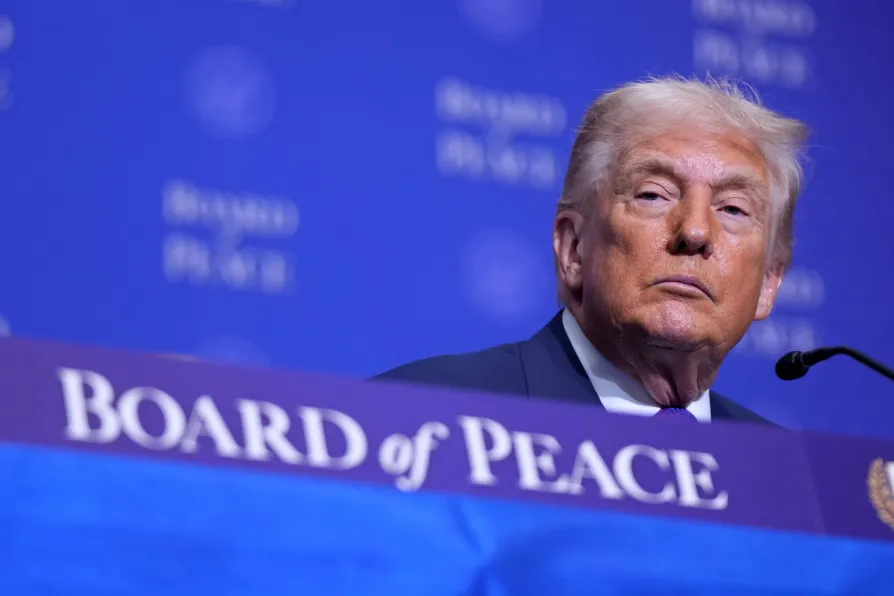
 President Donald Trump listens during a Board of Peace meeting at the U.S. Institute of Peace, February 19, 2026, in Washington
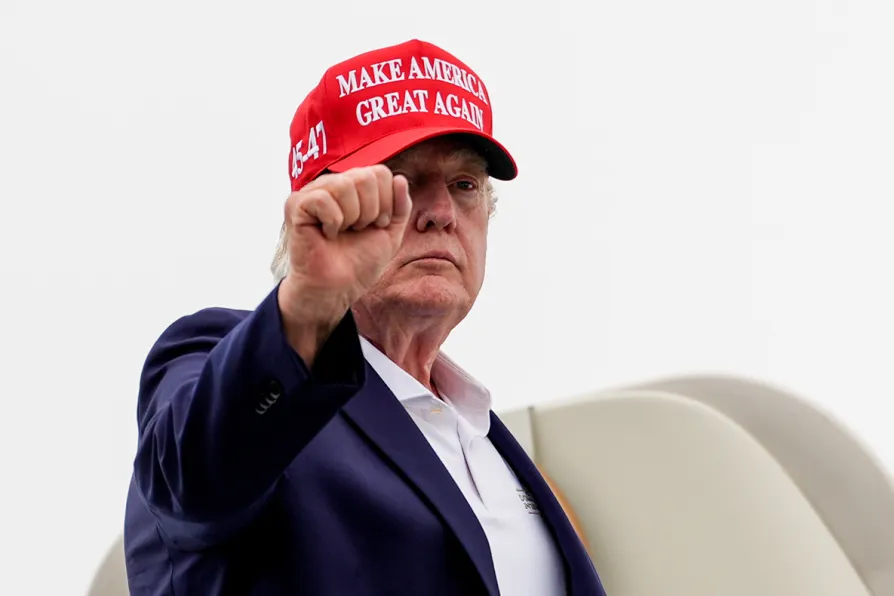





PRESIDENT Donald Trump has now assembled the largest US military force in the Middle East since the disastrous and criminal Iraq invasion in 2003.
It is not there for show. The chatter from Washington is that a US attack on Iran is now a “90 per cent” likelihood.
It is still possible that the deployment is simply to pressure the Iranian regime into complying with US demands regarding its nuclear power programme and its wider policy across the region.
But Trump has already attacked Iran once during his second term, and he is under pressure from the Israeli government to move towards overthrowing the regime in Tehran, something that would require military action on a far larger scale than previously, and co-ordination with pro-US political forces like the son of the deposed Shah.
So the danger of war seems imminent. The anti-war and labour movements here in Britain need to be clear-sighted.
Any military action by Trump, or Israel, or both would be a gross violation of international legality and a criminal imperialist adventure which would risk an escalating conflict across the Middle East. The peoples of the region, including the Iranian people, would be the losers.
Likewise, there must be clarity on the issues at stake in the dispute between Iran and the US.
Nuclear weapons proliferation is one of the great dangers of our age. The breakdown of almost all treaties and agreements on limiting the spread of nuclear armaments, overwhelmingly a US responsibility, is a disaster.
The Iranian regime denies seeking nuclear weapons. However, it is a fact that Israel has a substantial nuclear arsenal which is part of its machinery of regional hegemony. US forces in the region also doubtless deploy nuclear munitions.
If the US and Britain are serious about dissuading Iran from ever seeking a degree of strategic symmetry then they should commit to a nuclear-free zone across the Middle East.
Washington also demands that Iran end support for those fighting for liberation across the region, including Palestinian Hamas, Lebanese Hezbollah, and the Houthis in Yemen.
These are all indigenously rooted national movements, some of which have scant religious-ideological alignment with the theocracy in Tehran. The US terms them as Iranian “proxies,” a neocolonial framing which should find no echo in our movements.
Iran’s support for them may in some measure be self-interested, but to reduce them to conduits for political Islam is to demean the struggles of the peoples of the Middle East for liberation from imperialist and Israeli aggression.
When British forces bomb the Houthis, for example, because of the Yemeni peoples support for the Palestinians of Gaza, false equivalence amounts to a betrayal of internationalism.
Nor can the Iranian regime, for all its internal repression and policy of social immiseration, be equated with Israel. The latter has attacked not just Gaza but Lebanon, Syria, Yemen and Iran itself over the last year. There is the enemy.
If Trump and Starmer want a peaceful and stable Middle East, Israel is the rogue power which needs to be curbed. Instead it is armed, supported and diplomatically protected by the imperialist powers.
These are not nuances, but the heart of the crisis in the Middle East. The anti-war and solidarity movements here must not be distracted from their main responsibility — challenging the imperialist interventions and alliances of the Starmer government — by the temptation to sit in moral judgement on those who are its targets.
The future of Iran is for the Iranian people alone to determine. US or Israeli military intervention must be firmly opposed, and the British government pressed to dissociate from any such plan.
