TUC president and POA leader STEVE GILLAN speaks to Ben Chacko on the eve of Congress 2026


 Latest editorial
China’s revolution: What relevance today?
In the fifth and final part of a series of articles, Storming the Heavens author JENNY CLEGG explains how the Communist Party of China’s approach demonstrates how Marxism, rooted in concrete conditions and mass participation, can shape history
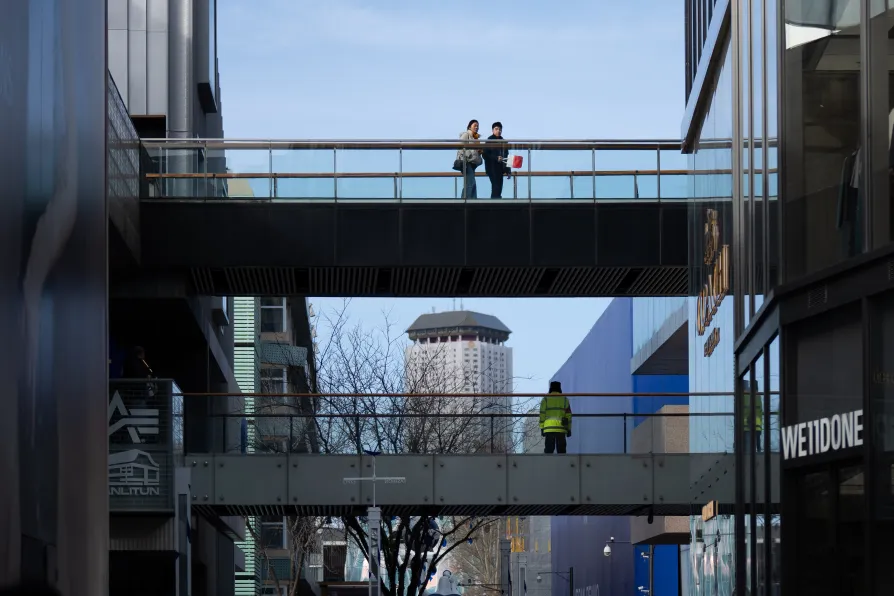 Pedestrians walk across a skybridge between commercial buildings in the Sanlitun area of Beijing, China, February 15, 2026

DOUG NICHOLLS welcomes a turning point at this year’s Congress, where many motions call for a co-ordinated plan to revive British industry, a perspective outlined in his new book
HOPE VIRGO of campaign Dump the Scales warns MPs voting today they should be alert to the threat legalised assisted death poses to people with eating disorders
The Together Alliance is hosting two summits, North and South, to build power and plan action against the scourge of racism peddled by the right. DANIEL KEBEDE urges mass participation
The drift toward militarisation in Europe is not inevitable, left-wing and peace movements can preserve sovereignty and prevent war, says DÁIRE HUGHES MP
Whatever differences exist among international sympathisers of the Bolivarian revolution about its current trajectory, they should unite against the imperialist power that is the source of an enforced retreat, argues ROGER D HARRIS
Trade unions need to step up and force a turn in the policies of the labour movement to effectively confront the far-right threat, argues NICK WRIGHT





WITH China on course to become the world’s most advanced major power in the next decade or two, understanding the roots of its transformation is obviously a necessity.
China’s revolutionary past is deeply imprinted into its present with its socialist constitution identifying the special characteristics of its primary stage — the leading role of the Communist Party, the alliance of the workers with the peasants, and the empowering of all the people contributing to building socialism. This includes the private entrepreneurs, who historically supported the revolution, and today continue to develop the economy, creating jobs in the cities for millions of rural migrants.
With these ”Chinese characteristics,” the CPC is clear theirs is not to be taken as a model — early on it followed the Russian path too closely, at great cost. Given the gap of time and such differing conditions, are there any universals in the particular experience from which wider lessons might be drawn?
Questions of democracy
In Britain, traditional parliamentary politics is collapsing, with millions breaking from the confines of social democracy, rejecting its compromises and incompetence. Given the hypocrisy and betrayals of its figureheads, the demand is for a leadership answerable to the working people. Meanwhile, the strength and breadth of the pro-Palestine movement has laid a wider basis for internationalism and anti-imperialism. Some now look to other mass struggles in the global South — the chaotic youth movements seen in Bangladesh, Nepal and Tanzania, and also Ibrahim Traore’s channelling of Sankara’s peasant-centred self-reliance and anti-imperialism in Burkina Faso.
The utopian left, however, tends to suffer an infatuation with spontaneism. It is not enough to indicate the aim of struggle with slogans calling the masses to action — political activity has to be situated in the context of action. Here the experiences of Mao and the CPC may offer insights beyond the particular.
Like Lenin, Mao saw political action taking place amidst complex conditions with contradictory struggles engaging a cast of political actors reflecting varied, unevenly unfolding interests. And like Lenin, situating the CPC as a conscious vanguard within these popular struggles — the spontaneous demonstrations, the strikes, the village and township protests — he responded flexibly to these diverse and contradictory currents, developing strategies over time to pull these together based on a working-class perspective.
The Chinese experience shows how at the point of interaction between the people and the leadership, democracy is created over time beyond formal structures. Nor is it just about unleashing a populist upsurge or simply a laissez-faire “doing everything the masses wants.” Opinions fluctuated between extremism and passivism as the influence of different sections of the people came to the fore at different times. Mao, it should be said, was adept at seizing the opportunity in a rising tide, “striking while the iron is hot,” but he was equally capable of working against the grain of spontaneism when swings of opinion began to undermine the overall popular movement.
Here the CPC’s responses were based on a distinctive approach to democracy, seeking to resolve the contradictions among the people. This was done through a policy programme which catered at least in part to the differing material interests underlying the varying political tendencies.
“Organising the workers” is not so simple: it is about engaging with different viewpoints, binding varying interests which share an underlying common goal together in such a way as to capture the popular will at any one time. But, as Ben Chacko pointed out in his Morning Star review of Storming the Heavens, the left in Britain has repeatedly failed to build a winning alliance that unites a majority of working people, taking into account their differences in income and assets.
Systems thinking
The challenge faces two interconnected ways — building unity among those seeking change, and targeting their opponents precisely as these seek to pry the unity apart. This calls for strategising — what Chinese Marxists term “systems thinking” namely, the dialectical method of the “splitting of a single organic whole and the cognition of its contradictory parts.”
Mao’s On Contradiction is the example — analysing out of a complex political situation, the whole series of conflicts around imperialism, feudalism and capitalism, not just as a collection of campaigns and struggles, but as an interconnected whole so as to find the key links.
Systems thinking enabled the CPC to take a long-term view, prioritising targets and sequencing struggles to take down adversaries one after another — the Japanese aggressors, then the bigger bureaucrat and compradore capitalists and landlords, then, with the national bourgeoisie left isolated, the takeover of private enterprise in the peaceful transition to socialism in 1956.
At each stage, it was necessary to work out how to move on the next, something the CPC accomplished by aligning classes in such a way as to ensure the continuing revolution. This sequencing stands out in contrast with the Trotskyist “all or nothing” permanent revolution which reduces the particularity of complex political processes to an abstract capital v labour conflict.
Imperialism, anti-imperialism and Chinese Marxism
Unfolding over several decades, the Chinese experience shows perhaps more clearly than that of the Bolsheviks, how the uneven development of both imperialism and anti-imperialism can impact on objective and subjective class conditions.
The CPC found its bearings amid its domestic complexities as part of the longer-term world proletarian revolution opened by the Russian Revolution in which the Chinese revolution served as a stage in the transition between semi-colonialism and semi-feudalism and socialism. Imperialism had its opposite impact: as Mao observed: when the imperialist powers used political, cultural and economic means of domination, ruling elites in oppressed nations would compromise, but when coercion and aggression were applied, this created opportunities to unite the various classes around national goals.
As an imperialist power, our consciousness in Britain of the balance of world power is dulled — the assumption is that the external conditions follow what happens here. But now the rise of China and the global South have become the international game changer.
Day to day, facing increasing reaction, we confront ever-sharper challenges. Understanding the historical trend towards socialism as a long and uneven process gives a sense of direction; seeing that contradictions will not to be resolved quickly can also be a reality check against making impossible demands, looking instead to what can be gained in any particular set of circumstance.
As Western Marxism comes under criticism from Domenico Losurdo and others as too dismissive of the concrete struggles of the people in socialist countries, Storming the Heavens helps to reveal the key points of Chinese Marxism as it developed from the revolutionary struggle of the Chinese people.
These are as follows: seeking legitimacy in resolving people’s problems and securing their livelihoods; applying dialectical and historical materialism; emphasising the long term, starting from basic reality; systems thinking — sequencing and setting priorities; learning from practice; balancing different interests among working people while focusing on their shared aspirations for a better life.
The relevance of the Chinese revolution today lies in showing that Marxism, applied in concrete conditions, can work.
Storming the Heavens is available from the Morning Star’s online shop.
