Andy Burnham’s message of hope will defeat Reform if Labour delivers the New Deal for Working People in full, says JOANNE THOMAS


 Latest editorial
Arundhati Roy refuses silence: why artists must speak out on Gaza
In times of genocide, art is not a refuge from politics but a weapon against injustice, says ROGER McKENZIE, highlighting three of his own favourite political truth-tellers
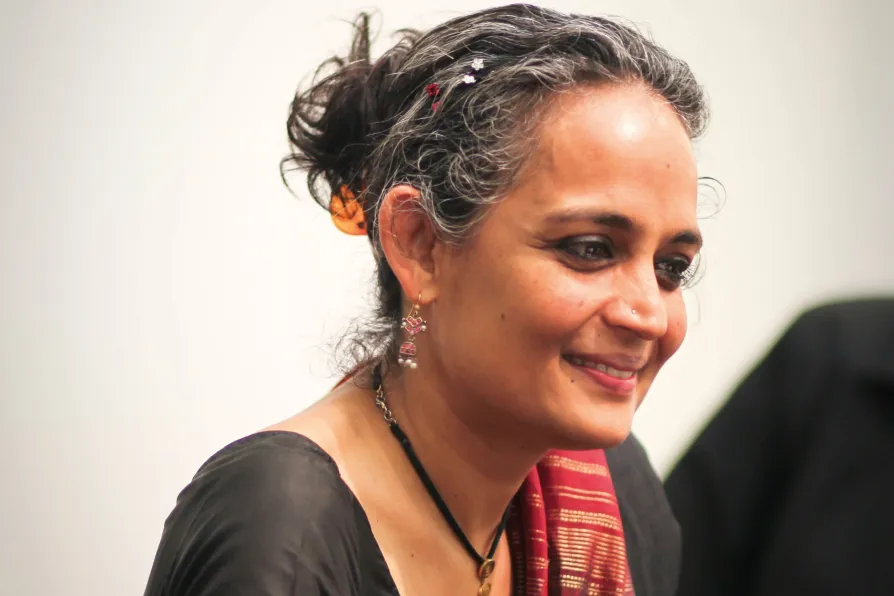 TAKING A STAND: Booker Prize-winning novelist Arundhati Roy. Photo: jeanbaptisteparis/ Creative Commons
The government’s latest asylum proposals abandon labour movement values and fuel division by aping Reform UK, writes DIANE ABBOTT MP
IAN LAVERY MP warns that decades of neoliberal policies have left former industrial communities behind — but a renewed Labour commitment to working people could change the political landscape
We need a government that invests in saving lives not destroying them, argues SOPHIE BOLT
HENRY FOWLER outlines the GFTU’s new 2026-27 education programme and argues that investing in trade union education is essential to building worker power, developing leaders and strengthening collective action
PAOLO SANTALUCIA reports on how an Italian region defies US pressure to end a Cuban doctors programme





THE great Indian writer Arundhati Roy took the decision last week to withdraw from the Berlin International Film Festival.
Roy decided to skip the screening of her recently restored 1989 film Which Annie Gives it Those Ones, after the festival’s chief juror, German director Wim Wenders, said film-makers must stay out of politics.
Faced with a number of questions about the genocide in Gaza, Wenders was asked if films can effect political change. He responded that “movies can change the world” but “not in a political way.”
He added that film-makers “have to stay out of politics because if we make movies that are dedicatedly political, we enter the field of politics. But we are the counterweight of politics, we are the opposite of politics. We have to do the work of people, not the work of politicians.”
Announcing her withdrawal Roy blasted the comments as “unconscionable.”
She said: “To hear them say that art should not be political is jaw-dropping. It is a way of shutting down a conversation about a crime against humanity even as it unfolds before us in real time — when artists, writers and film-makers should be doing everything in their power to stop it.
“Although I have been profoundly disturbed by the positions taken by the German government and various German cultural institutions on Palestine, I have always received political solidarity when I have spoken to German audiences about my views on the genocide in Gaza.”
Roy said she was clear that “what has happened in Gaza, what continues to happen, is a genocide of the Palestinian people by the Israelis.”
She added that the genocide was being “supported and funded by the governments of the United States and Germany, as well as several other countries in Europe, which makes them complicit in the crime. If the greatest film-makers and artists of our time cannot stand up and say so, they should know that history will judge them. I am shocked and disgusted.”
That this great writer and activist should take this stand will come as no surprise to anyone that has followed her work and read her brilliant writing over the years. You don’t have to agree with everything that she says — that would be extremely odd — but I find it ridiculous that there can still be any disagreement over the genocide taking place in Gaza.
Where some artists still apparently disagree is in the power of art and the artist to use their voices for humanity and to voice for radical change.
Roy follows in a very distinguished tradition of writers who have no doubt about their role in describing what is happening in the world and to advocate for change — even of the revolutionary variety.
I want to talk briefly about just three: Paul Robeson, James Baldwin and Alice Walker. There are plenty of others I could have chosen but these are three of my personal favourites.
I wrote about Robeson just recently, so I will not take up too much more space. But in his excellent 2016 book about Robeson, The Artist as Revolutionary, the historian Gerald Horne situates the legendary communist, actor, singer (and so much more) as a key and often neglected forerunner of the modern US civil rights movement.
In his book Horne says: “You cannot fully appreciate how the Jim Crow system came to an end without an understanding of the life of Paul Robeson.”
He added: “It was only with Robeson’s fall that [Dr Martin Luther] King and Malcolm X could emerge as they did; the undermining of Robeson created the vacuum that these two leaders filled.”
The rejection by Horne that Robeson’s communist politics “has been discrediting to his legacy” is clearly a fear that many artists have. They prefer to live in a selfish and idealised world that can somehow cocoon their work from everything else that is happening in the world.
Baldwin, perhaps my favourite writer and an activist in his own right, had no doubts. He said (forgiving for only a moment his non-gender inclusive language): “The importance of a writer is that he is here to describe things which other people are too busy to describe.”
Perhaps Baldwin was being kind in his use of the word busy in this comment? For busy we can maybe read “afraid” or even “unwilling” to describe?
Baldwin in even clear terms said “writing is a political instrument.”
I find it to be the height of arrogance and, in many cases, cowardice not to use whatever voice you have to stand up for people who cannot, for whatever reason, speak up for themselves.
I have heard Roy take issue with the term “being the voice of the voiceless.” Rather, she says, it is more about “being the voice of the deliberately not heard or ignored.” If there was ever a description of the position of the Palestinians then this perhaps is it.
Walker, the daughter of a sharecropper in Jim Crow era Georgia and the author of the multi-prize-winning and filmed The Colour Purple, could never divorce her writing from the world that she grew up in and in which she now lives.
After achieving literary fame, it would have been easy for Walker to take the easy way out and be some sort of high-flown artist. Instead, she turned her attention to injustice wherever she saw it in the world. She has protested over South African apartheid, the Iraq war, the Israeli occupation of Palestine, and female genital mutilation.
Walker has of course been slammed for her activism.
In 2012, Walker declined to have The Colour Purple published in Israel in protest at Israel’s inhuman treatment of Palestinians.
In her letter to the publisher, she compared the situation to South African apartheid and Jim Crow in the American South, claiming that conditions in Israel and Palestine were even worse.
The move, of course, elicited the now all too familiar condemnations of anti-semitism.
In an interview, Walker said: “I am tormented knowing what is being done to the children of Gaza.
“My view is that all children are the responsibility of all adults. The Jewish child is precious, so is the Arab child. So is the African child and the Indian child and so on. To turn away from them is impossible for me.”
These three writers, along with Roy, are part of a black (in the British political sense) radical tradition of writers standing up for change.
Of course this tradition of linking art and activism or, to put it another way, to lend their voices to those that are routinely ignored as the ruling classes exploit their bodies, minds, spirits and souls, is not just black.
Many whites and artists of many other backgrounds have stood up to be counted in the midst of exploitation or even genocide.
The principled position taken by Roy and other artists to stand up against the genocide in Gaza will no doubt continue to come under fire. We must stand beside her and them when it does.
We must also offer encouragement and solidarity to other writers and artists who feel a reluctance to speak out.
