ROB WARZYNIAK wades knee deep through a pile of ‘dead canaries’ of Trumpist policies which exacerbated the horrors of US capitalism domestically


 Latest editorial

Claudia Jones: the woman who altered the course of black history in Britain
On the 121st anniversary of communist Claudia Jones’s birth ROGER McKENZIE looks at political events that shaped her, and those she helped shape
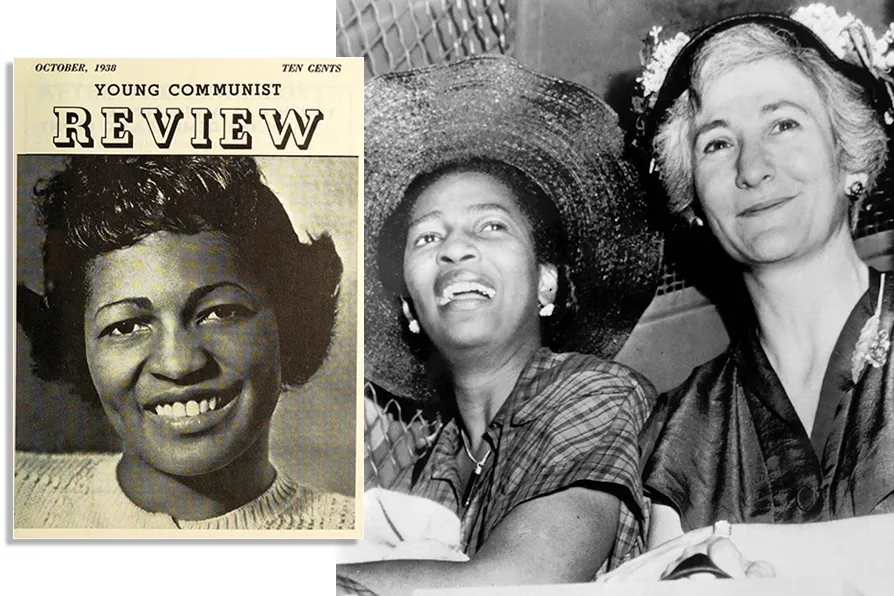 (L to R) Claudia Jones on the cover of the Young Communist Weekly Review (US), October 1938, Claudia Jones and Betty Gannett (CPUSA theoretician) arrested after their bail was revoked July 17, 1951 / Pics (L to R) YCL/CC, Public domain
Without evidence or Nato consultations Berlin’s answer to the Leipzig incident is a rupture of relations. SEVIM DAGDELEN examines why
FRANCISCO DOMINGUEZ introduces the background to a conference on defending Latin America’s sovereignty
The glacier collapse in Nepal is yet another warning that a warming planet is making Himalayan disasters more frequent and destructive – but the countries facing the greatest risks are often those least responsible, says LI YANG
Nick Blair is set to benefit from a hugely lucrative contract to ‘virtually’ train the British army for its next war. Like father, like son, writes SOLOMON HUGHES
Even when tragedy strikes, Western media cannot resist the opportunity to turn it into a sordid propaganda opportunity, as the Nepal-China border tragedy shows, writes CARLOS MARTINEZ
Trade unions should be at the heart of the anti-racist push for reparations for the historic legacy and continuing impact of slavery, writes ROGER McKENZIE





CLAUDIA JONES arrived in Britain in 1955 after being deported from the US as an already seasoned activist and leading US communist.
Although she cut her teeth as an activist in the US, Jones was born on February 211915 in the then British colony of Port of Spain, Trinidad. Her family moved to Harlem in New York City, the spiritual capital of the black diaspora, in 1923.
But neither the US or Trinidad and Tobago (TT) is her origin story. Jones, or Cumberbatch as she was known at birth, is of African descent.
Whatever her exact African ancestry, Jones inherited a fierce bravery.
To stand up for what one believes in is not, of course, a solely African trait. But to stand in front of crowds of white people who often would have looked at her as a curio rather than an experienced class fighter takes guts and fortitude.
It was after hearing the US Communist Party (CPUSA’s) defence of the “legally lynched” Scottsboro Boys, nine African-American boys accused of raping a young white woman and white girl in 1931, that she joined the Young Communist League.
Jones eventually went on to work for the YCL newspaper the Weekly Review, ultimately becoming editor in chief.
She became a leading member of the CPUSA, including becoming secretary for the party’s women’s commission and of the National Peace Council.
Much of Jones’s focus was the creation of anti-imperialist coalitions, particularly women-led alliances.
She focused on growing the party’s support for black and white women.
She insisted on the development in the party of theoretical training of women comrades, the organisation of women into mass organisations, daytime classes for women, and “babysitter” funds to allow for women’s activism.
In 1948 Jones was arrested for being a communist and imprisoned on Ellis Island.
She was found by a court to be in violation of the McCarran-Walter Act for being an “alien” who had joined the CPUSA. She was eventually slapped with a deportation order in December 1950.
In the same year she was convicted with 11 others of “un-American activities” under the Smith Act.
Released in October 1955, Jones was refused entry to TT, despite it being her place of birth, but was eventually offered residency in colonial ruler Britain on humanitarian grounds.
After arriving in Britain, Jones must have looked with more than a passing interest at events in the US where the Montgomery Bus Boycott, the spark that lit the fuse of the US civil rights movement, began months after her expulsion.
But Jones would have recognised the racism of Britain from her own experience.
The London experience for black people was not the same as in other places where black communities were trying to find their feet.
Liverpool and Cardiff, with their longest-standing black communities, were different from the melting pot of London. It was different still in the other towns and cities settled by black immigrants.
But what they all shared was a de facto “colour bar” where black people faced widespread racism in housing, employment and social venues.
White landlords routinely refused to rent to Caribbean, African and Asian residents, leading to concentrated, lower-quality housing. Pubs, dance halls and hotels often operated “colour bars.”
Black workers of African and Asian descent frequently faced entirely legal discrimination, receiving lower wages or being denied job opportunities.
Unions, while content to take money from black workers, often showed little interest in doing anything to confront this rampant racism.
These were the material circumstances facing Jones both as an activist and journalist.
She soon became active in the then Communist Party of Great Britain and, three years later, in March 1958, founded the West Indian Gazette (WIG), Britain’s first black newspaper.
In an important recognition of the need to unite African and Asian communities against the racism they were both experiencing, the title was later expanded to West Indian Gazette (WIG) and Afro-Asian Caribbean News (A-AN).
The recognition of difference and sometimes conflict between people of African and Asian descent is, unfortunately, central to Caribbean life. People of Asian descent were brought to the Caribbean as indentured labour to do the jobs that once enslaved Africans refused to do on their emancipation.
It also served the dual purpose of undercutting the wages of African workers. The inevitable consequence — deliberately fomented by the capitalist class — was to set African and Asian workers against each other.
This needed to be addressed in the British context if there was ever to be black working-class unity to stand up against racism.
As well as covering national news, including racist attacks and the communities of resistance that emerged to confront it, the WIG addressed anti-colonial struggles in Africa and in the Caribbean.
In her own last published essay, Jones said of the WIG that “the newspaper has served as a catalyst, quickening the awareness, socially and politically, of West Indians, Afro-Asians and their friends.
“Its editorial stand is for a united, independent West Indies, full economic, social and political equality and respect for human dignity for West Indians and Afro-Asians in Britain, and for peace and friendship between all Commonwealth and world peoples.”
Tensions in Britain reached a boiling point in 1958, when on August 30, a white Swedish woman named Majbritt Johnson was assaulted by a gang of white youths.
On the previous day, she had been arguing with her husband Raymond, a Jamaican, outside of Latimer Road Tube station, and a group of white people attempted to intervene, which resulted in a fight between them and a number of Raymond’s friends.
This event sparked the Notting Hill uprising of 1958, which stands as the biggest racially motivated period of violence in the country’s history.
The clashes between hundreds of people in white gangs and black residents lasted for a number of days.
Jones was responsible for one of the responses to the uprising when in January 1959 she was the organising force behind the country’s first indoor “Caribbean Carnival” in St Pancras Town Hall.
Two years after Jones’s passing in 1964, Britain saw its very first Notting Hill Carnival, which started near Ladbroke Grove in 1966.
Jones’s political activity has often been reduced to her essential role in getting the Notting Hill Carnival off the ground, usually with, at best, only a small passing reference to her communist beliefs and activity.
It’s an important role but she was so much more than that.
Jones was a leading communist and journalist who inspired many to follow her footsteps along both pathways.
She stepped into Britain at a time of deep racism and made a massive contribution towards exposing what was happening but also highlighting the communities of resistance that were being developed in the country and across the Caribbean and Mother Africa.
Jones is a working-class hero and it is right that the Communist Party celebrates her life every year at her grave which lies to the left of Karl Marx in Highgate Cemetery.
The next takes place from noon on Sunday February 22.

Similar stories
Britain funds the policing of black culture 16 times better than the culture itself. The Diamond Jubilee is the moment to end that, argues CLAUDIA WEBBE
A lifelong communist and community organiser, Pinder helped shape anti-racist and anti-colonial activism in Britain while dedicating himself to youth work and collective struggle, writes David Horsley
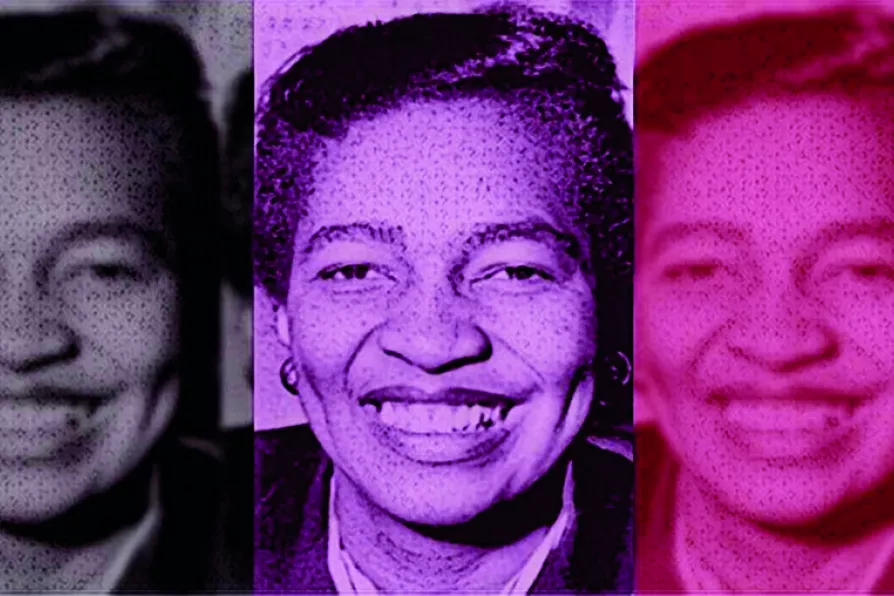
The pioneering activist understood that freedom could only be won through solidarity across communities. Her legacy offers vital lessons at a time when progressive politics risks losing that shared purpose
The Morning Star republishes PRAGNA PATEL’s speech at the annual commemoration of Claudia Jones on February 22 2026
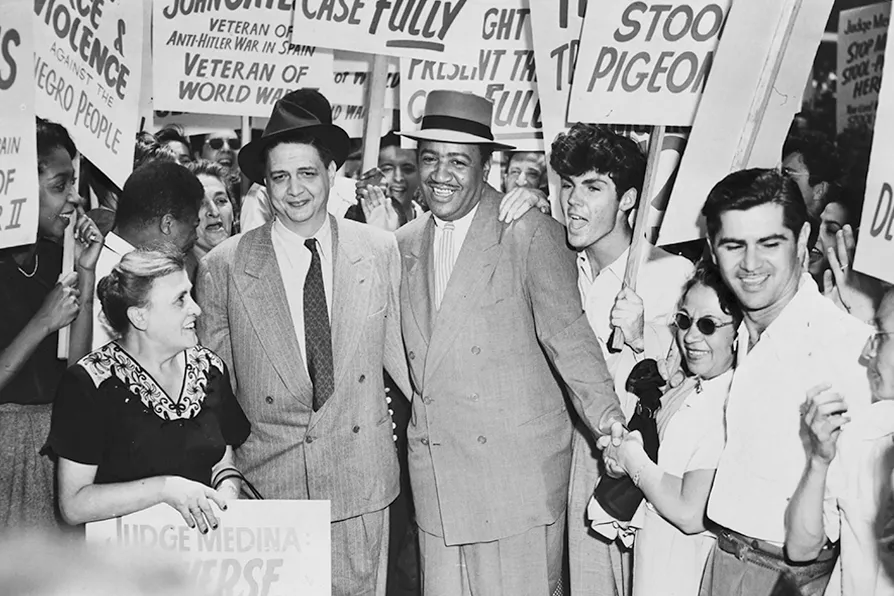
After Zohran Mamdani’s electoral win, BHABANI SHANKAR NAYAK points to the forgotten role of US communists in New York’s radical politics