
While riding the No 3 bus in Glasgow MATT KERR has ample time to dissect the moribund Scottish Labour decline into near oblivion and watch intriguing bus passenger dynamics


Keir Starmer’s small-stick diplomacy
In reopening relations with China, the PM showed an uncharacteristic grasp of power, proportion and Britain’s diminished place in the world – a lesson many in Westminster still refuse to learn, says ANDREW MURRAY
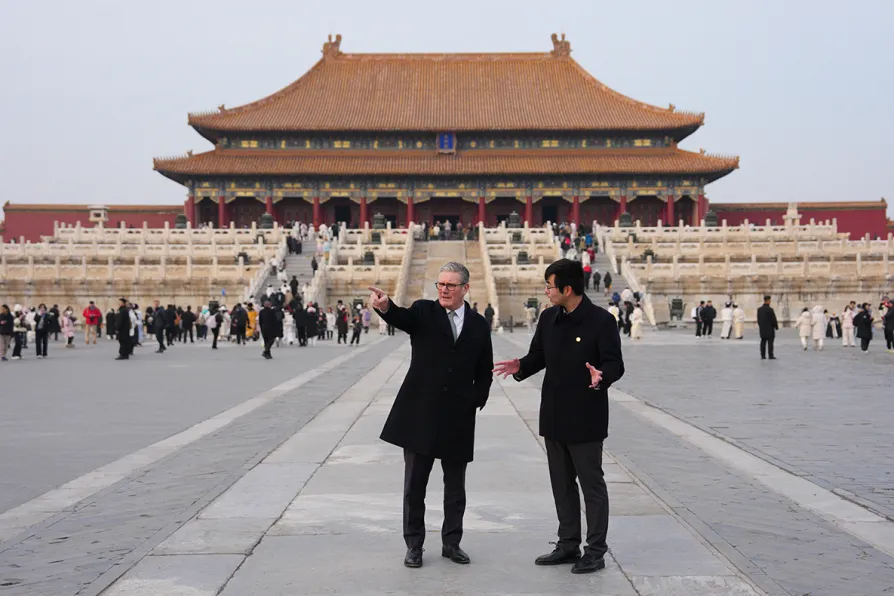
 Prime Minister Keir Starmer visits the Forbidden City in Beijing during his visit to China, January 29, 2026
The best wildfire service may begin with the community, argues KOMAL RAJ ARYAL
Dignity is important to all humans, argues the Marx Memorial Library and Workers’ School, but it does not come about automatically. In a less than perfect world, dignity can accompany suffering, but the collective dignity of working people is achieved through acting together to change the world.
The US aim to reshape the existing order in the Middle East needs to be resolutely resisted, argues PAYAM SOLHTALAB
Concessions to Washington by the post-Maduro leadership in Caracas are designed to preserve the core of the Bolivarian Revolution not betray it, argue Roger D Harris, Francisco Dominguez and Mara Paez Victor. How the solidarity movement responds is critical
ALMA EGAN suggests four days out that bring the region’s history of protest to life





ONE CHEER for Keir Starmer. The hapless Prime Minister has finally found a problem bequeathed by the Tories that he is addressing with some sense of purpose.
His visit to Beijing is the moment when the monkey at No 10, furiously pounding at the typewriter of governance for the last 19 months has finally produced, if not Shakespeare, at least a line or two of coherent prose.
Pragmatism may be entirely useless as a principle for leadership, but occasionally it can land you on the right decision when coupled with a sober recognition of realities. Rebuilding relations with the People’s Republic of China is surely one of those.
The last Conservative government switched from hot — David Cameron’s “golden age” — to arctic under Boris Johnson and Rishi Sunak, largely as a result of pressure from Washington to toe the new cold war line.
Sinophobia may not have plumbed the depths of (first) cold war anti-Sovietism, but it is not for want of trying by our political class. Any number of issues have been trialled in terms of whipping up sufficient hostility.
Daisy Cooper, deputy leader of the Liberal Democrats, offered a selection in the Commons last week, covering espionage, the case of Jimmy Lai in Hong Kong, the new Chinese embassy in London and the unevidenced campaign China is purportedly running “to hunt down pro-democracy protesters on the streets of Britain with bounties on their heads,” in one brief rant.
Brushed aside by David Lammy, standing in for his Beijing-bound boss, who told her that Labour aimed to use a “a consistent, long-term and strategic approach that is grounded in reality” in dealings with the PRC, Cooper responded by accusing the deputy premier of responding “as if the world has not changed.”
It has indeed, Daisy, but more than you realise. The days when countries around the world trembled at the raising of a Gladstonian eyebrow are dead and buried.
Hearing the exchanges, the thought rose unbidden that the opium wars against China infamously launched by British imperialism in the 19th century were the work of the Liberal Party.
It may be a stretch to compare Daisy Cooper to Lords Palmerston and Melbourne, but those architects of the opium outrages similarly claimed to be actuated by concerns for vital human rights, in that case the right of British drug-pedlars to trade freely whatever any other sovereign power felt about it.
That philosophy — that the rights of the market overwhelm all other considerations — lives on in the Liberal tradition and was carried into government by Nick Clegg in our own times.
Its most obvious consequences — if we disregard Clegg’s own elevation to Facebook’s global public relations supremo — were the evisceration of the public realm through austerity and the collapse of the Liberal Democrat position in the Commons. Only the last has since been reversed.
Such reflections are unlikely to stir Cooper’s political imagination, but it is worth observing that, while the Liberal Democrats currently score points for their intransigent opposition to Donald Trump, they still articulate the impulses of humanitarian imperialism even if they sometimes resile from the consequences.
Cooper is not alone in that camp. A bunch of foolish Labour MPs lobbied until the end to block the new Chinese embassy at the Royal Mint. They were worried about spying.
Doubtless the Chinese government does employ some spies. Do these ninnies really imagine MI6 has no station in Beijing or Shanghai?
In any case which state has more need to know what is going on in the other? China is not parking aircraft carriers off our coast, nor entering into an Aukus-like bloc to help encircle Britain and drag it into an escalating arms race. Nor even did it hold the Isle of Wight as a colony for a century.
And the considerable place it has secured in our markets was achieved without recourse to gunboats. Imagine!
Well might the Chinese government want to keep an eye on things here.
Then there is Kemi Badenoch, who portentously announced that she would not go to China if she were prime minister. However would the PRC manage?
Just one measure: over the last 10 years, since the British Establishment started to backpedal on positive relations with Beijing, China’s compound annual growth rate has been of the order of 7.5 per cent.
The British figure, since you ask, has been around 1.2 per cent. So who needs whom here?
Such sober calculation doubtless lies behind Starmer’s more constructive approach. He persisted with his visit even under the shadow of President Trump’s ire.
His White House buddy had just turned on Canadian Premier Mark Carney for a similar visit to China, with the inevitable threat of tariffs.
Of course, one step forward, one back. Doubtless to avoid upsetting Trump too much, the Prime Minister immediately indicated he was wholly fine with another lawless US aggression against Iran and — who knows? — may even join in.
Nor is the business-like turn exemplified by last week’s trip the whole of the story. As noted, Britain continues to indulge in various military provocations in the Far East directed at China, alongside the US, Japan and Australia, all in service of the imperial vanity project “global Britain.”
So we are several carats short of a new golden age.
But with transatlanticism crumbling by the day, and economic relations with the European Union compromised, the pillars of Palmerston’s policy — no eternal friends, just eternal interests, clearly need recalibrating to fit the fast-changing times.
“Those interests it is our duty to follow,” Cooper’s rather more illustrious predecessor concluded.
The interests in question are naturally those of the bourgeois Establishment, desperate for stable capitalist growth and profit, but there is in fact no major constituency in Britian which gains from confrontation with China, beyond the liberal-imperial humanitarian hypocrisy complex.
And when Starmer intones about international law and following the rules, it is pretty clear which of the two superpowers has gone rogue.
So Starmer discussed whisky, visas, migration and trade with the Chinese government. He also, in talks with Chinese President Xi Jinping, discussed football.
He handed over the ball used when his team, Arsenal, went down to a 3-2 home defeat to Manchester United the previous weekend, apparently signed by the players.
The chat subsequently ranged over United, Arsenal, Manchester City and … Crystal Palace. The first three teams are properly famous internationally, and Xi himself is believed to follow the red team in Manchester which, if he was raised on Engels’s Condition of the Working-Class in England, makes a lot of sense.
But Palace? That apparently left Starmer “flummoxed” and a lot of heads have been scratched since. This column can at least suggest an answer.
Perhaps Xi sent an urgent message to one of his espionage specialists in London to find out which Premier League club was on the worst run of form right now — alternatively, sorry Daisy Cooper, he may have just looked online.
The answer is indeed Crystal Palace, four defeats and two draws in the last six games, two points out of 18.
As a metaphor for British capitalism’s position in the world, it is perfect. Continual shuffling of managers but no improvement in results. On the threshold of relegation. Mutinous fans. Star players heading for the exits.
Who knows what Xi was aiming at? But we can at least be sure that the meeting in Beijing was between the representatives of a growing power — possibly the most rapidly growing in human history — and those of a shrivelling one.
At least Starmer seems aware that he is carrying a small stick and is therefore wisely refraining from speaking too loudly.
