Sovereignty and the rule of law are under threat from Trump’s attacks on Lula’s administration just as they have been across Latin America, argue CARLOS MARTINEZ and SARA VIVACQUA


 Latest editorial

The life and deeds of the father of Canada’s NHS
One of Canada’s most revered politicians is a native of Falkirk but is relatively unknown in his original homeland. KENNY MacASKILL tells his story
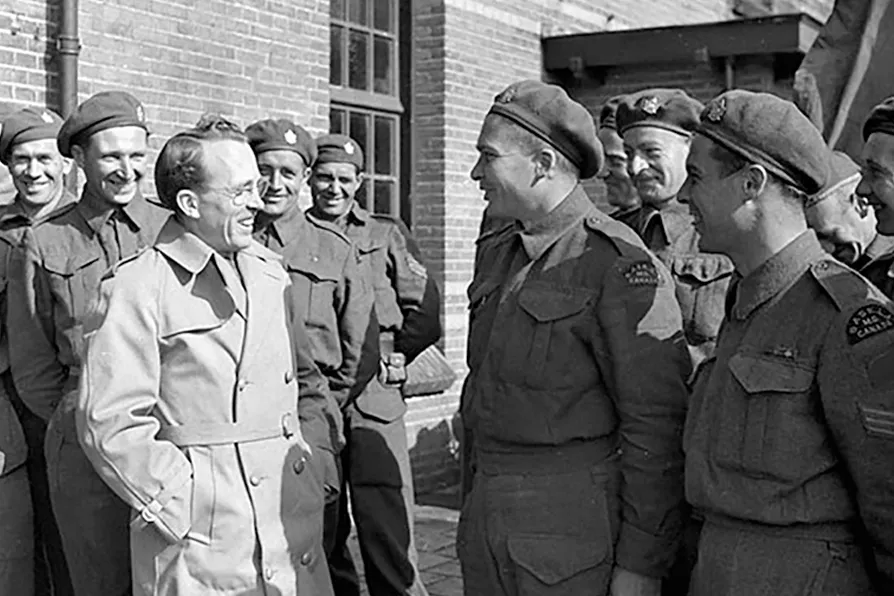 COMMON TOUCH: Tommy Douglas, Premier of Saskatchewan, meets members of the Saskatoon Light Infantry at Barneveld, Netherlands, in April 1945 / Pic: G. Barry Gilroy/CC
Glasgow will remember the martyrs of the 1787 strike this weekend in speech and song, their spirit is sorely needed today, writes JIM LISTER
ALEX BROWN explains how medieval Europe was plunged into sunless years, with widespread crop failures and devastating famines
Police crackdowns on Israeli peace demonstrators combined with court rulings and settler organisations are designed to strip Palestinian families of their homes and land. The Israeli state has tried to silence both Israelis and Palestinians who resist, according to Zo HaDerekh (This Is The Way) the Communist Party of Israel’s Hebrew-language weekly
Remembering a legendary trade unionist and inspirational leader
Communists in Australia, Britain and the US outlined a joint state agreement against their governments’ militarist provocations.





WHAT defines Canada or makes it distinct from its neighbour south of the 49th parallel? After all, in this country a Canadian and US accent can sound indistinguishable and the landscape either side of the border is similar.
For many Canadians as well as a pride in who they are with their distinct culture and politics, it’s the healthcare system.
As a National Health Service is absent in the US, and the Medicaid scheme and even limited assistance is worsening under Trump, Canada is proud of its Medicare scheme.
Many Canadians seeing that as the clear distinction between them and their southern neighbours, rightly contrasting it with the US where tens of millions go without, and many are bankrupted by costs.
The architect of the Canadian scheme which operates to this day was an emigrant Scot who’s sadly little known in his native land, although his grandson is known to all.
Tommy Douglas, though, is rightly revered in his adopted land where he is Canada’s equivalent to Nye Bevan with the Welshman’s establishment of the NHS in Britain.
Indeed, some 20 years ago the Canada Broadcasting Corporation (CBC) commissioned a TV series “The Greatest Canadian”. Shown over 13 episodes advocates put the case for their nominee.
Among the cast of Canadian titans proposed were politicians such as Lester Pearson, Pierre Elliot Trudeau and John A Macdonald, although the legacy of the latter and also a Scots emigre has rightly been reviewed recently his actions having been so cruel and damaging to First Nation peoples.
A poll was held at the programme’s conclusion, and the clear winner was Tommy Douglas. Of course, online polls have to be taken with a large pinch of salt but over 1.2 million voted and what’s clear is that Douglas is a major figure in the creation of modern Canada.
Thomas Clement Douglas was born in Camelon, now part of Falkirk, in 1904, one of three children. His father was an iron moulder, who was a socialist and Burns aficionado and his mother was the daughter of a Baptist preacher.
When he was six years old the family emigrated to Canada settling in Winnipeg, Manitoba. However, the outbreak of World War I saw them head back to Scotland where he attended school in Glasgow, but the family returned across the Atlantic when the war ended.
His political views were no doubt bequeathed by his parents and are perhaps best described as Christian Socialist, though as Jimmy Reid would later say Scottish socialism owed more to the gospel than Marx and Lenin.
Indeed, the famed Red Clydesiders had two Ministers elected as MPs, in Rev James Barr and Rev Campbell Stephen, and many others were active in either the Church or Chapel.
However, it was to be events in Canada which were to forge Douglas’s early political views into the philosophy and actions he would promote.
First, the postwar period was a troubled time for lands both sides of the Atlantic. In Britain there was turmoil with unemployment looming as soldiers were demobbed. A campaign in Clydeside for shorter hours saw a strike, armed soldiers on the street and even tanks despatched to the Glasgow Douglas had just left.
Winnipeg also had a general strike as increasing poverty and growing unemployment saw desperate workers seek to defend themselves and their families. And just as there was riot, disorder and police brutality in Scotland, so there was in Manitoba with Douglas witnessing Canadian police shooting and killing a striker along with baton charging others. That instilled a lifelong commitment to a fairer and more just society.
Another event was to be as, if not more, important to forging his political views. As a young child in Scotland, he suffered a knee injury which led to a rare bone infection, and which would continue to trouble him as the family moved across the Atlantic. At one stage in Winnipeg, it was feared that he may have to have his leg amputated.
Fortunately for the family a well-known orthopaedic surgeon offered to carry out surgery for free if his students could watch. The family readily agreed, Douglas’s leg was saved but he was also left with a lifetime commitment to healthcare for all irrespective of income.
After serving his apprenticeship as a printer, he returned to education studying theology and becoming a Baptist minister. At McMaster University he became a champion debater which would help him in the pulpit and then in politics. But also assisting in hobo camps which existed as the Great Depression struck.
On graduating he became a Baptist Minister for a small community in Saskatchewan but also joined the Co-operative Commonwealth Federation (CCF) party and in 1935 was elected to the Canadian Federal Parliament. Becoming leader of the Party in Saskatchewan, he resigned his seat and led the CCF to power in the province in 1944.
This was the first democratic socialist government elected in North America, not just Canada, and he set to with a radical agenda. A Bill of Rights, support for unionisation and most importantly the precursor of what would become Canada’s universal healthcare system.
The emigrant Scot faced opposition from doctors similarly as Bevin would in Britain. But re-elected five times he remained in office until 1961. Resigning from his provincial office his political career though was far from over.
The CCF amalgamated with Canadian organised Labor to form the New Democratic Party that same year with Douglas becoming its leader. Elected once again to the Federal Parliament in 1962, he remained leader until 1971 and sat as an MP until 1979.
Douglas died in 1986, it’s said still with a Stirlingshire accent but having left a legacy Canada blesses.
Many in this country won’t have heard of him. But his daughter Shirley married the Canadian actor, Donald Sutherland, and their son will be, as he’s Keiffer Sutherland — and the Hollywood star’s the great Tommy Douglas’s grandson.
