The question is not simply how much we spend on defence, but what we understand defence and security to mean, says SIMON BRIGNELL



Megapicket: the third dimension is union power
HENRY FOWLER and ROB POOLE explain the significance of today’s Megapicket
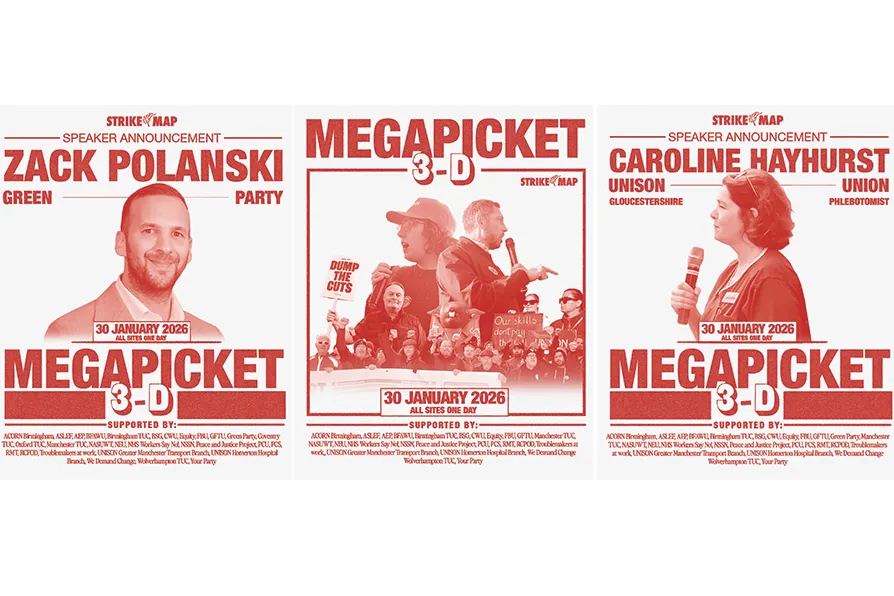
 Posters: Strike Map

Given the recent rejection of peace proposals by Israel the world must provide an immediate and resolute response to force accountability on Gaza, argues RAMZY BAROUD
MARK SEDDON tries to cool off in the countryside to avoid the heatwaves but the greed and incompetence of the privatised water industry is now at boiling point
The disputed election of a far-right president, who is also a US citizen, signals further consolidation of Washington’s regional power and represents a threat to the country’s democracy and sovereignty, writes WT WHITNEY JNR
by Her Excellency Ismara Mercedes Vargas Walter, Ambassador of the Republic of Cuba to the United Kingdom
DR STEPHEN WILKINSON assesses the life and legacy of a revolutionary giant





MASS picketing and the rise of the “Megapicket” have been defining features of 2025 for Strike Map and the wider labour movement.
After years of anti-union laws restricting secondary picketing and solidarity action — and the resulting erosion of union-to-union solidarity — bringing our movement together around key disputes has been central to Strike Map’s work.
Rebuilding that collective strength has never been more urgent.
This focus is not new. Through our Strike Clubs, we have helped build local organisations capable of hosting large-scale fundraising gigs and events, generating serious resources for workers on strike.
Beyond these events, our Join a Union Beer collaboration with Brighton craft brewery BRZN brought together activists and trade unionists to support key disputes, including the Unison Barnet mental health workers.
These moments of shared action matter: they turn abstract solidarity into something tangible.
Last year, we placed renewed emphasis on supporting major disputes across the movement.
Birmingham has become a focal point for this support. Two Megapickets, on May 9 and July 25, escalated action and successfully shut sites when Unite’s injunction prevented workers from doing so themselves.
Bringing together growing numbers of unions to sponsor these mass pickets, speak at them, and promote the dispute within their own structures has been critical to rebuilding a culture of solidarity.
The Fire Brigades Union (FBU) has set a powerful example for the movement — inviting strikers from across the country to speak about their disputes and raising thousands of pounds to keep workers on the picket line.
This work has not been limited to Birmingham. Through our support for national affiliate Aslef in Hull, we demonstrated the power of cross-union unity.
Our letter to Hull Trains management, delivered on the day of the demonstration at Hull station, was signed by 30 national trade unions. It sent a clear message to bad employers: you are not just taking on a union — you are taking on a movement.
Since launching in 2020, Strike Map’s core aims have been to document action, build solidarity, and show workers the everyday struggles taking place across the country.
Taking these aims from the digital space into the physical world has been one of the most rewarding aspects of our work.
We continue to support the striking Gloucestershire phlebotomists — helping build their rally last year, launching an NHS workers’ statement of support, running a pin badge fundraiser, and promoting their dispute across the health sector and the wider movement.
Their strike is now the longest action by directly employed NHS staff in history.
These long, difficult disputes are the direct product of anti-union laws: restrictive ballot thresholds, mandates expiring after six months, and a legal framework that consistently tilts power toward employers.
While the current government has pledged to change some of these laws — creating better conditions for organising and growth — we know that our ambitions cannot be confined to changes in employment legislation alone.
Power is built through collective action and the willingness of workers and their supporters to act directly.
As Arthur Scargill famously said: “What you need is not marches, demonstrations, rallies or wide associations — all of them are important. What you need is direct action. The sooner people understand that, the sooner we’ll begin to change things.”
That means going beyond Megapickets and publicly organised events. It means embracing the kind of direct action we have seen developing in Birmingham over recent weeks, led by activists supporting striking workers and causing daily disruption at key sites.
Strike Map is growing, and we are beginning to clearly define our role in supporting both official and unofficial union action — building power and showing workers that being active in a union matters. This has recently been recognised by Unite the Union and the Public and Commercial Services Union (PCS), who have become our latest national affiliates. We aim to build on this in the coming year, encouraging national unions, local branches, and trades councils to deepen their support.
We hope today’s Megapicket will be the biggest yet, and certainly the broadest—bringing together national trade unions, political parties, and, for the first time, politicians from Your Party, the Green Party, and the Labour Party.
This unity highlights the growing isolation of Birmingham Labour Council and its commissioners, and underlines the need for the Prime Minister to intervene and resolve this dispute.
We hope people take the lessons from today back to their own local struggles — particularly the escalation of direct action as a key tactic for winning disputes.
We must disrupt production. We must build effective picket lines. We must hit profits.
Our movement will not be rebuilt through recruitment leaflets or giveaway trolley coins. It will be rebuilt through industrial power.
Every worker, union, union leader, and political leader who takes part today stands on the right side of history — something workers will not forget.
Today, we are clear: the third dimension is union power.
Henry Fowler and Rob Poole are co-founders of Strike Map.
