ROB WARZYNIAK wades knee deep through a pile of ‘dead canaries’ of Trumpist policies which exacerbated the horrors of US capitalism domestically


 Latest editorial

Politicians fiddle while the country burns
It is time to stop tolerating the governing elites incompetence which makes our lives a daily misery, argues MATT KERR
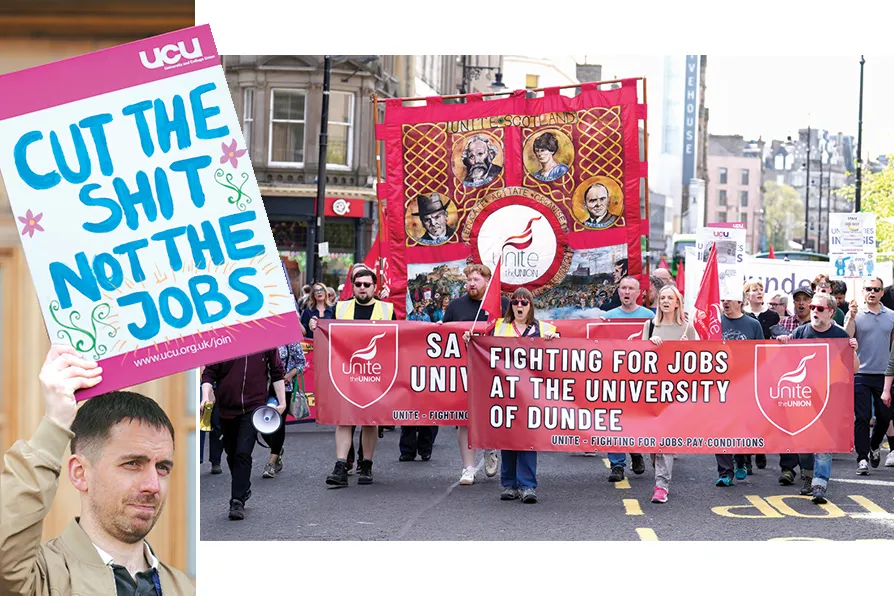 DIY POLITICS: Trade unionists, community activists, students and staff from the University of Dundee protest at job cuts to £35 million deficit, April 2025

Without evidence or Nato consultations Berlin’s answer to the Leipzig incident is a rupture of relations. SEVIM DAGDELEN examines why
FRANCISCO DOMINGUEZ introduces the background to a conference on defending Latin America’s sovereignty
The glacier collapse in Nepal is yet another warning that a warming planet is making Himalayan disasters more frequent and destructive – but the countries facing the greatest risks are often those least responsible, says LI YANG
Nick Blair is set to benefit from a hugely lucrative contract to ‘virtually’ train the British army for its next war. Like father, like son, writes SOLOMON HUGHES
Even when tragedy strikes, Western media cannot resist the opportunity to turn it into a sordid propaganda opportunity, as the Nepal-China border tragedy shows, writes CARLOS MARTINEZ
Trade unions should be at the heart of the anti-racist push for reparations for the historic legacy and continuing impact of slavery, writes ROGER McKENZIE





THE First Minister told us earlier in the week he was “deeply concerned” over not being informed about a tanker sitting in the Moray Firth.
In fairness to him, it was not just any tanker, but a Russian-flagged one seized by the US coastguard.
Personally, I’d be more “concerned” about the US coastguard operating with impunity in UK waters, or a Scottish government-owned airport being used to support the whole exercise.
Then again, I have the luxury of being able to point to what Nato actually is, as opposed to the UK and Scottish governments whose blind commitment to it mean they cannot bring themselves to admit it gives the US first-strike nuclear alliance free rein over our territory.
My concerns this week have however been a little more parochial.
I can’t wander the streets the way I once could, it’s a constant battle to stay upright, stumbling and tripping my way to the shops.
I can’t blame the potholes or the marvelous efficiency of the market that gifts us three telecoms companies digging separate trenches in our pavements to lay three cables where one would do; nor even the proliferation of delivery vans that litter the streets and pavements.
No, it’s the thousands of council workers wandering our towns and cities with nothing to do, like a hi-viz army looking for someone to surrender to, dazzling passing civilians who desperately make their way through the aimless throng of inactivity to go off and be productive somewhere to pay for all those gold-plated pensions.
If only.
Depending on how you wish to tally it, between 22,000 and 45,000 jobs have vanished from Scottish local government alone over the last couple of decades, a pattern much the same as elsewhere on these islands. The best boast anyone can come up with in these circumstances appears to be that it has been done without compulsory redundancies — whoopee!
The jobs may have vanished, but the work hasn’t.
It’s an old story. When the Tories sought to privatise British Rail, they didn’t do so after funding it properly for years, they cut it, they mocked it, they souped-up stories about leaves and the wrong kind of snow delaying services as a signal of public-sector profligacy. They allowed it to die on the vine then sold it for buttons to those whose highest ambition was to produce champagne for the few rather than transport for the many.
And so it is with local services. Class sizes rising, teacher jobs cut? That’s the councils. Pot holes? That’s the councils. Libraries closing? That’s those bad free-spending councils again.
What little progress being made in these services has little to do with any efficiency drives, but the hard graft and creativity of a dwindling workforce that not only have to contend with ever-changing roles but public anger.
A decade-long, unfunded — whatever the claims — council tax freeze enforced with menaces cost services billions in Scotland, and the providers of those services are now supposed to look to Holyrood with gratitude for being allowed to increase the levy on a populace that can now see no discernible improvement in exchange.
It’s been wildly successful in getting ministers at Holyrood and Westminster off the hook for eons, held back only by the odd rates rebellion. This is why — rather than engage with reality or trouble themselves with the kind of pressures they happily heap on public-sector workers — they do it.
This mindless approach isn’t only letting down workers and services, but it’s also killing-off what little faith remains in what they — in increasingly evangelical tones — like to call democracy.
There are, without doubt, glimmers in the draft Scottish budget. The increase in the Scottish child payment may not be everything anti-poverty campaigners demanded, but it acknowledges the problem and deserves credit.
Likewise, the 10 per cent increase in funding for colleges is also to be welcomed. It may allow those 11 campuses facing bankruptcy after a five year 20 per cent cut to stagger onward. Staggering is after all marginally better than falling over altogether.
Still, the damage in colleges is done. Their transformation from centres of working-class confidence, into corporations continues, and the principals will still coin it in as they try to make workers redundant.
What has become abundantly clear in recent years is that only workers and students themselves have the wit to challenge this, because it’s certainly not forthcoming from ministers whose idea of taking responsibility is to point at shiny new college buildings as they are driven past the picket lines.
Buildings founded on crippling debt, built on redundancies, built on chasing cash from the foreign students who aren’t turning up any more.
That’s a model the universities swallowed hook, link, and sinker across Britain in recent decades. Along with swingeing cuts to colleges, it helped fund free tuition in Scotland, but now the music has well and truly stopped.
Nowhere is that more obvious than at Dundee University, which demonstrated a remarkable flair for incompetence and silencing anyone who noticed.
They’ll see up to £20 million out of this week’s Scottish budget to help their new management keep it afloat. I wish them all the best in their efforts. We can only hope that they can turn the crisis around and show a new path.
Nonetheless, it’s fascinating to compare that sum going to a single university with the £70m extra going to Scotland’s entire college sector — a different class indeed.
Those on lower incomes will benefit from the bottom two income tax thresholds rising, and those on higher incomes will pay a bit more. Sounds fair enough. Net, it raises an extra £72m in the coming year.
It doesn’t take a degree in maths to work out the issue though.
Despite claims that councils will see more funding, the Scottish Fiscal Commission reckon councils will lose £472m by 2028/29. The mansion tax — in reality a slight tinkering with council tax — won’t even touch the sides and in a city like Glasgow will raise next to nothing.
Not to worry, they have thought of that. An army of public-sector workers are on the job.
Well off it, actually.
Over the next five years the plan is to cut £1.5 billion from spending and with it 11,000 jobs. This is not conjecture, this is not guesswork, this is a stated Scottish government target that somehow manages to leave Rachel Reeves’s appalling 10,000 target for the UK Civil Service in the shade.
It would be easy to round on the SNP and Greens who will back this budget, but the truth is that they can only take an axe to 11,000 livelihoods and cause further immeasurable damage to our society because, beyond a few plucky individuals, there is no parliamentary opposition worth a damn.
Tories will be Tories, and Liberals will be Liberals, but Labour’s conscious choice to play along with the waste story rather than setting out how to raise more cash and rebuild our society only serves to draw a veil over the whole sorry mess.
That members of this cross-party clown show all then scratch their heads at their little summits and wonder why a coalition of Thatcherite ultras who would happily torch what is left of our public realm stand at the gates is the real mystery here.
Thatcher claimed New Labour as her greatest achievement. A generation on, you can barely move around the corridors of power without tripping over the kind of time-served centrist automatons whose greatest legacy will be to pass the torch to a bunch of merchant bankers in Reform.
They should own it while they still can, but so should we.
Seized tankers or merchant bankers, this farce will continue as long as the workers of this Earth tolerate it.

Similar stories


Years of underfunding are eroding Scotland’s local services and deepening inequality in communities, says VINCE MILLS

As Scotland heads to the polls, the main parties offer variations on the same script, says MATT KERR

Cuts are sweeping campuses as cash-strapped universities slash staff and politicians fail to act on a growing funding emergency. VINCE MILLS reports