
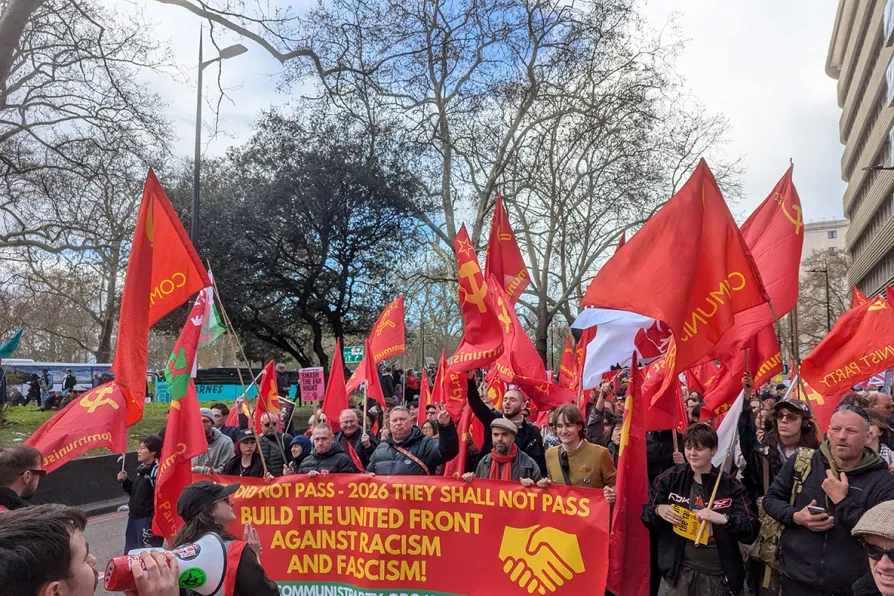
Working people across Britain are fighting back against austerity, war, repression and exploitation. The challenge now is to unite those struggles, says Communist Party of Britain assistant general secretary JOHNNIE HUNTER

Can Germany's left beat the ever-repressive powers coming from the right?
NICK WRIGHT returns to Berlin and finds a city in darkness and political turmoil
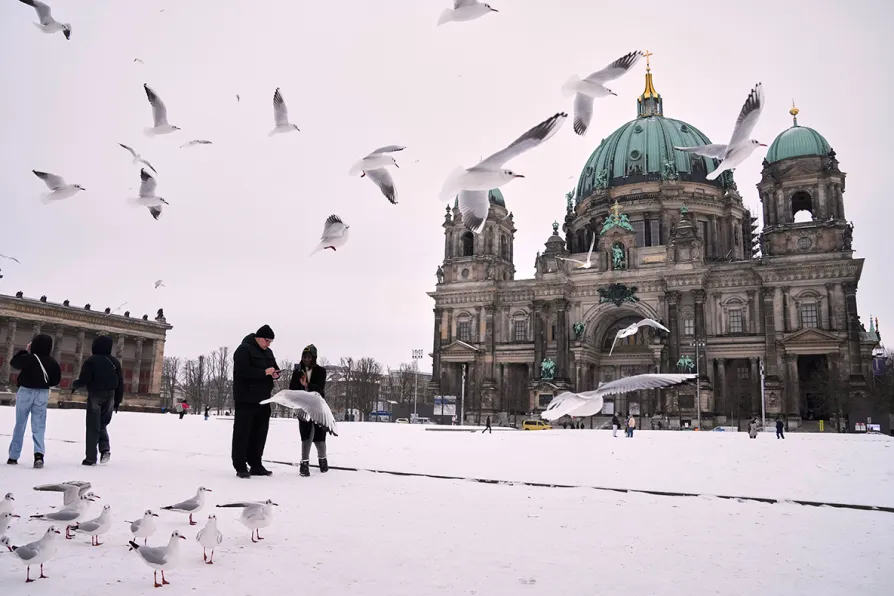
 Berlin Cathedral is covered by snow in Berlin, Germany, January 9, 2026
Train drivers’ union Aslef general secretary DAVE CALFE speaks to Ben Chacko about his hopes that Burnham’s devolution agenda will include the importance of the railway
DIANE ABBOTT provides an analysis of the reasons for EU and British voters’ dramatic swing to the right
Some of the review’s proposals could make the benefits system less cruel and dehumanising. But its vague plans for services and non-cash support revive the threat that disabled people will lose control over the money we need to survive, writes DYLAN MURPHY
Believe it or not, there was a time when the US government built beautiful homes for working‑class Americans to deal with a housing shortage, writes ERAN BEN-JOSEPH
MAT COWARD has heaps of good advice on recycling garden and household waste over the winter





FINDING myself last weekend back in Berlin after several years’ absence I found many changes but some constants.
A power outage which cast some of Berlin’s southern districts in to darkness for days brought forth some very old themes in Berlin politics.
A fire damaged the cables running over the Teltow Canal that connects parts of the city to Berlin’s Lichterfelde gas-fired power station. In Berlin a winter time power outage is no laughing matter.
A week later temperatures on the day of the annual Luxemburg Liebknecht march was still 7° below zero. Power had been restored but the political arguments still raged with Berlin’s CDU mayor under attack from the even more right-wing AfD.
The media reported that the ostensibly far-left Vulkangruppe had claimed responsibility for the attack and claimed that this “exemplary” act highlighted the dangerous role that fossil fuels play in driving the climate crisis.
Responsibility for a series of infrastructure attacks have been attributed to Vulkangruppe.
The rhetoric associated with this tendency turns on the seductive idea that we can no longer afford the consumption models of the rich.
Accordingly Tesla has been targeted as the exemplar for capitalist corporations that practice super exploitation, destroy both the environment and jobs and through their dependence on extractive industries in the global South intensify colonial and neocolonial relations of production.
These are compelling arguments and when, two years ago Vulkangruppe described Elon Musk as a “techno-fascist” its rhetoric struck a nerve and established a meme the accuracy of which is daily confirmed by the man himself.
Nevertheless, I am sure there is more to this than appears on the surface. Both before and after the counter revolution I was often in Berlin, East and West, and remain highly skeptical about the performative ultra leftism that is a permanent feature of the city’s political culture and which provides the forces of law and order with a constant narrative.
In the years before the re-establishment of capitalism throughout Germany, West Berlin was a hot bed both of leftist groups and contending intelligence outfits with its economy driven by the imperative to showcase capitalist consumerism. Paradoxically it also became a place where migrants found a place in the marginal economies that depend on low pay and long hours. This combined with large student population made for a politics that stood in sharp contrast to the relative tranquility of life in the socialist sector of the city.
Today the two sectors of the city are integrated with a political system in which Berlin has a status as both the capital of federal Germany and as a city state itself. The present mayor, Kai Wagner, is a CDU politician and is criticised by the further right populist AfD with a current line of attack that picks apart his clearly mendacious account of his activity in dealing with the power outage.
But Berlin is where the left, Die Linke, is a powerful force able to win seats in the Bundestag not only on the proportional list system but directly with simple majorities in several constituencies.
At the turn of the century the social democratic party (SPD) was forced to enter a coalition with the left and were thus able to hold on to the mayoralty until 2023. In the interim the city was ruled by both joint CDU/SPD coalitions and after the 2016 the so-called RED/Red/Green coalition of the SPD, Die Linke and the Greens.
Presently the Berlin government is a local version of the national Grand Coalition comprising the CDU with 52 seats, the SPD with 34 seats with the Greens (34 seats), The Left (21 seats), the AfD (17 seats) and BSW with just one.
Eco-activism has a strong presence in German politics and in its earlier stages was most closely associated with the rise of Die Grune as an electoral force.
These Greens have morphed from a generally progressive voice for the protection of the environment and, in its earlier years, a force for peace into almost its polar opposite with the last administration’s Green foreign minister Annalena Baerbock among the loudest voices for a more muscular projection of Germany’s military and a Nato presence on Russia’s borders.
No longer in government since the last federal election it has lost ground, especially among young people and sections of the university-educated middle class with many of its voters switching to Die Linke, the biggest left-wing force in German electoral politics. Part of this is a reaction to its collapse into the cold war politics of confrontation with Russia and partly because of its retreat from environmentalism and its enthusiastic embrace of an energy strategy that depends on fossil fuels including the importation of expensive and environmentally damaging fracked gas from the US in place of the cheaper Russian supplies on which the German manufacturing economy depended.
Into this situation it was inevitable that a direct-action-orientated eco-activism would emerge. Where I remain sceptical about the form it takes arises because the Bundesverfassungsschutz, the Federal Office for the Protection of the Constitution, claims not to know how the group is organised.
This pervasive secret police outfit is all over the German left like a rash, publishes regional assessments of “left and right-wing extremism” and maintains a high level of surveillance while even more shadowy outfits run interference on any challenge to a “constitutional order” built on the sanctity of private ownership and capitalist relations of production.
Conveniently now there is an intense media speculation that the group is sponsored by the Russian state.
Vulkangruppe rejected this, saying: “These speculations are nothing more than attempts to conceal one’s own weakness. Those who insist that every act of sabotage must be linked to a foreign intelligence service deny the reality of internal social conflicts.”
And Berlin’s deputy police chief Marco Langner also said there were no indications pointing to Russian involvement.
In a political situation where the German economy is being mortgaged to finance a steep rise in military spending, where young people are being registered for military service and where the government threatens conscription if not enough volunteers sign up to the Bundeswehr any state-sponsored narrative that supports these aims must be suspect.
The question is, from where is opposition to this drive to war coming from?
Two years ago Die Linke was in crisis. Its opinion poll rating had fallen below the 5 per cent level to enter the Bundestag and the breakaway Buendnis Sahra Wagenknecht (BSW) was clocking up nearly one in 10 levels of support, winning office in some eastern German lander (states).
BSW’s rise was based on its sharp opposition to the war drive which it combined with a sceptical take of the economic policy of the German state to welcome the flow of mostly higher skilled migrants from the Middle East. In an official German political culture suffused with support for Israel — official Germany presents the defence of Israel as a Staatsraeson or Reason of State — BSW stands out not only in opposition to official policy but also to a Die Linke leadership which ostentatiously does not commit to solidarity with the Palestinian cause.
BSW made some very substantial advances, especially in the lander of the formerly socialist East but has lost momentum, in recent days losing its leading position in Berlin’s neighbouring Brandenberg state when two members resigned the party. In the last election it missed returning to the parliament by polling just 4.9 per cent while Die Linke surged ahead winning a big section of the Green and youth vote while conceding ground in its former, and more working class, eastern strongholds.
While it is true that in this election Die Linke enjoyed a new relationship with the media — which, when it was not condemning it as an emanation of the East German socialist order had hitherto muted references to its existence and policies. The main factor in the restructuring of its electoral base was a well-organised turn to a community politics that focused on the practical concerns of working people, on wages, prices and public services.
At the beginning of December, the Berlin House of Representatives passed an amendment to its General Security and Public Order Act — a roughly 750-page document intended to address “current legal situations and modern technologies,” or so the Social Democratic-led Senate Department for the Interior claims.
The German Communist Party says that this means that comprehensive infringements on fundamental rights such as personal rights and the protection of the home will be possible in the future. These infringements go so far that even Berlin’s Data Protection Commissioner, Meike Kamp, sees them as a fundamental “shift in powers toward surveillance,” as she told the Berliner Morgenpost.
Much like Starmer’s Britain where our rulers anticipate resistance to their policies, their response is to strengthen the repressive laws they have at their disposal and give extra powers to the coercive apparatus of the state.

Similar stories
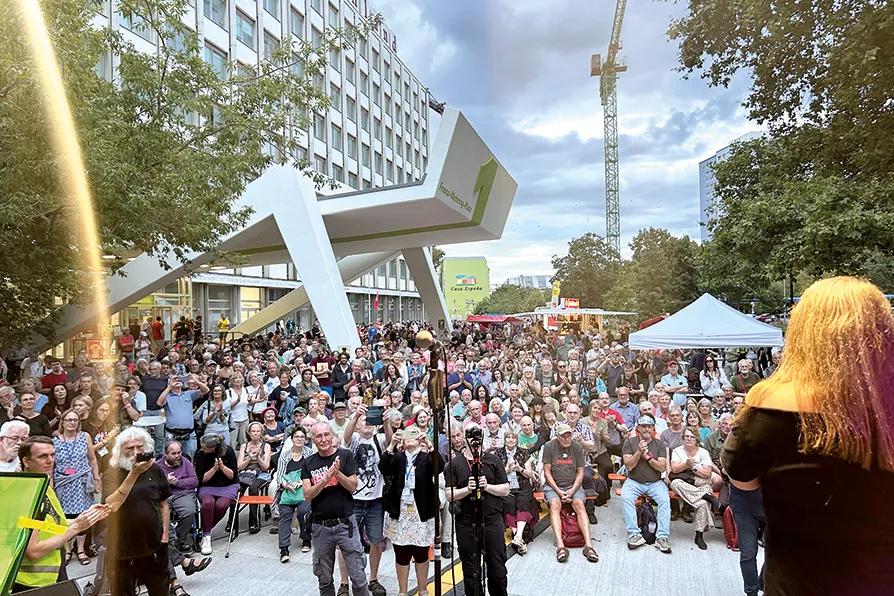
JOHNNIE HUNTER reports from the German Communist Party’s (DKP) weekly Unsere Zeit (Our Newspaper)-organised Peace Days festival in Berlin last weekend