Cuban trade union federation CTC leader OSNAY MIGUEL COLINA speaks to Ben Chacko about life and work under a crippling US siege


 Latest editorial
How should the left respond to a Labour leadership contest?
With speculation growing about a Labour leadership contest in 2026, only a decisive break with the current direction – on the economy, foreign policy and migrants – can avert disaster and offer a credible alternative, writes DIANE ABBOTT
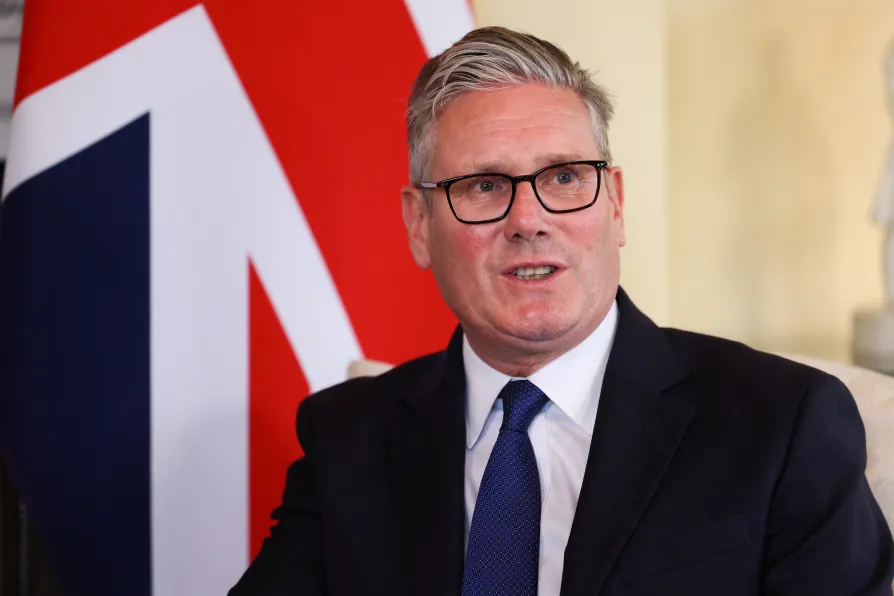 APING REFORM: Sir Keir could be facing a leadership challenge

A part of the British empire’s network of slavery, today the Caribbean island of Nevis faces a new form of exploitation in the form of crypto-colonialism, CLAUDIA WEBBE writes
A new book by Victoria Holmes illuminates the many hidden histories of the oppression experienced by Gypsy/Roma/Traveller community, writes ROGER McKENZIE
Even the oligarchs of the artificial intelligence industries are warning that their creations have the capacity for the ultimate destruction of the planet and its population. ANDREW MURRAY suggests that there might just be other solutions
The Labour government must deliver on its commitment to bring back privatised services into the public sector. This not only saves money but also creates accountability and generates wider social benefits, argues ANDY MCDONALD MP
Public ownership of Great British Railways has enormous potential to improve our railway network, but that can’t happen unless jobs, employee rights and union recognition is at the heart of the transition, argues MARYAM ESLAMDOUST
Challenges from the unscrupulous misuse of AI to steal actors’ voice and physical likenesses is being met with a firm union response, writes LYNDA ROOKE





THERE is a possibility that there will be a contest for the leadership of the Labour Party in 2026. Keir Starmer acknowledged that possibility when he recently told MPs that speculation about his position was “rife.” This poses the question of how the left should respond if there is a contest.
The answer must be based on an accurate assessment of the period we are in, the balance of forces between left, centre and right, and above all, on what we are trying to achieve.
A recent report in one of the many newspapers who have little knowledge or insight about the workings of the Labour Party suggested a deal was possible where the left would back one of the frontrunners in return for a job in the Cabinet.
I do not believe it for a second. Back-room deals like that always blow up, and most Labour MPs are smart enough to know that.
Instead, we have to begin with objective situation, which is best described as grim. The economy is weak and may be slowing.
Unemployment is rising and is particularly hitting young people. It should be noted that this is disproportionately affecting black people. The House of Commons Library has recently produced a report detailing the effects of jobs discrimination. It shows that, while the headline rate of unemployment for all workers is now 5.1 per cent, for white people it is 4.3 per cent and for black people it is 8.8 per cent, more than double.
The first two Budgets from this Labour government have both sharply increased austerity. The stealth tax of freezing income tax thresholds means tens of millions of workers have seen a real tax rise. Key government departments such as health and education have been starved of funds. In part this is to fund a large increase in military spending. At the same time, productive public investment has been slashed to fund this war drive.
Having repeatedly promised growth and investment, the government has overseen cuts to both. Official growth forecasts have been slashed over the medium term.
This dire economic situation is matched politically and socially. Reform UK has led in every opinion poll since the beginning of May 2025, and by a widening margin. At the time of the general election in 2024, Labour held a 10-point lead over the Tories and a 20-point lead over Reform UK. The puerile assertion from No 10 that the next election would be Labour versus Reform (and that therefore we would win) was severely undermined by the Caerphilly by-election. It now seems outlandish in light of recent polls where Labour is being beaten into third place behind that Tories and even, in a couple of polls into fourth behind the Greens.
Polls also show that most people in this country regard Reform UK as a racist party, with racist policies and supported by racist voters.
Yet the government (and the Tories) have responded by reinforcing Reform’s key political lines, blaming all the ills of society on asylum-seekers and migrants. Inevitably, this strengthens Reform and undermines Labour. The majority of the population thinks that racism is a bad thing, and are not attracted to it when branded with a red rosette.
Critics say that these policies are leading the country and the Labour Party to disaster. The response of the current leadership is to move “further and faster” in the same direction. There is no mystery surrounding Labour’s unprecedented crisis.
It is these interlocking calamities that the left must address, as it is clear the current leadership will not. Our approach must be informed not only by our political principles, but by the certain knowledge that current policies are massively unpopular.
Some tacticians, even on the left, suggest that compromise is necessary, given the strength of the Labour right and some of their supporters in the centre of the Parliamentary Labour Party. Yet driving off the cliff in second gear rather than fifth means only that the wreckage may be less scattered, but it will still be a wreckage.
Our argument should be for a 180-degree change of direction. Where there is austerity, we will argue for growth, investment and prosperity. Scrap the increase in military spending demanded by Donald Trump, remove the huge tax breaks for banks and energy companies, and introduce a wealth tax. All these could be used to fund decent public services and to fund an investment-led recovery powered by the public sector.
We oppose Trump’s wars, and Israel’s. We do not support blockades or attacks on Venezuela, Cuba or any other Latin American countries. They are no-one’s backyard. All supplies of arms, personnel and intelligence to Israel must stop. Interference in Africa must stop and the aim should be to support peace proposals in Ukraine, not endless war.
The permanent campaign against migrants and asylum-seekers has led both to a sharp rise in the politicisation of immigration and a rise in racist attacks, as it was designed to do. Instead of racism and discrimination, there should be unity and equality. There is no justification for Labour whipping up racism, and no benefit either. A strategy for tackling violence against women and girls needs proper funding.
These headline policies are the basic minimum the left should champion in any leadership contest. It is extremely unlikely that any of the well-touted candidates would support such a programme. In general, they have all tended to support a version of the current policies which are leading the country and the Labour Party to disaster.
In a recent poll match-up against Nigel Farage nearly all possible Labour contenders came off worse, precisely because they are associated with current policies, or previous iterations of them. This is despite the fact that Farage could only poll in the low thirties in every head-to-head poll. He represents a minority of British society, but versions of Labour’s current programme of war, austerity and racism cannot command a majority to stop him.
Of course, the option that Keir Starmer clings on cannot be ruled out, even if the May elections are disastrous. The rules for a leadership contest have been rigged to a ridiculous extent to protect the incumbent.
But political reality always assets itself in the end. Aping Reform, following Trump’s orders for war and implementing austerity that George Osborne would be proud of means that hundreds of Labour MPs will lose their seats. They know this and are likely to become even more restive.
Yet it is the public that concerns the left, and their well-being and prosperity. Policies which defend them are central to any potential recovery for the left.
Diane Abbott is Labour MP for Hackney North and Stoke Newington.
