
CLAUDIA WEBBE speaks out against the lethal mechanics of Britain’s culture-war press


Britain on the brink: politics, prejudice and war
From the mainstreaming of far-right ideas to Europe’s looming conflicts, 2025 has been a year of sharp warnings. The coming year demands decisive action before these crises escalate, writes ANDREW MURRAY
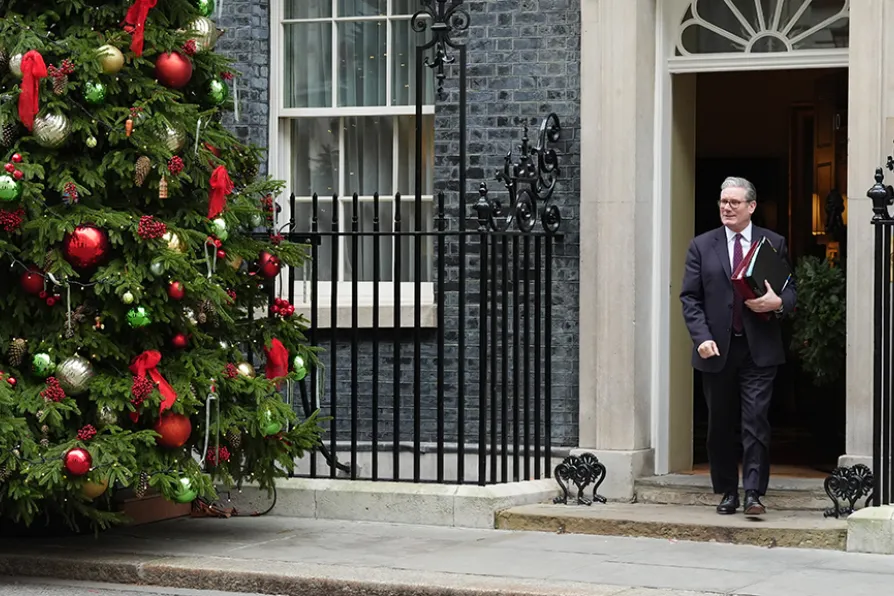
 Tis the season to be jolly, but Morning Star political reporter Andrew Murray is finding it hard
Powerful agribusiness interests are trying to overturn efforts by the Lula government to protect the environment and indigenous peoples of the Amazon region, writes GABRIELA SA PESSOA
Trade unions and community groups are mobilising to push back against Trump’s racist raids after new revelations of spying on legal protesters. MARK GRUENBERG reports from the US state of Minnesota
The best wildfire service may begin with the community, argues KOMAL RAJ ARYAL
The evolution of the Scottish nationalist leadership into cheerleaders for Nato has led the party to betray its pledges on Palestine and social spending, writes COLL McCAIL
While riding the No 3 bus in Glasgow MATT KERR has ample time to dissect the moribund Scottish Labour decline into near oblivion and watch intriguing bus passenger dynamics





‘TIS THE season to be jolly. But not in my lifetime has the prevailing political atmosphere made it more of a challenge.
2025 has been a year of what younger people might call a vibe shift, in two critical respects. Lines have been redrawn, and the once-unthinkable has matured into the all-too-possible.
The first is the prospect — one could call it a likelihood as things presently sit — of a hard-right government swept to office on the back of a less-and-less-abashed racism. Every month of the year, it seems, the boundaries against the overt demonisation of migrants and ethnic minorities generally were pushed further back.
Tory MP Katie Lam urges forced “remigration,” including of the legally settled, in the interests of cultural homogeneity.
Conservative leadership hopeful Robert Jenrick moans that he doesn’t see enough white faces in a district of Birmingham.
Reform by-election winner Sarah Pochin manages to start a debate over the number of black people in television adverts. New Home Secretary Shabana Mahmood states that she will make life harder for refugees.
And the Prime Minister talks of an “island of strangers” before he is forced into a climbdown.
This is a rancid atmosphere in which Reform, Tory and Labour politicians, to varying degrees, are all complicit. It is perhaps the most lurid symptom of a society in decay — stagnant, introverted, pessimistic, unable to satisfy the most basic expectations of citizens and thus turning in on itself.
This is the society which has been stewing since 2008. Repeated efforts by centrism in various forms to get Britain out of the ditch have foundered because the leading political forces are unwilling to address the implications of the great crash — unsurprisingly, since they eminently include their own fitness to govern.
So decisive sections of the electorate lurch from one expedient to another — a Brexit that left Toryism in the saddle; Boris Johnson’s “levelling up” and most lately Keir Starmer’s bogus “change” — and are now flirting with a hard-right authoritarianism, some form of a bloc of Farage and Jenrick.
The social basis for that bloc remains fairly narrow, uniting frightened sections of the middle classes and the most backward parts of the working class under the hegemony of the less scrupulous neo-Thatcherite circles of big money.
It is amplified by the once-Tory, now simply reactionary media, adroit as ever at framing events in a unidirectional form. Today, the main targets are migrants and black and ethnic minority people more generally. But trade unions, mass progressive organisations and democracy in general will be not far behind.
It is only sensible to assume that a Farage-Jenrick regime will not stint at the most draconian measures in the attempt to force its chauvinistic, nostalgic and neoliberal programme on society, and absolutely a racing cert that it will still fail.
That prospect is, sorry to be an Xmas party-pooper, not the worst of it by a stretch. The second line that has been crossed in 2025 is in the drive towards another war.
Again, consider what has been said. Germany’s defence minister says the continent has had “its last summer of peace.” Nato boss Mark Rutte says we must prepare “for the scale of war our grandparents or great-grandparents endured” — that is, world war.
The chief of Britain’s own military says our “sons and daughters” must be ready to fight, and his French opposite number calls on the country to be ready to sacrifice its children.
From his side, Russian President Vladimir Putin, indulging his regime’s very non-Soviet taste for bellicose bombast, says that if Europe wants war it can have it. And it appears that Europe’s decisive leaders do indeed want war and are hamstrung only by the fear that they could not presently make much of a fist of it without US support.
Thus their plan — to string out the Ukraine conflict for as long as possible, tripping up every Trumpian peace initiative without being too blatant about it, in order to buy time for their military build-up.
Should Keir Starmer and Emmanuel Macron succeed in inserting their troops into Ukraine as part of a ceasefire plan then war will certainly have come one big step nearer. The next provocation could be Russian, or it could be Ukrainian, but it would certainly be a trigger for escalating war.
Whether the US could actually stay out of such a conflict must be moot, and dependent on too many variables at present unknowable.
Either way, Britain is now preparing for such a conflict at breakneck speed. As important as the major arms build-up presently imposed by Starmer is the war psychosis being stoked at every turn.
Brasshats and spooks alike are mobilised to warn, with gloomy authority, of the peril from the east almost daily, without the slightest attempt to explain why Russia might want to invade, nor how it imperils British sovereignty in any way at all.
This rhetoric, more than amply backed up by engagement in the Ukraine conflict, which has already seen its first official British military casualty, seems to have made this country the Kremlin’s number one enemy.
Is this sensible? Can it end well? Very few in our elite are even asking such questions. And while the threat of far-right governance is now mobilising a significant degree of resistance, the danger of an existential war does not register to anything like the same degree in popular consciousness.
One section is bought off by the promise of industrial investment as a corollary to militarism, another by the stale bromides of a defence of democracy, civilisational values, international law and the rest, as if Iraq, Libya and, indeed, 200 years of imperialism had never happened, and if a lawless aggression against Venezuela did not seem just about to happen. With maybe Greenland next.
Underpinning it all though is a familiar disjuncture — the tenacious error that domestic and international policy are two entirely different things, that progress here can go hand-in-hand with aggression abroad, that a ruling class has two distinct policies for home and away.
Shaking off that illusion and understanding that welfare and warfare cannot be combined, that bad Starmer in Britain does not become good Starmer when he crosses the water, must be a 2026 priority.
Many of course, do understand that. Your Party was their hope in 2025. Can it play the part in the new year? Jeremy Corbyn was right to observe at its founding conference that there is no book to consult on how to launch a new socialist party.
However, there is now no need to write a work on how not to engage in such an enterprise. The story of Your Party is a precise catalogue of every misstep that could be made.
But still there are glimpses. Last week Zarah Sultana took herself down at 2am to one of the prisons holding pro-Palestinian hunger strikers unjustly incarcerated — and stayed there for 12 hours until an ambulance was forced to arrive to take one to hospital.
At the same time, Corbyn was using his own immense authority to press the Prime Minister in the Commons to at least meet with the hunger strikers’ representatives.
What a team that could be. I hope Jeremy and Zarah are both the type for new year’s resolutions, and that they listen to their best selves when composing them.
Certainly, the plan and programme of Corbyn’s Labour 2017, reinforced to meet the two sharp new challenges, offers the best hope of a way out of the looming catastrophe.
It is only necessary to break with one aspect of “Corbynism.” Enough with kinder, gentler politics. Let us instead approach 2026 in the spirt of the great Clash:
“Let fury have the hour, anger can be power,
Do you know that you can use it?”
We shall find out for sure.
Kennedy who? Trump takes over
PRESIDENT Donald Trump has renamed the Kennedy Centre in Washington the Kennedy-Trump Centre. And two new US warships are dubbed the Trump Class.
Why stop there? Rename the capital. Trumpton has a ring.
