

 Latest editorial
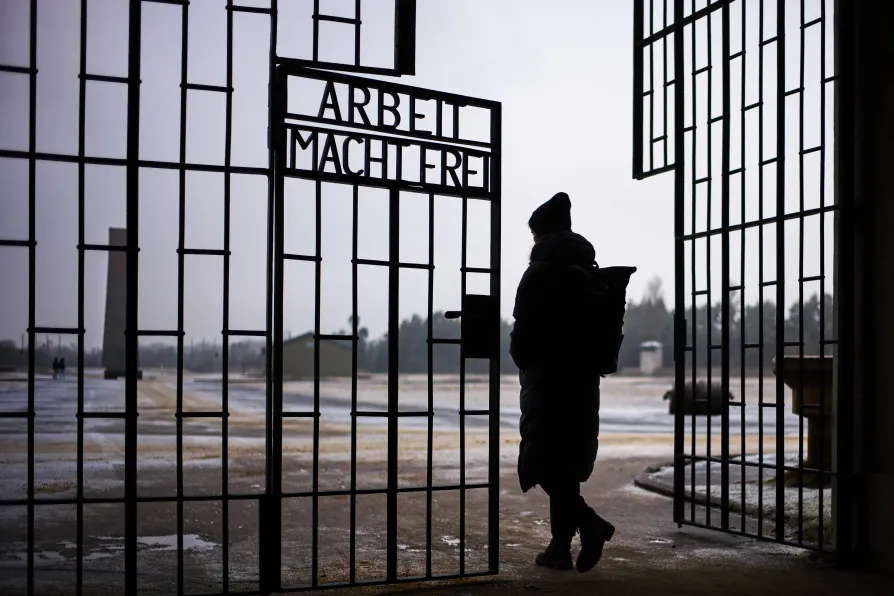 A women enters the Nazi concentration camp Sachsenhausen through gate with the phrase: "Arbeit macht frei", Work makes free, on the eve on the International Holocaust Memorial Day in Oranienburg, Germany, January 26, 2026
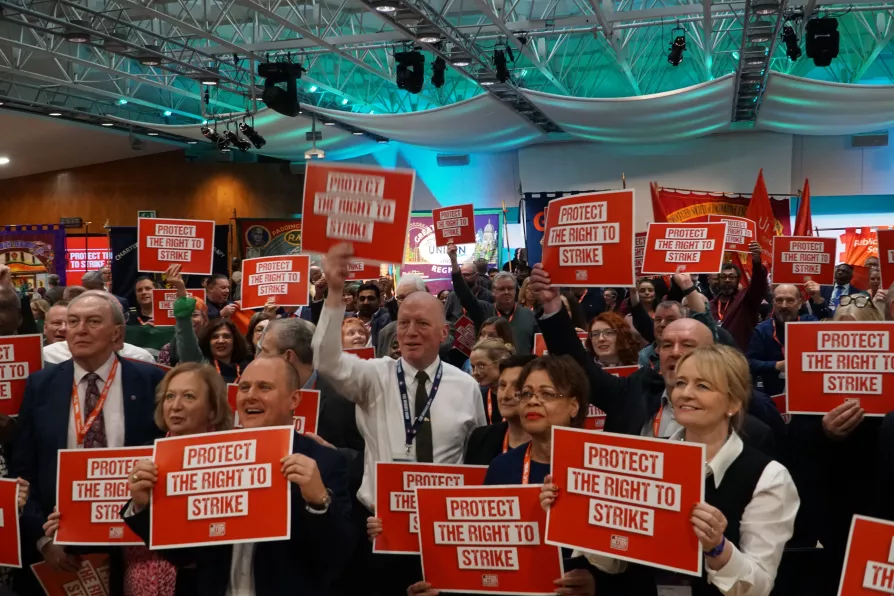





HOLOCAUST Memorial Day is always a solemn event. Commemorating the six million Jews, half a million Roma and Sinti and hundreds of thousands of gay, disabled or mentally ill people murdered by the Nazis forces reflection on the most terrible crime in human history.
That is more urgent than ever now fascist violence is back.
The term “fascism” has often been bandied around irresponsibly, used to describe any form of right-wing authoritarianism and sometimes any opponent at all.
Whether today’s far right can be accurately described as fascist has been debated at length in international socialist circles. But there are mounting reasons to say so.
The Communist International defined fascism as the “open, terrorist dictatorship of the most reactionary, most chauvinist and most imperialist elements of finance capital.”
The far-right project headed by Donald Trump is certainly about the dictatorship of capital — removing all democratic restrictions on corporate profit. Its imperialist aggression is more “open” than that of previous US governments, justified publicly in the name of resource grabs.
It is clearly reactionary and chauvinist. Terrorist? The terrorising of communities by Ice agents — now effectively a paramilitary force operating above the law — is escalating.
The murders of Renee Good and Alex Pretti show both that the Maga movement is unapologetic about killing those who resist, and that the US government lies through its teeth about events everyone can watch live footage of. The purpose cannot be to convince: it is to reassure its strike force of racist brutes that they can operate with total impunity.
Organised violence has been a hallmark of fascism since Mussolini’s Blackshirts. Its apparent absence from the movements around figures like Nigel Farage, Marine Le Pen or Giorgia Meloni have made many query whether they can be called fascists.
It has of course been a longstanding feature of other modern far-right movements — Narendra Modi’s BJP grew out of the paramilitary RSS, and works with a whole constellation of religious, community and street-fighter organisations (the Sangh Parivar or RSS “family”) many of which play roles analogous to the Blackshirts.
Now, with Trump, we see these practices being rolled out in a Western state. “Tommy Robinson” calls for a British equivalent to Ice, and Reform continues to cheer Trump on.
We are getting closer to confronting recognisable fascist movements. And if their targets appear to have been updated — Muslims and refugees being the most prominent — the old racisms are there too. Anti-semitism is rife in the Maga movement and periodically explicit; Musk celebrated Trump’s re-election with a Nazi salute. And anti-Roma racism remains socially and politically acceptable to an unusual degree, including in Britain.
Trump’s fascist revival applies too to international politics.
Holocaust Memorial Day is marked on January 27, the date that the largest death camp, Auschwitz-Birkenau, was liberated by the Red Army.
That reminds us of the ultimate triumph of anti-fascism. And the global monument to that victory was the creation of the United Nations — to join which, originally, you had to declare war on Nazi Germany.
Trump’s bid to dismantle international law and promote US-controlled alternatives to the UN, like his “Board of Peace,” is a direct challenge to the international order established through the defeat of fascism. Dropping the pretence of humanitarian concerns that disguised previous wars shows his eagerness to rehabilitate might-is-right aggression as once glorified by the fascist powers.
The Holocaust emerged from fascism and war. It was not the starting point for the Nazis. That we can see parallels to the fascist movements of the 1920s and ’30s is a warning: if this is not stopped much worse may be on its way.
Never Again cannot be a mantra we repeat once a year as we reflect on the horrors of the death camps. It is a call to organise against fascism, more urgent by the day.
