ROB WARZYNIAK recalls the emblematic 1906 book, The Jungle, in its analysis of the crisis presently engulfing the US Food and Drug Administration


 Latest editorial

How Wapping shaped today’s media and industrial relations: Marx House conference brings dispute back to life
Strike veterans and trade unionists found many parallels between Rupert Murdoch’s attack on the print unions and today’s democratic struggles, reports BEN CHACKO
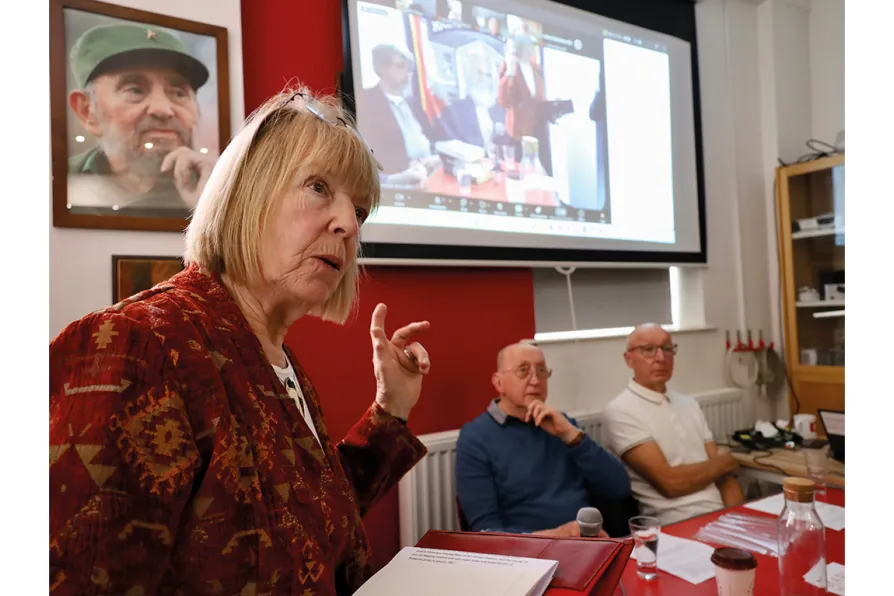 Ann Field addresses the conference, with (at table) Paul King and John Lang. Pic: Karl Weiss

Welsh wanderings showcase fiery destruction, alternative water ways and revive memories of a local mining legend, writes MARK SEDDON
As thousands die in the eastern DRC, a global health emergency is being starved of funds, says S KRISHNASWAMY
MAT COWARD explains how in the 17th century a row over whether to kneel at communion became a battle over religion, class and royal power
Renewed illusions in social democratic reformism are sprouting as a result of Andy Burnham’s rhetoric, but material conditions are already intruding into the debate, argues NICK WRIGHT
Andy Burnham could learn a few lessons from a previous Labour government in the pre-privatisation era on how to tackle water shortages, writes KEITH FLETT





SECRETS and lies, solidarity and treachery: the Wapping dispute was a defining battle of the 1980s, whose consequences still shape the media and industrial relations today.
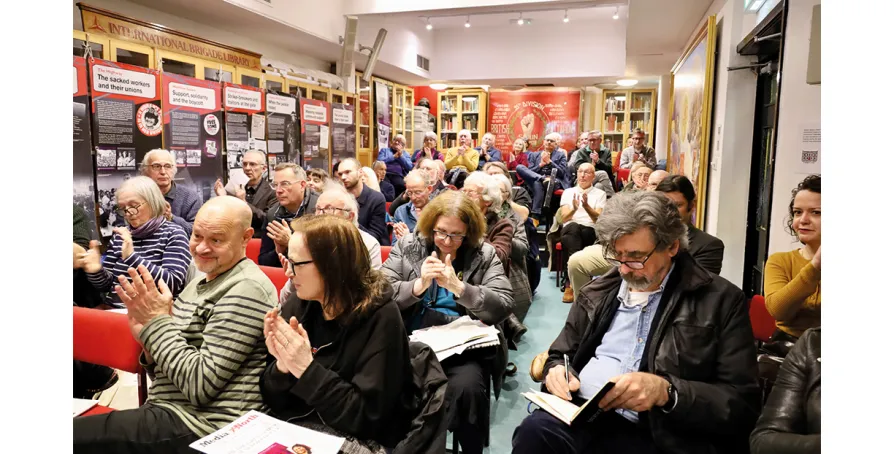
Strike veterans, campaigners against media monopolies and trade unionists packed the Marx Memorial Library on Clerkenwell Green on Saturday for an emotional 40th anniversary conference.
Clerkenwell was a fitting site, explained Ann Field, who as an official of the Society of Graphical and Allied Trades (Sogat) played an active role in the strike. “Clerkenwell is print worker land: stand on the steps of the library and to your right is a large building, where in April 1786 24 print workers were charged with conspiracy for attempting to secure an hour off the working day… eventually six of them were imprisoned for two years, and one of them died during that process.
“Then look to your left: next to the Crown pub there was once a cafe called the Red Star, and in 1889 my union [the National Society of Operative Printers and Assistants, Natsopa] was formed in that cafe.”
Rupert Murdoch’s plot to break the print unions at Wapping has always been presented by the right as about technological change, a business response to the way computers began to make parts of the old printing process obsolete. Today, many predict the death of print journalism itself.
But the Wapping conference was not a history lesson, though the fascinating history of the dispute — detailed in the weekend’s 16-page Morning Star supplement, still available on our website — was related by strikers who walked out, workers sacked en masse within half an hour of doing so and refusenik journalists who turned down the bribes and lost their jobs through refusing to work at Wapping where new printing presses shutting out the print unions had been set up by the scab Electrical, Electronic, Telecommunications and Plumbing Union (EETPU).
Image
The parallels with today were stark: just as Rupert Murdoch used the excuse of new technology to permanently disempower media workers and establish a model of all-powerful newspaper proprietors that still exists, today even richer tycoons like Elon Musk and Peter Thiel seek to use AI and digital surveillance technologies to assert ever greater corporate control of the workplace and society as a whole.
Indeed, Murdoch was in some ways a prototype of these plutocrats with their global ambitions, establishing a media empire spanning multiple continents and enabling an Australian-born US citizen to shape politics across the world: famously every one of his 175 newspapers in 2003 supported the Iraq war, giving the lie to the idea that ownership does not compromise editorial independence.
Lessons included the dire consequences when unions do not stand together: the EETPU’s treachery, working with Murdoch to secretly set up and then operate printing presses at Wapping so he could sack the entire existing workforce and abolish terms and conditions negotiated over decades, is well known. National Graphical Association (NGA) striker Paul King said the workers were defeated at Wapping by collusion between three people: Murdoch, Margaret Thatcher and EETPU leader Eric Hammond.
Image

In a different way that applies to the National Union of Journalists (NUJ) too, though its national leadership called on members not to work at Wapping. Its chapels at Murdoch titles voted to do so, and a majority of its members at them went over to Wapping though there were heroic exceptions.
The NUJ was not Murdoch’s target in that dispute, but the defeat of the print workers ensured it would follow, and it soon lost recognition and bargaining rights across his media empire — a situation that continues to this day, as NUJ general secretary Laura Davison explained in the weekend supplement.
The state’s collusion with Murdoch against his workforce was another object lesson in ruling-class ruthlessness. A couple of days before he issued his mass dismissal notices, Murdoch was lunching with Thatcher at Chequers.
Morag Livingstone, co-author of Charged: How the Police Try to Suppress Protest, detailed the secretive police manual authorising extreme violence against protesters, and the behind-the-scenes role of then home secretary Douglas Hurd in pushing it on police chiefs, who supposedly are operationally independent of ministers (we see more open attempts to politicise policing today with Shabana Mahmood’s interventions against West Midlands chief constable Craig Guildford).
Hurd laughed and walked out of the Commons when questioned by Tony Benn about the extraordinary police brutality against peaceful demonstrators at Wapping. A quasi-military policing operation to ensure Murdoch’s plant kept running and the lorries distributing his newspapers got in and out even saw random Wapping residents snatched and held in prison cells while walking home; one, 19-year-old Michael Delaney, was crushed to death under the wheels of one of those lorries. A police force deployed not to maintain order but to ensure Murdoch won had long turned a blind eye to violations like speeding by his lorry drivers.
Livingstone quoted our current PM Keir Starmer on the policing at Wapping: “What role should the police play, if any, in civil society? Who are they protecting, and from what? Who controls them, and for whose benefit?” It would be interesting to hear Starmer’s answers to those questions today, as he oversees mass arrests at peaceful sit-ins for Palestine.
Still, the police didn’t have it all their own way at Wapping — King and Sogat striker John Lang recalled pickets using radios to lead them a merry dance around the streets. Residents in high-rise buildings — the way the history and geography of Wapping, a docklands area, shaped the dispute was the subject of a fascinating contribution from Annette Mackin of the Tower Hamlets Archive — would use their bird’s-eye view to warn pickets of approaching police.
Communist Party general secretary Alex Gordon, from the floor, tied Wapping with the miners’ strike just before and the National Union of Seamen dispute with P&O shortly afterwards as a trinity of assaults on organised labour that enfeebled unions for decades after.
Indeed, the 2022 mass sacking of P&O workers in order to replace them with cheaper labour on worse conditions strongly echoed Murdoch’s behaviour at Wapping, he pointed out: and showed how unions are still legally barred from deploying the tactics that could prevent such outrages, such as secondary picketing.
Anti-union laws played a key part in the workers’ defeat at Wapping, as explained by the Institute of Employment Rights’ Professor Ruth Dukes. Dukes explained that a series of Acts passed by Margaret Thatcher in 1980, 1982 and 1984 ended unions’ blanket immunity from damages lawsuits relating to industrial action, hugely narrowed the conditions under which a trade dispute could legally take place (banning secondary action) and placed tight new restrictions on legal picketing.
Much that the workers at Wapping tried to resist their mass sacking were illegal by 1986 when they would have been perfectly legal in 1979: picketing outside the Wapping plant (which had never been their own workplace), blacking instructions to members not to handle News International titles, requests for solidarity action. Indeed, initial support from other unions that might have blocked distribution of Murdoch papers was blocked by threats that their assets would be sequestrated if they took this now illegal action.
The 1997-2010 Labour government left all those anti-union laws in place, merely introducing individual protection under unfair dismissal legislation from being sacked for strike action within the first 12 weeks. The Employment Rights Act of the current government lifts the 12-week limit — but does not restore unions’ immunity from damages claims or end the ban on secondary action. Would it stop another Wapping, another P&O? The answer in the room was no.
“The issues we face in the world of work today can be traced back to the Wapping dispute,” former Unite assistant general secretary Tony Burke said, summing up. It had set the blueprint for fire and rehire, and for derecognition of unions across companies and sectors, many of which remain union-free today.
But the strength and solidarity of those who fought so hard for their jobs and their industry can still inspire. “We shall never forget those events, or the workers who stood by their principles all those years ago.”
