
The US is hell-bent on dismantling the International Criminal Court as part of its assault on global legal systems, but others also have valid reasons to seek its demise. BEN CHACKO provides the analysis


Guinea-Bissau: A coup staged to protect the neocolonial order?
Claiming to be under arrest, president Embalo has left the country while his opponents remain in custody after a military coup a day ahead of the announcement of the final results, argues PAVAN KULKARNI
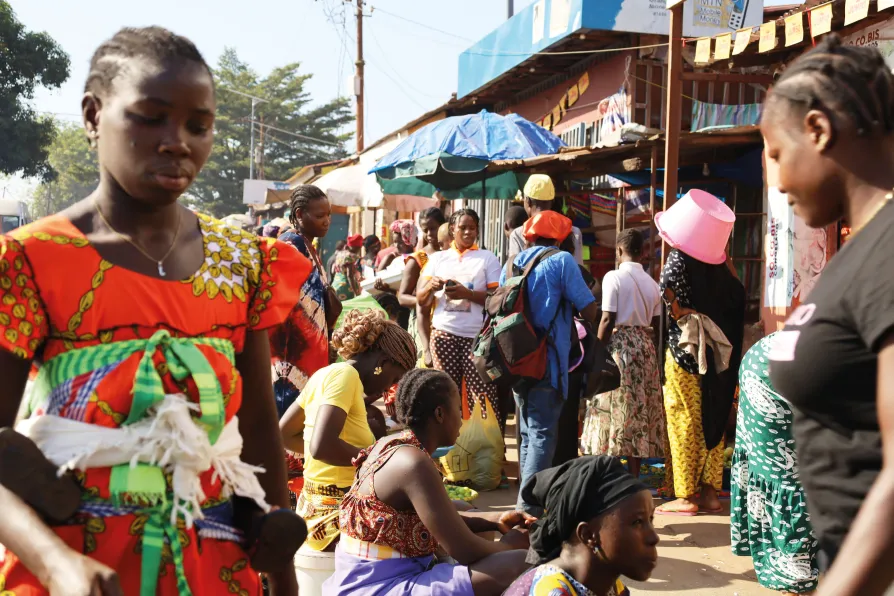
 UNREST: Women sells goods at a market in Bissau, Guinea-Bissau
A small Palestinian village is under attack from illegal settlers and the Israeli state to forcibly extend their illegal settlements. It is a template for the future, writes RAMZY BAROUD
The fawning obituaries have painted a flattering portrait of Rod Liddle. STEPHEN ARNELL offers a rather less reverential view of the man and his legacy
Sovereignty and the rule of law are under threat from Trump’s attacks on Lula’s administration just as they have been across Latin America, argue CARLOS MARTINEZ and SARA VIVACQUA
Glasgow will remember the martyrs of the 1787 strike this weekend in speech and song, their spirit is sorely needed today, writes JIM LISTER





THE military coup in Guinea-Bissau on November 26 was not directed against the outgoing president, Umaro Sissoco Embalo, but orchestrated by him to thwart the return to constitutional order, opposition parties and members of the dissolved parliament allege.
Claiming to be arrested by the coup leaders — while still communicating with the French media — Embalo flew to neighbouring Senegal the following day. His opponents, on the other hand, are still held in military custody.
The coup came on the heels of the long-delayed elections on Sunday November 23. Both domestic and international observers had reportedly agreed that Embalo was voted out of the presidency.
“Why would anyone do a coup against a losing candidate?” asked Imani Umoja, central committee member of the African Party for the Independence of Guinea and Cape Verde (PAIGC).
Having led the country’s liberation struggle against Portuguese colonialism under the leadership of the Marxist revolutionary Amilcar Cabral, PAIGC is the country’s largest party. Its presidential candidate, Domingos Simoes Pereira, Embalo’s main opponent, was barred from contesting the election by the Supreme Court, whose legitimate president had been replaced in 2023 by militias of the presidential guard under Embalo’s command.
“We had three options. One was to boycott the election,” which would have only handed over power to Embalo for the second term without a fight, Umoja told People’s Dispatch. “Or we could have taken the streets in protest, but that is what the regime wanted. They would have killed us and postponed the election,” further extending his rule that had already continued beyond his term.
“So we decided to back one of the candidates approved to contest. Dias was our natural choice,” because he is the head of the Party for Social Renewal (PRS) — a splinter from the PAIGC. “There is no great ideological difference between us,” he added, explaining the split was over tactical differences, overcoming which the two parties had often collaborated on broader struggles.
Although the leadership of the PRS identified the party as “social-democratic” as opposed to PAIGC’s “socialist” identification, the rank-and-file of both parties are Cabralists.
“So we were able to reach an agreement that once Dias becomes the president, he would reverse all the unconstitutional decrees by Embalo.”
An unconstitutional regime
Swearing himself in as the country’s president at a hotel guarded by soldiers in February 2020 after a disputed election against the PAIGC leader Pereira, who was barred from contesting this time, Embalo had the president of the Supreme Court replaced, practically at gunpoint, in November 2023.
Then, in December that year, he unconstitutionally dissolved the parliament, where the PAIGC had the majority, justifying the action by citing a coup attempt he had allegedly staged himself.
Removing the ministers constitutionally chosen by this parliament, he replaced them with a so-called “government of presidential initiative.”
Thus, grabbing all power and dismantling democratic structures, Embalo has allegedly been signing away in secret valuable natural resources and lucrative infrastructure projects to France and the neighbouring west African states under its neocolonial yoke.
A reversal of this neocolonial penetration was set to begin under Dias’s presidency, starting with the restoration of the dissolved parliament, the National People’s Assembly, dominated by the PAIGC and presided by its leader and barred candidate, Pereira.
According to the vote count from each region published by the Regional Electoral Councils, Embalo bagged around 43 per cent of the votes, while Dias had won with about 53 per cent, said Umoja.
A staged coup
However, one day before the National Electoral Council was set to publish the final results, summing up the nationwide count and the votes from the diaspora, gunfire erupted near the presidential palace.
“But there was no fighting. Soldiers were shooting in the air,” said Umoja. Embalo then told the French media that he had been removed from power in a coup led by a group of soldiers who had put him under arrest. “It was all staged. The coup was not against Embalo, but Dias… the president-elect.”
Opening fire near the National Election Council, “another group of armed people from the Ministry of Interior, accompanied by some soldiers, barged into its office and seized the phones of all the workers there, including the representatives of the candidates,” he added.
“A group of heavily armed militias associated with the presidential palace” also “invaded the campaign headquarters of the presidential candidate [Dias],” said Ruth Monteiro, director of the Office of the President of the National People’s Assembly, namely Pereira.
Pereira was arrested with Dias’s National Representative, Octavio Lopes, and several others, Monteiro added. Dias himself managed to escape arrest “through a back door,” he later said in a video message.
Shutting down the radio, the officers who carried out the coup read out a statement on television, declaring themselves in charge, christening their junta as the “High Military Command for the Restoration of Order.”
Announcing the closure of borders, they ordered the suspension of the electoral process “until further notice,” ostensibly to thwart the “capture of Guinean democracy” by “narcotraffickers.”
Labeling this as “a self-coup orchestrated by Umaru Sissoko Embalo, who was overwhelmingly defeated at the polls,” the West Africa People’s Organisation said: “The very clear aim is to prevent the electoral body from announcing results that are unfavourable to this well-known agent of the neocolonial system.”
On November 27, when General Horta Nta Na Man swore in as transitional president for one year, the junta announced that it “strictly prohibits any demonstration, march, strike or action that disrupts peace and stability.”
Protests
“We cannot fold our hands while our leadership is imprisoned unjustly. When our leader and candidate was barred from contesting, we chose to avoid” a confrontation by not taking to the streets, backing another candidate instead. “But now we have run out of options. We have to protest.”
The Amilcar Cabral African Youth (JAAC) posted videos of protest marches in some neighbourhoods around the Ministry of Interior.
Large-scale protests are at high risk at the moment in Guinea-Bissau. A large section of “our leadership is still in hiding,” Umoja added.
However, the diaspora is mobilising. In Dakar, the capital of Senegal, progressive Senegalese activists protested alongside the diaspora outside the Guinea-Bissau embassy against hosting Embalo in the country.
“Dictators are not wanted anywhere!” Umoja remarked.
JAAC Portugal and Firkidja di Pubis, an organisation of Guinean students and workers abroad, protested in Lisbon, capital of their former colony, outside the Community of Portuguese Language Countries (CPLP), chaired by Embalo.
“The CPLP and the so-called international community” is complicit with Embalo, who “orchestrated a fake coup d’etat with the sole purpose of derailing the electoral process in which the people had defeated his dictatorship,” Firkidja di Pubis accused. Protesters demanded the “completion of the electoral process in which the people chose Fernando Dias da Costa as their president.”
Should the junta not pay heed, Umoja warns, “Embalo’s followers in the military are only those who are paid” for their loyalty, but the bulk of the rank-and-file soldiers are unpaid.
The PAIGC denounced on Saturday November 29, that a group of masked and armed men raided their headquarters, attacking party leaders and those present. In statements released, the party alleges that the objective of the raid was to plant weapons in the office to later serve as evidence against them. The party called on the international community to “follow these events closely and support all of the efforts to preserve democratic legality.” The party has also called for authorities to release Pereira and all others arrested amid the coup plot.
This article is republished from peoplesdispatch.org.
