The US cannot countenance the idea of not being the world’s number one, the dominant global force economically and militarily. All its actions have to be viewed through the prism of this geopolitical imperative.
Apply this to US’s recent attempts to re-engage with Africa when Washington held a US-Africa summit in December — the first in eight years.
President Joe Biden reversed a decision by Donald Trump to draw down US troops from Somalia and the Sahel.
Secretary of State Antony Blinken has made two tours of the continent, the latest in August when he visited the resource-rich Democratic Republic of Congo and Rwanda, while in South Africa, he launched what was billed as a reset of relations.
Are the Americans doing this because they love the African people? Their attitudes to sharing vaccines during the pandemic would suggest otherwise.
One-third, if not more, of the minerals that will be needed for the transition to sustainable energy lie beneath African soil.
Chidi Odinkalu of the Fletcher School of Law and Diplomacy at Tufts University detects a cold war throwback.
“The US has come to the conclusion that, if they don’t re-engage, they will be abandoning Africa to Russia and China,” he said.
Russia’s interests in Africa remain very minor in reality and are largely confined to military matters. China is much more involved in the continent economically: this, coupled with its lead in the renewable energy sectors in which US clearly wants to establish dominance, provides a potential cockpit in which competing forces for influence meet, a scramble for Africa redux for the 21st century.
Odinkalu neglected to mention that Britain and the EU remain major neocolonial powers in Africa — see Tom Burgis’s magnificent The Looting Machine for a description of how that works.
The US will have no issues with taking actions that damage their ostensible allies in Europe.
The continent is already weakened economically by the US proxy war in Ukraine, a war that has seen US liquified natural gas exports to Europe rise by more than 137 per cent.
However, despite the slavish loyalty to US in Ukraine, the IRA will inflict more damage on Europe’s economy.
The IRA tax incentives have made the US irresistible to investors and many companies are thinking about relocating in order to get the benefits.
The IRA’s inherent protectionism, and the extent of the state largesse has alarmed some loyal “allies.”
President Emmanuel Macron says the IRA could “fragment the West.” European Commission president Ursula von der Leyen has complained it would bring “unfair competition” and “close markets.”
US incentives are so high, and comprehensively placed across the entirety of green supply chains, it will be very difficult for the EU to compete.
Support for US-made electric vehicle chargers, unveiled by the administration last week, provoked responses from EU business leaders.
“Our most important trading partner decides things in their own interest,” said Luisa Santos, deputy director-general of BusinessEurope, which represents companies across the EU.
“They keep doing this. But they want us to support them on China.”
A spokesperson for DigitalEurope, which represents the continent’s technology sector, described the latest support as “like deja vu.”
Cecilia Bonefeld-Dahl, its director-general, said: “The way to achieve our common climate goal is not through more ‘Buy American’ but through joint action and common standards.”
The US remains a long way behind in clean energy. Together, China and Europe produce more than 80 per cent of the world’s cobalt, the US less than 5 per cent, while China accounts for 60 per cent of the world’s lithium refining.
Almost two-thirds of the world’s batteries for electric cars and nearly three-quarters of all solar modules are currently produced in China, according to the International Energy Agency (IEA).
A rational country that genuinely believed in international collaboration would see this situation, the survival of the planet based around a just energy transition, as one that demanded co-operation between the leading nations; collaboration that would in itself would have a much-needed irenic influence on world affairs.
Daniel Liu, a Wood Mackenzie analyst quoted in the FT on February 16, said: “Global arms race for clean energy? Certainly, but there has to be some level of collaboration because no country can do it alone.”
The US is not run by rationality or by democracy. The needs of the military-industrial-complex and the fossil fuel industry dictate priorities and actions.
Combine this with the geopolitical and emotional imperative to be “Number One,” and it culminates in the adversarial bellicosity of the US’s climate and foreign policies that we see today.
China is clearly seen as an enemy that must be neutralised, a task made easier by the damage inflicted on its Russian ally by a lengthy war. When Victoria Nuland said “Fuck the EU” in a taped conversation with the US ambassador on who should be the next Ukrainian leader after Maidan, it now seems more a policy prescription rather than an expression of entitled exasperation.
Clarke’s book on the sleepwalkers is great apart from one major flaw: his Germanophilia leads him to blame the start of WWI on everybody apart from imperial Germany.
Currently we are sleepwalking into a major global conflict as few people fully recognise that, right now, the US is the most dangerous and aggressive world power out there, with policies and an ethos that are taking us to the brink of armageddon.
The world needs to wake up and act, including the supine European satraps and the more enlightened forces in the US itself.



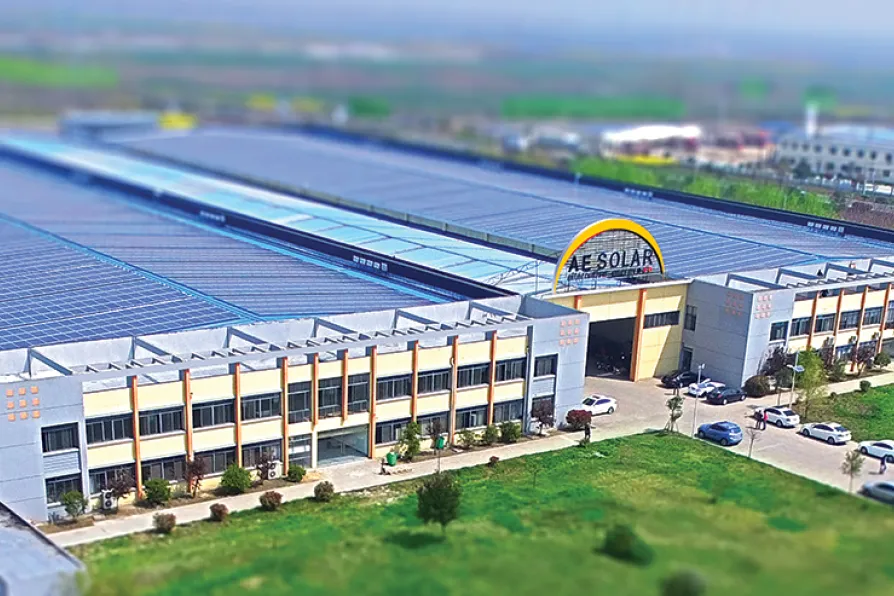
 AHEAD OF THE GAME: AE Solar factory in China produces both polycrystalline and monocrystalline photovoltaic modules (solar panels), 2017.
[AE Solar / CC]
AHEAD OF THE GAME: AE Solar factory in China produces both polycrystalline and monocrystalline photovoltaic modules (solar panels), 2017.
[AE Solar / CC]