Latest editorial

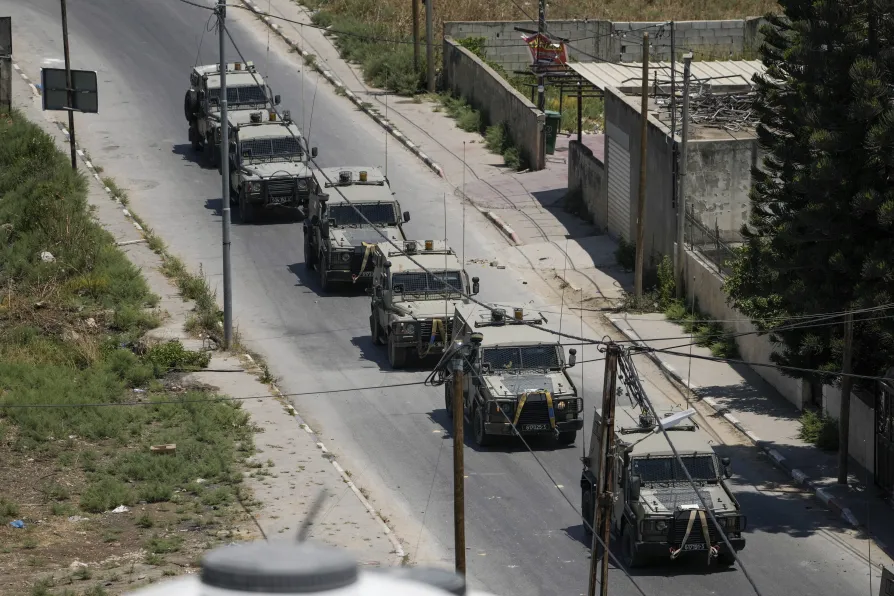 Israeli forces raid the Jenin refugee camp in the occupied West Bank, July 3, 2023





ISRAEL’S assault on the Jenin refugee camp amounts to a full-scale invasion.
It involves 2,000 soldiers and 150 armoured vehicles. Following last month’s bombing of the camp using helicopter gunships, warplanes were today conducting air raids on an enclave 10 times more densely populated than Birmingham.
Israeli military spokesman Lieutenant-Colonel Richard Hecht described the operation as the biggest since 2006, when Israel invaded Lebanon.
The climbing death toll adds to the more than 130 Palestinians killed by Israel in the West Bank so far this year, meaning 2023 is on course soon to exceed 2022’s grim total of 170 Palestinians killed — the highest number since 2006.
These are the actions of the most extreme government in Israeli history.
One which is proceeding, despite massive weekly protests, to rip up legal restrictions on the conduct of an administration crammed with fanatics.
One which is accelerating the colonisation of the West Bank, passing laws allowing the re-establishment of previously abandoned illegal settlements.
Its national security minister Itamar Ben-Gvir, who has a conviction for incitement to racism, boasted last month of the number killed so far this year and promised “there will be more.” Its finance minister Bezalel Smotrich describes himself as a “fascist homophobe.”
It is this out-of-control government that British ministers are seeking to protect with their Economic Activity of Public Bodies (Overseas Matters) Bill.
The anti-boycott Bill targets the Boycott, Divestment and Sanctions (BDS) movement in solidarity with Palestine. It is openly a bid to enforce British foreign policy on all public bodies: Communities Secretary Michael Gove claims councils, universities or other institutions which seek to make ethical decisions on how to spend or invest funds are guilty of “pursuing their own foreign policy agenda.”
In banning public bodies from taking stances on international questions at odds with that of central government, the law is part of the creeping enforced conformity chilling democratic debate in Britain, reflected in Tory anti-protest legislation, Labour’s relentless search for heretics to expel and the online censorship of alternative and foreign media in the name of combating “disinformation.”
The cross-party consensus on stripping us of our democratic rights is evident here too. Though Labour proposed a “reasoned amendment,” setting out objections to the Bill without actually amending it, it instructed its MPs to abstain when that fell rather than oppose the legislation.
In an interview with Jewish News, shadow communities secretary Lisa Nandy stressed the party’s support for a ban on BDS, saying Labour’s only concerns were that the Bill might also stop councils boycotting other countries, namely China: suggesting Labour would police enforced alignment with British foreign policy even more closely than the Tories. Her concerns are misplaced, anyway: the Bill breaks new ground by explicitly referencing Israel, giving it a unique impunity from activist pressure under British law, as well as by specifying that it should also cover the occupied West Bank and Golan Heights, endorsing Israel’s illegal colonisation projects in practice while continuing to oppose them formally.
Grassroots boycott campaigns have a long history in social justice campaigning, from the struggle to abolish slavery to the boycott of apartheid South Africa, cited by Nelson Mandela as a significant morale booster for that regime’s victims.
Trying to ban their use against what liberal human rights organisations including Amnesty and Human Rights Watch assess as a modern apartheid regime echoes Margaret Thatcher’s notorious Local Government Act, which prohibited anti-apartheid boycotts by councils (as well as barring them from “promoting homosexuality” in the infamous Section 28).
A British state which knows it lacks public consent for its policies at home and abroad bans criticism rather than engaging with it.
This Bill is yet another expression of politicians’ fear of what ordinary people can achieve through activism. We must show, through redoubled solidarity with Palestine, that their fears are justified.


The people of Palestine need our solidarity in actions not words – trade unionists must give them our full support in their darkest hour, writes DANIEL KEBEDE

MICAELA TRACEY-RAMOS explains how Britain’s largest union is putting pressure on the British government to recognise the Palestinian state and end its complicity with Israel’s murderous actions