


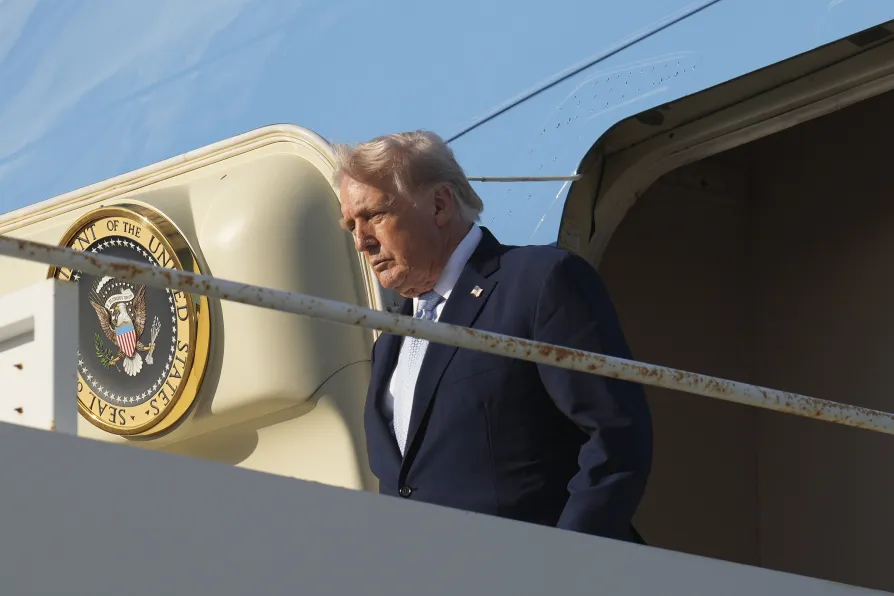
 President Donald Trump steps off Air Force One, March 20, 2026, at Palm Beach International Airport in West Palm Beach, Fla.
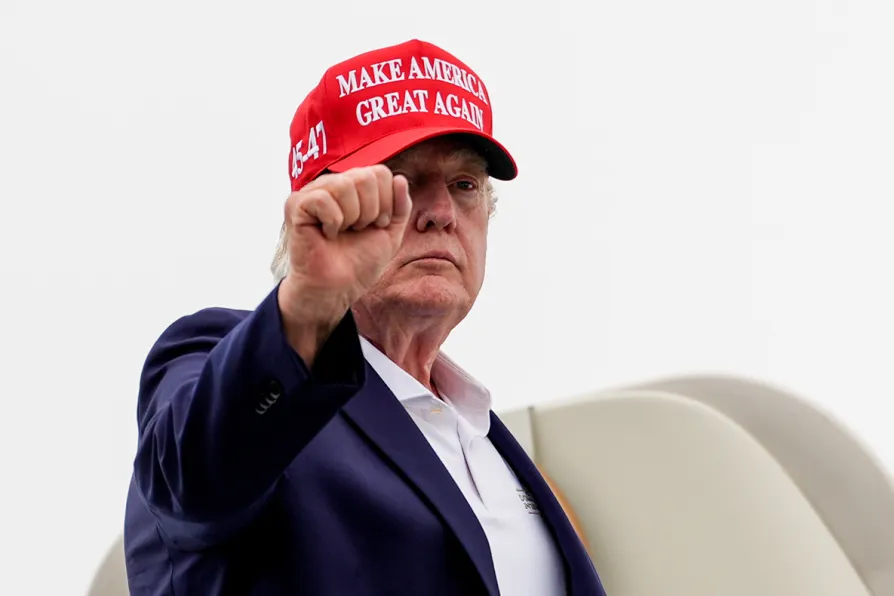





US PRESIDENT Donald Trump’s cavalier dismissal of worries about the economic impact of imperialism’s “permanent war” has been highlighted by his claim that the economic effects of the latest war on Iran is “a very small price to pay” for his now clearly failing strategy of regime change.
If Trump thought he could secure Iranian government compliance with his demands comparable to the way the US has brought the Venezuelan ruling elite to heel, he is now proven mistaken.
His notional second objective is for Iran to diminish its nuclear programme. This was among the issues being discussed in talks between Iran and the US under way while the US war machine was planning its strike and as the bombs and missiles began to kill Iranians.
But people resist. Venezuelans on the streets and kidnapped Nicolas Maduro in his New York cell appear defiant and we can see the raw courage of Iranian officials who take responsibility for the work of their assassinated compatriots, knowing that they too anticipate a guided missile strike on their family home.
The entire global South now understands that negotiations with the US cannot be undertaken on trust or that a negotiation necessarily excludes armed attack. And with the US’s notional allies there is now an understanding that while the US ruling elite are perhaps not actively planning military action, they are quite willing to deploy powerful economic measures to ensure compliance.
This war is not going the way Benjamin Netanyahu and Trump anticipated and the ruling elites in the region who thought a US military base on their territory offered protection are now discovering that, rather, it makes them a target.
And as Keir Starmer binds Britain even more closely to the war drive in both west Asia and eastern Europe — with US bases in Britain hives of military aviation activity — the realisation is growing that Nato bases make us a target too.
In west Asia the long-term strategy of the US has been to make a militarised Israel the pivot of its force projection.
The effect of this has been to create a permanent state of tension in which the flow of hydrocarbons to the developed capitalist world has been guaranteed by a system of interlocking alliances that have bound the oil-producing states, with the exception of Iran, into an imperialist protection racket in which the US military machine plays the part of the mob, with Trump cast as Al Capone.
We can note that Britain’s complicity in this process has had a profound effect on the political culture of both Britain and Israel.
In Israel it has produced a society so conditioned to dehumanise Arabs that genocide is endorsed by a substantial majority. In Britain it has brought into being a mass movement that now commands majority support for the Palestinian cause, while in the US a majority now favour the Palestinians, and among American Jews, especially among the young, unqualified support for Israel is now becoming a minority trend.
In west Asia it has emphasised even more the distance between the compliance, even if forced, of the ruling elites with the US strategy and what people on the Arab street think.
The price to be paid for this never-ending war will not be paid by the rich but by the working people.
In the region much of this process will be paid in blood.
Here it means a cost-of-living crisis without end as the demands of an everlasting war economy, which cannot be met without raising taxes and shifting spending from welfare to warfare, hit the family budgets of working people.
Starmer’s promised £300 increase in energy prices is not the end of it.
