ROB WARZYNIAK wades knee deep through a pile of ‘dead canaries’ of Trumpist policies which exacerbated the horrors of US capitalism domestically


 Latest editorial

From Manchurian to Mancunian candidate: how different is Burnham from Starmer?
Burnham’s ministerial appointees, to the right of himself, might indicate the direction of his government, writes SOLOMON HUGHES
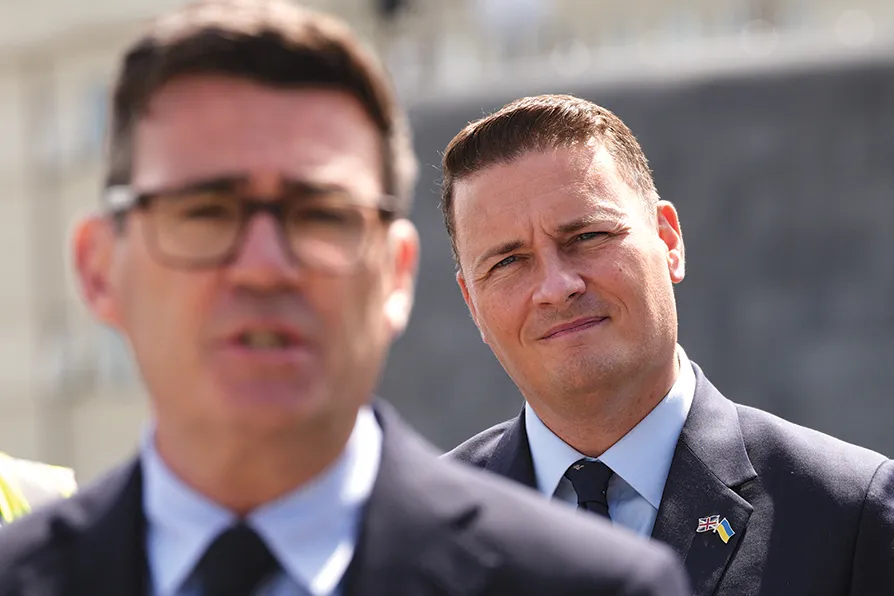 JOKERS TO THE RIGHT: Andy Burnham with Defence Secretary Wes Streeting, at BAE Systems, in Barrow in Furness, Cumbria, set out plans for British defence procurement


Without evidence or Nato consultations Berlin’s answer to the Leipzig incident is a rupture of relations. SEVIM DAGDELEN examines why
FRANCISCO DOMINGUEZ introduces the background to a conference on defending Latin America’s sovereignty
The glacier collapse in Nepal is yet another warning that a warming planet is making Himalayan disasters more frequent and destructive – but the countries facing the greatest risks are often those least responsible, says LI YANG
Nick Blair is set to benefit from a hugely lucrative contract to ‘virtually’ train the British army for its next war. Like father, like son, writes SOLOMON HUGHES
Even when tragedy strikes, Western media cannot resist the opportunity to turn it into a sordid propaganda opportunity, as the Nepal-China border tragedy shows, writes CARLOS MARTINEZ
Trade unions should be at the heart of the anti-racist push for reparations for the historic legacy and continuing impact of slavery, writes ROGER McKENZIE





KEIR STARMER’S disintegration must have lessons for Andy Burnham, but SW1’s political commentators are trying their hardest to ignore them.
Starmer had a massive majority and widespread support in the centrist media, so his government falling to pieces on contact with reality is not “normal politics.” But that same centrist punditry doesn’t want to look too hard at the wreckage to find the reasons for the crash, because they also had their hands on the steering wheel.
There have been some half-hearted attempts to discuss the “mystery” of Starmer’s fall, but mostly our punditry are trying to ignore this awkward episode and “move on.”
But the reasons for Starmer’s demise were very obvious from the start. Back in 2020 Times columnist Janice Turner praised the new Labour leader, describing him as “Starmer the Manchurian candidate, a sleeper agent within the Corbyn regime, cleverly drawing centrist support without alienating the left, only to turn on his boss” to make a “clean hit” on the Labour left.
It’s a pithy description. The Labour centrists want privatisation and cuts but have learned these ideas are deeply unpopular. So they chose the sophisticated tactic of simply lying.
Starmer acted as their “sleeper agent” and became Labour leader by pretending to be left wing, with his 10 pledges. He then squeaked into Number 10, with a big majority but a low vote, by promising “change.” Instead, he launched on “missions” that were not in his manifesto, like trying to cut benefits for disabled and old people, while he grabbed free suits, glasses and tickets.
Turner was praising Starmer as a “Manchurian Candidate,” but the odd thing here is believing that could work. She was referring to the Noir-ish 1962 thriller. It’s a great film, but a bad example.
In the movie, a US army veteran, Raymond Shaw [Laurence Harvey], has secretly been kidnapped by Chinese intelligence. They brainwash him to become their “sleeper agent,” a killer programmed to shoot journalists and politicians.
They want Shaw to assassinate a liberal American presidential candidate so his authoritarian deputy can take over. The Times columnist thought Starmer being a brainwashed assassin working for sinister forces to push reactionary politics was a good thing.
Of course this scheme came unstuck. Even in the movie the “sleeper agent” fails and ends up blowing his own brains out.
Turner may have made the basic error of thinking that someone who pretends to be on the left only to later attack the left would be popular and attractive because she has made a similar journey in life.
Once a firm supporter of “Labour Briefing,” the Jeremy Corbyn-supporting Labour group, Turner has moved to the right to get a well-paid career as a Times pundit.
Rupert Murdoch’s media may reward turncoats, but the voting public are less keen on betrayal.
If Starmer was the Manchurian Candidate, what does that mean for his replacement Andy Burnham, the Mancunian Candidate?
Starmer was wooden and unappealing precisely because he was a “sleeper agent,” a front man for a project who pretended to believe in one thing then did another.
By contrast, Burnham is a good communicator because he does believe in making the world somewhat better. His move from Blairite to “soft left” is genuine.
But having a prime minister with good communication skills and some progressive beliefs is quite a limited gain. It’s more shocking that the Labour machine and media conspired to foist a “Manchurian Candidate” with no beliefs and no communication skills on us.
Burnham’s political ambition is also limited.
All government’s will reach an equilibrium, and Andy Burnham clearly wants his government to balance to the right of Andy Burnham. He has given some important ministerial posts to other “soft left” figures like Lou Haigh and Lucy Powell. Burnham has also retained lots of Labour centrists like Wes Streeting and John Healey.
We may not have a “Manchurian Candidate” as prime minister, but his handlers are still in government. Burnham has not appointed any ministers significantly to his left. Even the “mainstream” group of leftish MPs, formed to get Burnham into power, haven’t been rewarded with ministerial posts.
With many ministers to his right, and no ministers to his left, Burnham’s government is in real danger of leaning back to centrist policies, being dragged towards welfare cuts or embarrassed attempts to please President Trump.
Starmer was defeated largely from the left. Protests by grassroots radicals and Labour rebels over Sir Keir’s stance on Gaza, welfare cuts, or on his attempts to ape Reform on migration broke Starmer’s project.
When this opposition took an electoral form via the Greens and Independents, Labour MPs were scared enough to put Burnham in power.
We have to hope those same grassroots or rebel forces can possibly keep up some left pressure on Burnham to counteract the dull weight of centrists in the shadow cabinet.
Careless people
IN MY last column I noted how much of the new hard anti-migrant right was funded and driven by businessmen who used to mostly push Thatcherite free market economics. Notably investor Paul Marshall, owner of GB News, who funds several far-right “influence” organisations.
Marshall used to be a Lib Dem who wanted to drive that party rightwards away from “soggy socialism” towards privatisation of hospitals, prisons and Royal Mail.
His turn to hard-right politics looks in part like an attempt to dress up his “neoliberal” politics, which became unpopular after the 2008 crash, in a new cloak of anti-migrant “nationalism.”
An even more blatant example of big business trying to use fascist-y parties just to protect their profits comes from Sarah Wynn-Williams in her new, very readable, book, Careless People.
Wynn-Williams was Facebook/Meta’s director of public policy, but has turned whistleblower, exposing Facebook’s bosses’ willingness to do deals with all kinds of repressive regimes in search of greater profits.
In the book she reports a Facebook board meeting around 2016. Issues discussed by the directors included: “The proposal that we should use the election support and campaign tools we were offering to US presidential candidates (and Donald Trump was using aggressively in his 2016 campaign) and offer them to Alternative fur Deutschland, the far right in Germany, and to Marine Le Pen and the Front National, the far right in France.
“Getting closer to these political parties and helping them into government would be the most effective way to stop governments from regulating Facebook.”

Similar stories

In a wide-ranging interview, JEREMY CORBYN talks to Ben Chacko about the difficulties the new Prime Minister faces and why he sees no future in Labour

Labour’s toxic centrists have wealthy backers but there’s little to suggest they can win over MPs or party members in an open fight, writes SOLOMON HUGHES