
ROB WARZYNIAK wades knee deep through a pile of ‘dead canaries’ of Trumpist policies which exacerbated the horrors of US capitalism domestically


Women in work: time for the Civil Service to pay its dues
FRAN HEATHCOTE looks at the persisting inequalities women face in the Civil Service workplaces as TUC women’s conference begins
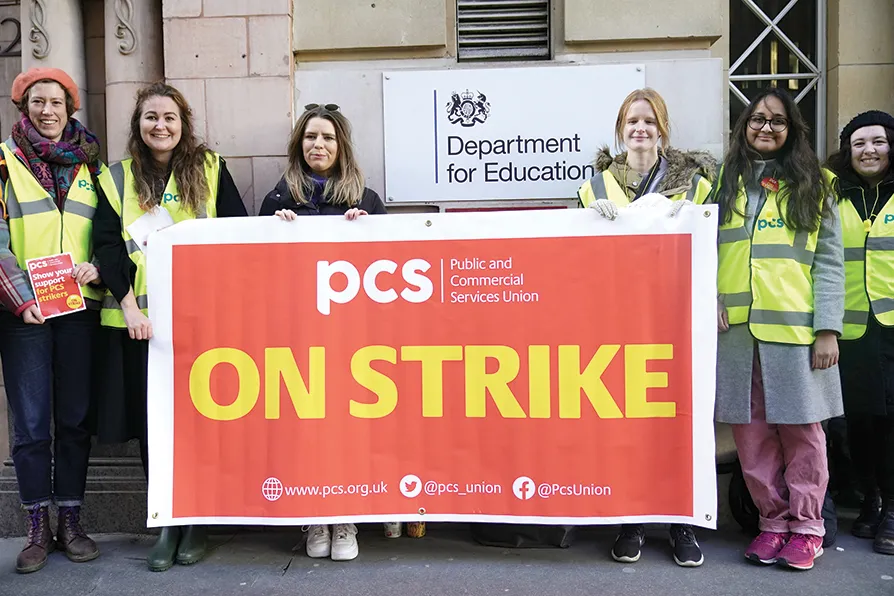
 DETERMINED: Public and Commercial Services (PCS) union members picket the Department for Education, in Westminster in a dispute over jobs, pay and conditions in February 2023
Without evidence or Nato consultations Berlin’s answer to the Leipzig incident is a rupture of relations. SEVIM DAGDELEN examines why
FRANCISCO DOMINGUEZ introduces the background to a conference on defending Latin America’s sovereignty
The glacier collapse in Nepal is yet another warning that a warming planet is making Himalayan disasters more frequent and destructive – but the countries facing the greatest risks are often those least responsible, says LI YANG
Nick Blair is set to benefit from a hugely lucrative contract to ‘virtually’ train the British army for its next war. Like father, like son, writes SOLOMON HUGHES
Even when tragedy strikes, Western media cannot resist the opportunity to turn it into a sordid propaganda opportunity, as the Nepal-China border tragedy shows, writes CARLOS MARTINEZ
Trade unions should be at the heart of the anti-racist push for reparations for the historic legacy and continuing impact of slavery, writes ROGER McKENZIE





THIS week, as the TUC gathers for its annual Women’s Conference, it is worth pausing to consider the realities women continue to face across the workforce, which include those at the heart of the Civil Service.
Often headlines can be read celebrating progress towards equality, and although a step in the right direction, the lived experience of our members can tell a very different story.
One persistent of pay gaps, overwork, and care responsibilities that continue to fall disproportionately on women.
The challenges women face was laid bare in the recent Civil Service People Survey. Morale across departments remains stubbornly low, weighed down by low pay, unmanageable workloads, and constant organisational change.
These pressures aren’t abstract. They shape women’s daily lives, forcing impossible choices between career, family and wellbeing.
And coupled with all of that, a stubborn gender pay gap still exists in the Civil Service. Women earn, on average, around 6 per cent less than their male colleagues. Six per cent may sound small on paper, but it represents years of opportunity lost, pension contributions diminished, and a tangible drag on women’s economic security.
This figure should be zero per cent, and until it is, there is still work to do. PCS recognises that and over the past two years, as an employer, the union has completely eradicated its own gender pay gap.
Low pay is not gender-neutral. Women remain overrepresented in lower-paid roles across the Civil Service, from administrative staff to front-line services, while men are more likely to occupy the better-paid senior positions.
And while pay continues to stagnate, women continue to carry the lion’s share of unpaid care work — according to Carers UK, approximately 58 to 59 per cent of all unpaid carers are women.
That’s childcare responsibilities, caring for elderly relatives or domestic labour disproportionately on women. Then, when it becomes too overwhelming to bear, women are four times more likely to quit paid work to manage these responsibilities.
These responsibilities are a hidden subsidy to the economy yet largely ignored when policy decisions are made.
But pay and progression are not the only battles women face.
Sexual harassment remains a serious and ongoing workplace issue. A recent PCS survey found that 22 per cent of respondents identified men as the perpetrators of abuse, and over half said incidents took place in the workplace or on employer premises.
Yet 34 per cent did not report what happened, and nearly a third of those who did felt their case was not handled appropriately. Some avoided certain work situations altogether, while others feared reporting would damage workplace relationships.
No-one should have to choose between their safety and their career.
That is why PCS is encouraging affiliates to run campaigns to tackle sexual harassment, violence against women and racism, and to challenge the misinformation and division spread by the far right to scapegoat asylum-seekers.
To support members, PCS has developed a new toolkit with guidance on legislation and practical workplace materials, alongside training through the PCS Academy to equip reps on the front line to respond effectively to reports of harassment.
These inequities are not inevitable. They are the product of systems and cultures that continue to undervalue women’s labour and lived experience.
The union has long campaigned for fair pay, equality, and workplace justice. In the year ahead, we will continue to make the case for closing the gender pay gap, for protecting women from the corrosive effects of excessive workloads, and for ensuring that the Civil Service recognises, and values, the full contribution of its female workforce.
Part of this fight is structural. We must tackle the culture of constant change that leaves staff uncertain, undervalued, and overworked.
Morale does not improve through piecemeal initiatives; it improves when staff are given fair pay, reasonable workloads, and a workplace that recognises their contribution.
We also need targeted action to tackle the barriers that prevent women from progressing in their careers. Leadership pipelines, training opportunities, and promotion criteria must be scrutinised to root out bias, intentional or otherwise.
The Civil Service cannot claim to be modern, effective, or fair while women remain concentrated in lower-paid, lower-status roles.
And this isn’t just a women’s issue; it’s a public service issue and a societal issue.
When the Civil Service undervalues women, it undermines the delivery of essential services, it stifles talent, and it perpetuates inequality that reverberates across every community.
The simple message is, creating a sustainable and economically fair environment for women benefits everyone.
Fran Heathcote is the general secretary of the PCS union.
