


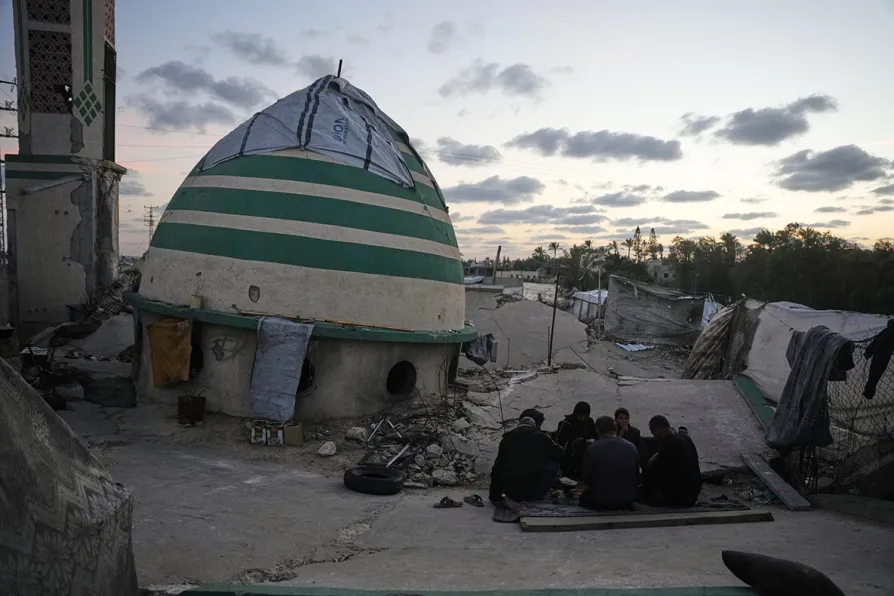
 The Suleiman family break their fast during the holy month of Ramadan beside the ruins of a mosque where they are currently taking shelter in Deir al-Balah, Gaza Strip, March 6, 2026






WOMEN are bearing the brunt of collapsing healthcare and mass displacement as a result of Israel’s genocide in Gaza, Amnesty International UK has warned.
In a briefing today, the campaign group highlighted medical staff reports of an “exponential rise” in maternal and neonatal health conditions, and women with cancer facing interrupted or inaccessible care.
Between February 5 and 24, Amnesty interviewed 41 displaced women and 26 healthcare workers across six facilities in Gaza City and Deir al-Balah.
Almost 60 per cent of health service points are non-functional, placing immense pressure on the few providing emergency obstetric care, according to the World Health Organisation.
About 46 per cent of essential medicines remain at zero stock, including drugs for managing contractions, haemorrhage and infections.
Some 37,000 pregnant and breastfeeding women face acute malnutrition by October, the Integrated Food Security Phase Classification has warned.
Medical personnel told Amnesty that women giving birth endure extreme shortages of food, medicines and nutritional supplements.
Most arrive suffering from anaemia due to malnutrition and waterborne diseases from polluted water, and hospitals lack equipment and have resorted to using expired anaesthesia.
Neonatologist at Al-Helou Dr Nasser Bulbol said the number of high-risk pregnancies they receive has significantly increased as mothers’ immune systems have been compromised because of malnutrition.
“Displacement conditions have led to infectious diseases and most women come here under stress, trauma and uncertainty, having suffered multiple displacements, lost loved ones, unable to obtain the nutritious food they require,” he said.
Neonatal units are operating at 150-170 per cent capacity, with up to three newborns sharing an incubator, Amnesty said, while single-use medical supplies are being reused.
Medical evacuations remain severely obstructed by Israeli authorities, with the process halted entirely since the US-Israeli offensive on Iran began.
Amnesty secretary-general Agnes Callamard said: “As tensions across the Middle East escalate sharply following Israeli-US attacks on Iran, we must not forget Israel’s ongoing genocide against Palestinians in Gaza and the brutal price women and girls have been paying.
“Women in Gaza are being denied the conditions needed to live and to give life safely.
“This systematic erosion of their rights to health, safety, dignity and a future is not an unfortunate by-product of war, it is a deliberate act of war targeting women and girls.”
-additional online-
Throughout the genocide, women’s access to sexual and reproductive healthcare has been severely compromised due to Israel’s bombardment, displacement, destruction of reproductive and maternal healthcare services and restrictions on the entry of vital aid and hygiene kits, amid the decimation of Gaza’s water and sanitation system, Amnesty said.
A humanitarian aid worker told the group that they had already turned away more than 1,000 patients with non-communicable diseases, including cancer, as they had not been allowed to bring medical supplies into Gaza since the start of the year.
Nisrine, a 49-year-old mother of seven diagnosed with a frontal lobe tumour, described how her mother and brothers were killed in an Israeli air strike and her home destroyed: “I sank into a severe depression.
“Constant displacement seeps life out of you, it drains you. The hardest thing is having to start from scratch all over again every single time.”
A 24-year-old trained nurse, eight months pregnant and anaemic, said she cannot obtain iron infusions or nutritious food.
Her infant son died in 2024 from an untreated infection, and her husband was killed just before she discovered her current pregnancy.
She described the misery of living in a tent while pregnant, being constantly unwell from the cold and struggling to access the toilets.
The woman said that she is worried about how she will keep the baby safe from viruses in her tent full of sand and bugs, or afford nappies, baby clothes and sanitary pads for herself post-partum.
Medical evacuations to the West Bank, including East Jerusalem, have been almost entirely prohibited since October 7, 2023, Amnesty said.
Since the partial reopening of the Rafah crossing on February 2, the UN has supported the evacuation of 289 Palestinians.
But severe restrictions and delays imposed by Israeli authorities have resulted in preventable deaths.
The process has stopped altogether since the joint US-Israeli offensive on Iran began.
Ms Callamard said that the “human-made catastrophe has caused immense suffering,” saying: “Our action and support are past due!
“We must stand firmly with Palestinian women and girls in Gaza and call once again on states to take meaningful action to end Israel’s genocide and unlawful occupation, including by ensuring women and girls can access their fundamental rights and securing a future where all Palestinians can live in dignity.”
