Committee for the Defence of the Iranian People’s Rights general secretary GAWAIN LITTLE discusses the impact of the US-Israeli war on the Iranian people and economy


 Latest editorial

Why is Starmer unpopular? The answer’s obvious, but it mystifies the media
SOLOMON HUGHES says Starmer has done everything the Westminster set think Labour leaders should do – but it hasn’t endeared him to the public
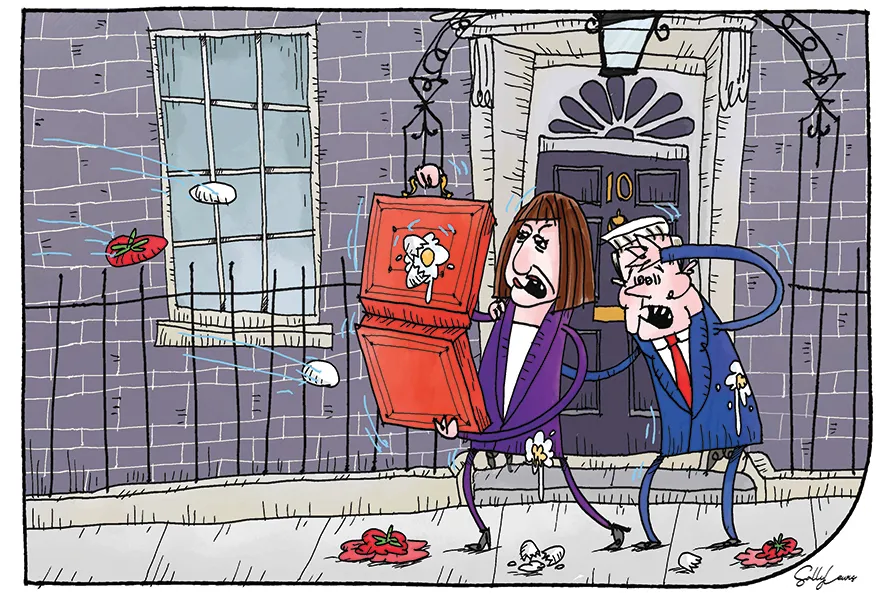 Cartoon: Sally Lewis


Capitalism has extracted itself from crisis before, argues PRABHAT PATNAIK – but through methods no longer available. So it is turning to authoritarianism, militarism and neocolonialism
The five young men killed in the A66 crash were responsible for a devastating tragedy — but the crash should force us to ask difficult questions about wider society, argues RENATA MEDEIROS MIRRA
Britain funds the policing of black culture 16 times better than the culture itself. The Diamond Jubilee is the moment to end that, argues CLAUDIA WEBBE
Despite Andy Burnham’s declaration defending the continued partition of the island, all major international and internal trends are converging to make Irish reunification inevitable
Humans are part of the ‘animal kingdom’ – and of nature in general – but also distinct from it and labour (work) is part of what makes us unique, declared Engels. His insights 150 years ago into how our species came to be and how we differ from the rest of nature, are as important today as they were then, says the MARX MEMORIAL LIBRARY





ALL the “serious” media pundits are working on “Why is Keir Starmer so unpopular” columns. The one thing the pundits won’t say is “He is so unpopular because we told him to be.”
Media commentators can’t ignore Starmer’s unpopularity because it is bursting through the polling and focus groups, their preferred method for measuring politics.
But while Westminster commenters know they have to address the question, they are really mystified by the answer.
Tom Baldwin – Starmer’s biographer — told the Financial Times that Keir’s unpopularity shows Britain’s drift towards “ungovernability” and “a rising tide of inchoate rage” because the “idea that Keir Starmer is worse than Boris Johnson is nuts. Something is going on with the electorate.”
The only explanation for Starmer’s unpopularity is that the world’s gone mad and the voters are primitive headbangers.
Baldwin is an extreme case, but the general sense that it’s the voters who are wrong, or confused by social media, or driven by unreasonable expectations, or miseducated, or lost in shallow “celebrity culture” pervades Westminster commentary.
It’s not like voters aren’t saying why they hate Starmer. The Financial Times also reported that in focus groups “people say Starmer is a liar and only said what he thought he needed to say to get elected” while “Reeves is often deemed to be uncaring. People say she is targeting people who can’t fight back.”
Which is pretty straightforward: Starmer did repeatedly lie about the amount of “change” he was offering, beginning from his ditched “pledges” through numerous relaunches. Reeves’s determination not to tax the rich or corporations means she and her fellow ministers keep coming for the weak – personal independence payment recipients, pensioners, migrants — instead.
Throughout Europe formerly powerful and popular “Socialist” or “Social Democratic” parties have seen their popularity collapse because they were abandoning redistribution in favour of managerial, centrist politics.
Before the 2008 financial crisis this decay was masked by economic success. But after 2008, stagnating wages meant failure to “bring home the bacon” to their working-class voting bases became obvious.
Votes for nominally left parties playing centrist politics collapsed in a process called “Pasokification,” which hit the German Social Democrats, The Parti Socialiste of France and Greece’s Pasok. This process was happening to Labour, but was interrupted by Corbyn. Starmer has reverted to centrism, and so restarted Pasokification.
But the media pundits can’t – or won’t — see this because that would mean admitting their whole basic worldview was wrong.
It is absolutely written into Westminster reporting that a Labour leader must “go over the heads” of (basically soft left) party members and appeal to more right-wing voters. But instead what has happened is Starmer has gone over the heads of party members — and voters don’t like him either. The party members were closer to the ground than the Westminster pundits.
When Starmer started making his “country before party” speeches, this reflected the pundit wisdom. But they and he were wrong.
The Westminster wisdom is that a Labour leader should ignore Labour members and appeal to the middle ground of middle earners in middle England.
But the “middle ground” doesn’t exist like it used to because demands for better wages or public services can’t be easily satisfied without redistribution in a stagnating economy.
Westminster repeatedly misjudges what the “middle income” is: median full-time salaries – literally the middle income – are around £39,000. But, for example, the Guardian recently claimed “middle earners” are on £50,000 plus. And middle England is actually Coventry or Birmingham, while Westminster thinks it’s in the small towns of south-east England.
Clause 4 Moment
The supposed need for Labour leaders to attack their own party and move right to succeed is baked into most Westminster reporting in the phrase “Clause 4 Moment.” In 1995 Tony Blair won an internal battle to redraw the pro-nationalisation Clause 4, one of the founding statements of the Labour Party. Westminster commenters saw this as both key to winning the 1997 election and creating an eternal law for future Labour leaders.
Starmer called his own move right “Clause 4 on steroids” while newspapers lauded his “Clause 4 Moment.”
Really the 1997 landslide shows Blair could have won the election without revising Clause 4, but what almost all Westminster pundits ignore – because they only look at the “theatre” of politics, not its actual effects — is that the revised Clause 4 failed.
Blair’s “Clause 4 moment” was largely aimed at ending Labour’s plan to renationalise rail. How did not renationalising British Rail go?
Railtrack, the privatised track operator, failed in 2002. A series of rail crashes, including the 2000 Hatfield crash, showed privatised Railtrack and their corporate subcontractors were not maintaining the tracks properly, so passengers and staff were killed.
After the lethal crashes, Railtrack tried to get control by imposing emergency speed limits, but these made the system unworkable.
Passengers died, then the system started grinding to a halt. Railtrack couldn’t make a profit and be safe, so went bankrupt.
Blair made opposing rail nationalisation central to his supposedly successful “Clause 4 moment” but was forced by lethal accidents to renationalise the track.
The linked decision not to renationalise water is also a policy failure that fills our rivers with filth and is unpopular with the public. Blair’s “Clause 4 moment” was also designed to allow more private finance being used in the public sector, leading to the disaster of the Private Finance Initiative.
It’s no surprise Westminster pundits are confused by Starmer’s unpopularity. He did what they wanted him to do, he attacked his party, he had his “Clause 4 moment.”
Because they can’t reflect on how this politics isn’t an eternal law, but instead led to PFI disasters, death on the rails or the ongoing disaster of water privatisation, they can’t understand why going through the same rituals does not make people love Keir.
