
The US administration is endangering lives by reversing environmental protection laws, CHAUNCEY K ROBINSON argues

When Scotland rose for democracy: the untold story of 1820
In the year following Peterloo a mass strike erupted into armed revolt as Scotland’s workers demanded their rights, yet this uprising remains largely absent from popular history, writes KENNY MacASKILL
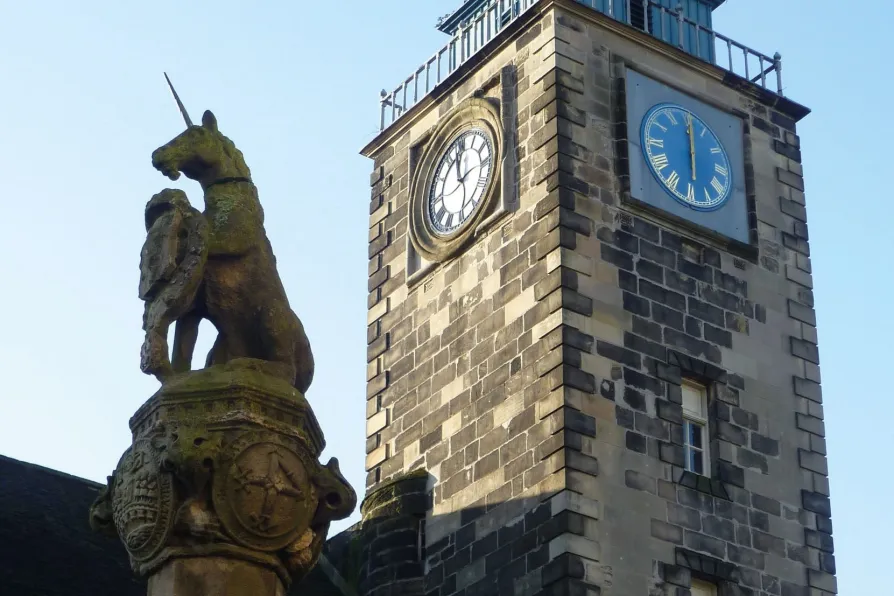
 HISTORIC: Stirling Tolbooth and Cross where a plaque commemorates Baird and Hardie. Pic: Kim Traynor /Creative Commons
It’s time to stop retreating and go on the offensive to promote working-class interests, argues DOUG NICHOLLS
Marco Rubio wants to defeat socialism in Nicaragua, not restore ‘democracy,’ writes JOHN PERRY
Believe it or not, there was a time when the US government built beautiful homes for working‑class Americans to deal with a housing shortage, writes ERAN BEN-JOSEPH
DIANE ABBOTT provides an analysis of the reasons for EU and British voters’ dramatic swing to the right
Train drivers’ union Aslef general secretary DAVE CALFE speaks to Ben Chacko about his hopes that Burnham’s devolution agenda will include the importance of the railway





AS WITH so much of our radical history, the 1820 Rising’s shamefully little known in Scotland, and even less so in England.
Yet it was the last armed insurrection on mainland Britain, the final use of the barbaric execution of hanging and then beheading in the UK and its precursor was the Peterloo massacre the year before.
Some have claimed it a nationalist uprising, but it wasn’t. It was a fight for democracy, the franchise and freedom for the evolving working class within Britain, albeit in a distinctively Scottish struggle.
This was a time when the French Revolution and Tom Paine had ignited imaginations everywhere of a better world available on earth, not just in a future heaven. But with neither modern transport links nor mass media existing the countries were quite separate entities.
As Red Clydesider and historian Tom Johnston stated it was a general strike from which it was hoped a revolution might spring.
Its genesis lay a generation before when Thomas Muir and the Friends of the People had pushed for democracy and that better world. The idea that Britain faced down Napoleonic despotism for freedom and liberty was a myth, the reality being that only around 4,000 people possessed the vote in Scotland, half of whom were fictitious. Large landowners ruled the roost with even the growing merchant class sidelined.
Those early Scottish political martyrs had faced repression and transportation to Botany Bay and along with changing attitudes towards revolutionary France the radical cause had dimmed. But it had never gone away and after Waterloo and Napoleon’s final incarceration a post-war slump saw unemployment and poverty rise. That was matched by a resurgence of demands for democracy with huge rallies held north and south of the border, with again repression being imposed.
That tinder box of the people’s demands and desperation confronting the rage and fear of the authorities led to the Peterloo Massacre on August 16 1819 which is rightly recalled. What’s less well known is the effect which it had in Scotland and the role it played in the Rising the following year.
For when news of the murder of so many reached Scotland there was anger and outrage with numerous large demonstrations held in Glasgow, Kirkcaldy, Dundee and Kilmarnock over coming weeks and months.
The most significant outbreak of disorder was in Paisley on September 11 where a rally was held on the southern edge of the town for easy access from Glasgow and Ayrshire, along with Renfrewshire.
Between 14,000 and 18,000 attended, which given the population and political atmosphere was substantial.
Consideration had been given to banning it, but it proceeded with the Sheriff Renfrew, along with yeomanry and the military, nervously watching on.
The situation was tense with many protesters dressed in funereal black and banners similarly adorned. All seemed to have passed off without incident until special constables sought to grab banners from the crowd returning to Glasgow. A riot followed and the authorities lost control despite the military presence. The Riot Act was read with crowds confronting cavalry and Paisley was under curfew for five days. Disturbances also took place in Glasgow and surrounding weaving villages.
Scotland was not alone in its anger and rioting also occurred in England. Radicals required to consider their response, and as with Scotland in the 1790s some decided that meek submission was no longer an option. A meeting was therefore held in Nottingham with representatives from radical groups from both sides of the border in December 1819 when a rising was planned for the following April. Reform societies and radicals in Scotland met in February 1820 when plans were made but that same month the Cato Street conspiracy was uncovered in England.
That was entirely separate from what had been discussed in Nottingham, but it resulted in the wider English radical leadership, not just the plotters, being detained.
Despite that Scotland chose to proceed and Saturday April 1 saw posters go up widely calling for a general strike. A confrontation had been looming with tension rising in Glasgow and across the west of Scotland. Banks and businesses in the city were boarded up and the wealthy fled. Troops and yeomanry were mobilised, and the drilling of men and manufacture of pikes took place in weaving communities.
Monday 3rd saw the strike commence across huge swathes of the west of Scotland despite the authorities’ intimidation. Tuesday had been set for the Rising with the signal being the London mail coach failing to cross the border — indicating a rising had commenced in England.
It arrived in Dumfries but for whatever reason a rising occurred with large houses attacked in Paisley as arms were sought and shots fired. In Glasgow a group set off for Carron Iron Works where weaponry could be obtained.
Led by Andrew Hardie, an unemployed weaver, they met with John Baird, another weaver, at Condorrat. The following day continuing their march but running into cavalry and being tired and poorly armed, they were no match for professional soldiers. They were soon overcome and captured at the Battle of Bonnymuir.
Baird, Hardie and James Wilson, who had led another group in Strathaven, would later be hanged then beheaded. Nineteen others were transported to Botany Bay.
Disturbances had taken place across the west of Scotland and the military acknowledged having lost control of entire areas such as Ayrshire. The strike and related incidents spread across to Edinburgh and as far north as Perth.
Eight people were also killed as radical prisoners were being taken to Greenock. Limited disturbances also took place in northern England.
It’s easy to overplay the Rising but equally it should not be underplayed. The extent of the confrontation was significant and widespread. Both the brutality of the response but also the ceding of the first Franchise Act a decade later showed the Establishment’s fear, but also their acceptance of the need for change.
It’s why the 1820 and Rising and Baird, Hardie and Wilson sacrifice should never be forgotten.
