Trade unions need to step up and force a turn in the policies of the labour movement to effectively confront the far-right threat, argues NICK WRIGHT


 Latest editorial

“We Are Hunting You Down Like We Hunted al-Qaida”: Pentagon chief announces Latin America as the focus of the new War on Terror
Trump Is Building a Legal and Military Architecture to Invade Latin America. SARA VIVACQUA reports
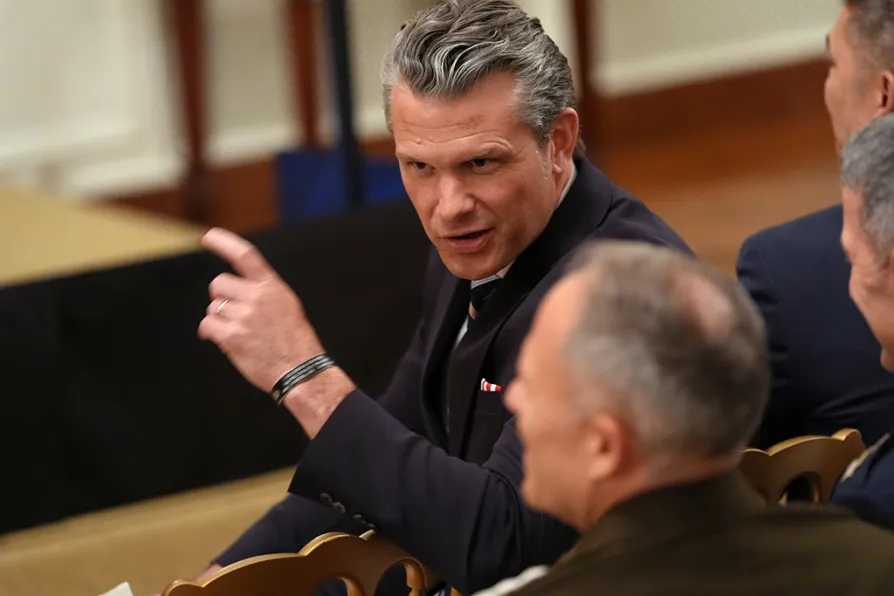 Pentagon chief Pete Hegseth leads efforts to usher in a new age of US terror in Latin America
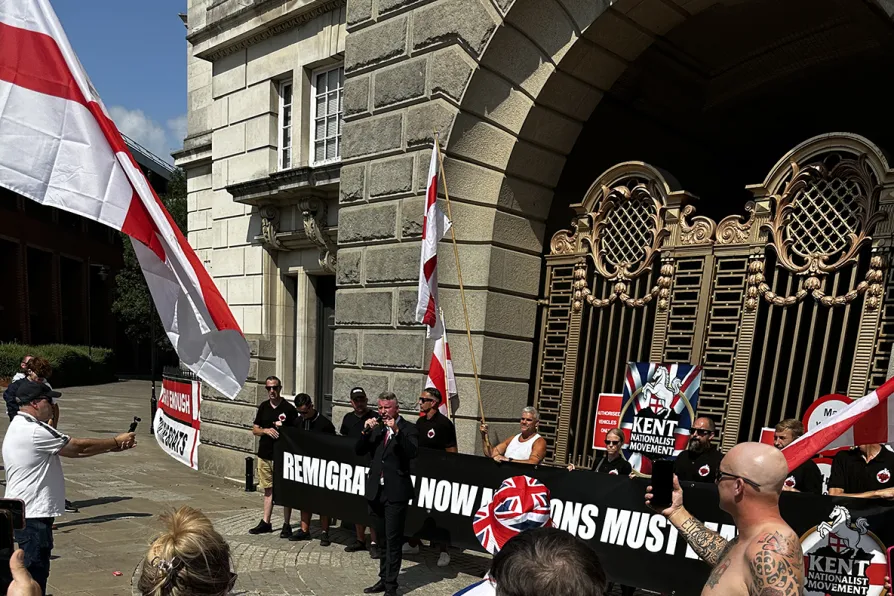
As the 90th anniversary of the outbreak of the Spanish civil war is marked, Teesside campaigners will gather to remember the local men and women who stood against fascism, explains TONY FOX
Whatever differences exist among international sympathisers of the Bolivarian revolution about its current trajectory, they should unite against the imperialist power that is the source of an enforced retreat, argues ROGER D HARRIS
Washington’s inability to subjugate Iran is an example of how it is trying to preserve a regional order that no longer exists, argues RAMZY BAROUD
US financial instability is exposing the limits of a dollar-dominated global economy — and giving the Global South a historic chance to build an alternative, says MURAD QURESHI
Deprivation is a fundamental factor in criminal behaviour that must be addressed but, KENNY MacASKILL argues, there needs to a major rethink in sentencing to tackle overcrowding





Brazil in Trump’s New War on Terror
PETE HEGSETH, US Secretary of War, announced on June 10 from the naval base at Guantanamo Bay that Washington is “taking back our hemisphere” — and that, to do so, it is already deploying in Latin America the same intelligence, the same networks and the same military force used against al-Qaida and Isis in the Middle East, in co-ordination with the allied countries of the Shield of the Americas.
“We are hunting you down like we hunted al-Qaida and Isis in the Middle East — with the same networks and the same intelligence,” Hegseth told the troops, in exercise kit, invoking the 19th-century Monroe Doctrine and what he called the new “Trump Corollary” — an update of the Roosevelt Corollary that treats the western hemisphere as “key terrain” for US national security.
In Brazil, the largest country and economy in Latin America, this new architecture ceased to be an abstraction on June 5. The Primeiro Comando da Capital (PCC) and the Comando Vermelho (CV) were designated by the United States as “Foreign Terrorist Organisations” (FTO) and “Specially Designated Global Terrorists” (SDGT) — the same legal categories applied to al-Qaida and Isis. But Brazil was not the first. The designation campaign had been running for over a year. On February 20 2025, eight Latin American cartels were designated as FTOs and SDGTs at a single stroke: Tren de Aragua, MS-13, the Sinaloa Cartel, the CJNG, the Cartel del Noreste, La Nueva Familia Michoacana, the Cartel del Golfo and Carteles Unidos. In October 2025, OFAC went further still, adding Colombian President Gustavo Petro — a sitting, elected head of state — directly to the SDN List.
OFAC — the Office of Foreign Assets Control of the US Treasury Department, the body responsible for enforcing economic sanctions and freezing the assets of sanctioned persons and entities — updated its sanctions list (the Specially Designated Nationals and Blocked Persons List, or SDN List) to classify the PCC and the Comando Vermelho as a “Transnational Terrorist Group” and “Criminal Organisation.” Whilst the designation criminalises the entity itself as terrorist, the listing means that any individual, bank, company or institution — inside or outside the United States — with any exposure to the designated organisations becomes subject to secondary sanctions and criminal prosecution. This instrument guarantees the global financial isolation of any designated entity, extending the reach of the doctrine far beyond American borders.
As a result, Brazil is being drawn into the same counter-terrorism legal architecture applied to these groups in the Middle East, against a backdrop of expanding US military presence in the surrounding region, including Paraguay and Argentina. Brazilian companies, Brazilian institutions and Brazilian individuals are now potentially subject to OFAC sanctions even outside the United States, and liable under arbitrary immigration and national-security laws within it.
Image
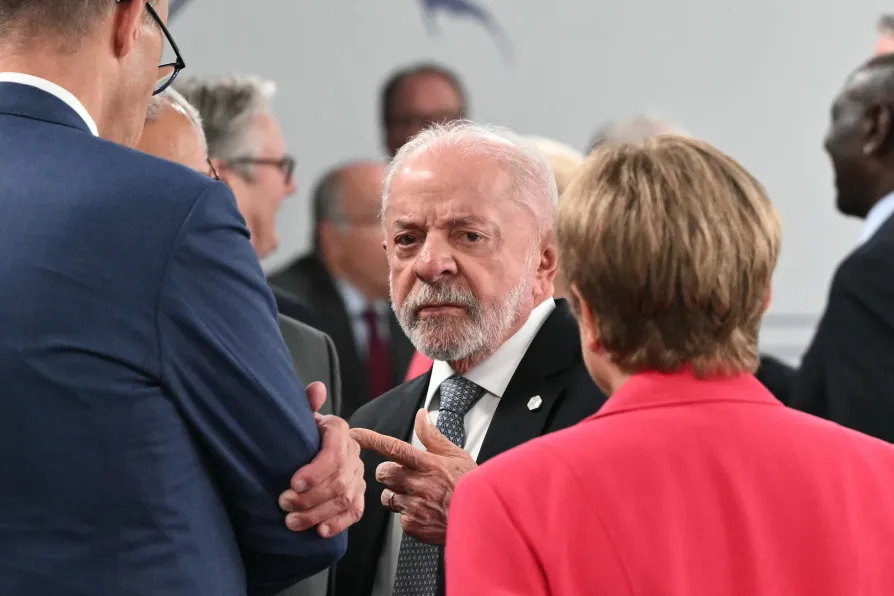
It is no rhetorical improvisation that the Bolsonaro family has been attempting to link Lula and the Workers Party (PT) to the PCC since 2022 — a false claim that led the TSE to order the removal of the relevant publications and to fine Jair Bolsonaro. Flavio Bolsonaro is now reactivating the same strategy on an international scale, seeking to turn ideological opposition into criminal suspicion and to pave the way for the international criminalisation of his adversaries — including Lula personally, in an election year.
[Hegseth video — cut to 2’24’’ https://www.youtube.com/watch?v=NJufZcDVpoQ]
The New War on Terror of the post-October 7 era
Hegseth did not make this declaration at Guantanamo Bay as the former Fox & Friends Weekend presenter he once was, but as the civilian head of the Pentagon — the world’s largest war machine — and the official responsible for the entire US military apparatus. His is the second-highest post in the military chain of command, below only the president.
What Hegseth describes is not a metaphor. It is the literal transfer of the doctrine, methods and infrastructure of the post-9/11 War on Terror to Trump’s new war on terror against transnational “violent left-wing extremism.” This new architecture was inaugurated by the 2026 National Counterterrorism Strategy, signed by Trump on May 6.
That document fused, for the first time in US history, three official categories of terrorist threat into one: “narco-terrorists and transnational gangs,” “legacy Islamist terrorists” and — unprecedented — “violent left-wing extremists, including anarchists and anti-fascists.”
Hegseth cited the Strategy as the doctrinal magna carta of the offensive to “take back our hemisphere,” claiming that previous presidents had “ignored the Monroe Doctrine for far too long” and “pretended that our own backyard did not matter.”
It is no coincidence that Hegseth spent 45 minutes at Guantanamo Bay — a site of torture and of the illegal US occupation of Cuban territory — extolling the military operation that captured Venezuelan President Nicolas Maduro in a matter of minutes. He hailed that operation, against Venezuela, as the great dress rehearsal for putting the doctrine into practice.
Trump’s new war on terror moves away from the doctrine of “Arab-religious” terrorism, shifting the war on jihadism towards the heart of the contemporary ideological struggle of the post-October 7 era within civil society itself — including against “left-wing extremism.”
Numerous official documents and acts of the Trump administration set out a clear, well-documented and opportunistic doctrine against a new form of ideological terrorism: “violent left-wing extremism.” The strategy is global. Whilst at home, in the United States and Europe, this doctrine translates into campaigns of securitisation and the criminalisation of civil society — above all of the Palestinian solidarity and immigration movements — in Latin America it takes the form of a far more radical rupture.
How Trump Is Building a Legal and Military Architecture to Invade Latin America
Legally, the strategy for Latin America consists of merging “narco-terrorism” and “left-wing extremism” into a single category and attributing it to elected governments and leaders deemed hostile to Washington — thereby opening the door even to military intervention.
1. Terrorist Designations
Designating cartels within the same legal category as al-Qaida unlocks the same powers of extraterritorial military action used in the post-9/11 era. Latin America emerged as a political priority for the Trump administration from the very first day of his term. On January 20 2025, the day of his inauguration, Trump designated Cuba as a State Sponsor of Terrorism (SST), while Venezuela was deliberately excluded from that list.
Deliberately so, because on that same day Trump signed an executive order inaugurating a different strategy, to be tested in Venezuela: a formal process to designate, in broad and expansive language, “certain cartels” and “other organisations” as Foreign Terrorist Organisations or Specially Designated Global Terrorists. Most significantly, the document altered the very definition of a cartel, establishing that such groups go beyond traditional organised crime by virtue of their convergence with extra-hemispheric actors, including hostile governments.
In November 2025, Hegseth designated the Cartel de los Soles as a Foreign Terrorist Organisation and publicly insisted that Maduro was “the leader of that cartel” — precisely in the terms of the executive order’s new definition.
The Cartel de los Soles has never existed. The term is Venezuelan slang from the 1990s, used generically for leaders corrupted by drug trafficking. The Department of Justice (DOJ) itself would later concede in court that the organisation does not exist, and technical bodies of the US government — the DEA, the State Department, the Congressional Research Service and the UNODC’s World Drug Report — contradict the lie that justified the invasion, identifying neither fentanyl production nor distribution networks in Venezuela.
Nor were weapons of mass destruction required — the lie told by Bush and Tony Blair to their respective legislatures — to justify the invasion and destruction of Iraq. The designation alone was enough to open the legal pathway to the invasion of a sovereign state. As Hegseth himself acknowledged in an interview with One America News Network, declaring the Cartel de los Soles a terrorist organisation embedded within the Venezuelan state would bring “a whole lot of new options” for how the United States deals with narco-terrorists in the region.
2. Intelligence Networks and Coalitions of Allied Countries
In his speech, Hegseth also announced the expansion of the Shield of the Americas — the anti-narco-terrorism coalition — as a mechanism for operating inside allied countries, “finding where these designated terrorists operate, where they produce their drugs,” replicating the special-operations model used in Afghanistan and Iraq.
Image
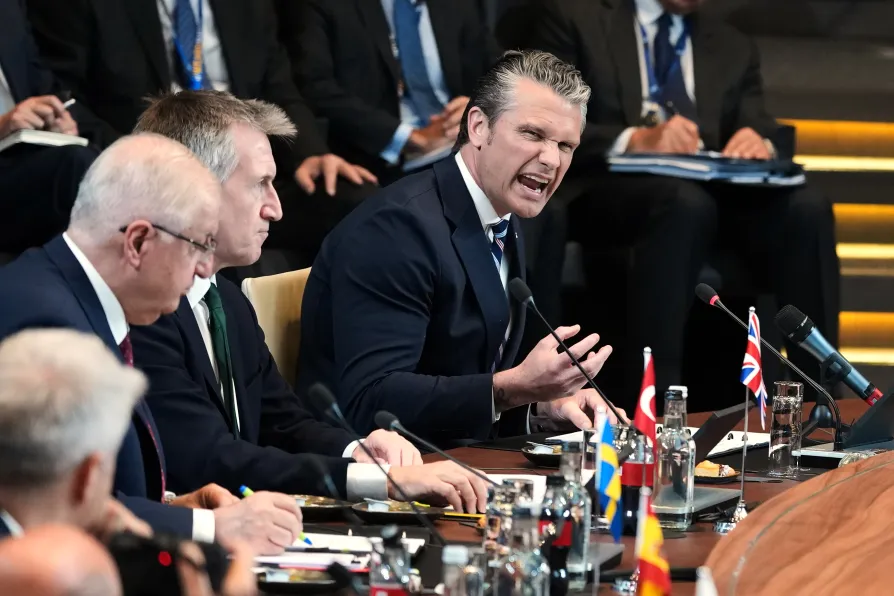
The same surveillance structures, data-fusion capabilities and special operations built in the Middle East are being replicated in the Caribbean, the Amazon and the South Pacific — with the Shield of the Americas as the equivalent of the post-2001 “war on terror” coalition, and with Bukele and Milei playing the roles that Musharraf and King Abdullah played in the Middle East.
Two months after the invasion of Venezuela and the abduction of President Nicolas Maduro and First Combatant Cilia Flores, on March 7 Trump gathered heads of state from twelve Latin American nations at his golf resort in Doral, Florida, for the inaugural summit of the Shield of the Americas (officially the Americas Counter Cartel Coalition — ACCC). The leaders of the region’s largest independent economies — Brazil, Mexico and Colombia — were not invited, whilst the autocrat Nayib Bukele of El Salvador and Javier Milei of Argentina were on the guest list. The official narrative was the fight against cartels, but the Shield’s proclamation spoke of repelling “foreign influences” and “interference in the hemisphere” — language aimed at China, whose trade with the region rose from $12 billion in 2000 to $515bn in 2024. The coalition brings together 18 countries with the aim of expanding intelligence-sharing and maritime interdiction in the Caribbean and the Pacific.
3. Military Bases
Guantanamo, the Argentine bases under Decree 264/2026, the FBI office in Ecuador and the Paraguayan SOFA become the functional equivalents of the US bases in Kuwait, Qatar and Bahrain. Cuba still holds out.
In the days following the summit, the regional architecture of the Shield of the Americas began to take shape. On March 10, under an agreement negotiated between Marco Rubio and Paraguayan Foreign Minister Ruben Ramirez Lezcano, the Paraguayan Chamber of Deputies approved a Status of Forces Agreement (SOFA) permitting the presence of US military and civilian personnel in the country, with criminal immunity equivalent to that of diplomatic staff. President Lula expressed concern at the possibility of US soldiers being deployed along the Paraguay–Brazil border.
One day later, on March 11, the United States opened its first permanent FBI office in Ecuador, crowning a chain of security agreements signed in just a fortnight between Washington and Quito — including, on March 3, the first joint anti-drugs military operation on Latin American soil, led by Southern Command. Analysts note that Ecuador’s strategic position — with direct access to the Pacific and the Galapagos Islands — makes it a privileged hub for US intelligence projection in the region.
In the process of replacing what remains of diplomacy with militarisation, Milei has proved an obedient and structurally indispensable ally of the Shield of the Americas. Decree of Necessity and Urgency 264/2026, signed by Milei on April 17 and published in the Official Gazette, authorised the entry of United States Armed Forces personnel and equipment for the “Daga Atlantica” exercise, between April 21 and June 12 2026, at the Naval Base of Puerto Belgrano, the Cordoba Military Garrison and the VII Air Brigade in Moreno, Buenos Aires — in parallel with the deployment of the nuclear-powered aircraft carrier USS Nimitz in South Atlantic waters.
Even as the legal architecture was being formalised, Washington had already deployed warships, positioned F-35 fighters in Puerto Rico and sent the aircraft carrier USS Gerald R Ford to the Caribbean — firepower plainly disproportionate for combating cartels that have no air force. Since September 2 2025, the United States has carried out at least 44 attacks on vessels in the Caribbean and the Eastern Pacific, in what the UN classified as extrajudicial executions. In March 2026, a defence official confirmed to Congress that 47 vessels had been attacked and at least 157 people killed, including fishermen from Trinidad and Tobago and from Colombia. The UN determined that covert or direct military action against another sovereign state would constitute “an even graver violation of the UN Charter.”
The commander of Southern Command (Southcom) — the military structure responsible for US operations in Latin America and the Caribbean — Admiral Alvin Holsey himself raised internal concerns about the legality of the operations and tendered his resignation at a tense meeting with Hegseth on October 6.
4. Mass-Surveillance Technology on Foreign Soil
The technological dimension of this architecture arrived, however, with another figure from the corporate world — one with deep roots in the intelligence services of both the United States and Israel. On April 12 2026 — precisely as US troops were beginning to take up positions on Argentine bases — Peter Thiel landed in Buenos Aires accompanied by family, advisers and personal security. On April 23 he was received at the Casa Rosada by Milei and Foreign Minister Pablo Quirno. Milei described the meeting as a “wonderful” conversation between “anarcho-capitalists.”
Thiel, a former limited partner of Jeffrey Epstein, is co-founder and chairman of Palantir Technologies, a company built around data integration, intelligence analysis and government contracts.
Since 2014, Palantir has supplied technology to Israeli security agencies and entered into a “strategic partnership” with the Israeli Ministry of Defence to support the “war effort,” holding a board meeting in Tel Aviv “in solidarity” with Israel. A report by UN special rapporteur Francesca Albanese concluded that there were “reasonable grounds” to believe that Palantir supplied predictive-policing technology and the artificial-intelligence platform powering the “Lavender,” “Gospel” and “Where’s Daddy?” systems — systems that automatically generate lists of tens of thousands of targets in Gaza. Palantir also supplies the Gaza Civil–Military Co-ordination Centre, the US military complex in Kiryat Gat created in October 2025 to implement the Trump plan for Gaza.
It is the same company that, in the United States, accumulated contracts with ICE worth $287 million between 2011 and 2025, providing the system that gives every immigration officer access to a network of public and private databases on any individual. Palantir is penetrating Brazil through the TV presenter Luciano Huck and the former Supreme Court Justice Luis Roberto Barroso.
The Unprecedented Nature of Trump’s New War on Terror
The United States is inaugurating, before our eyes, a hemispheric and global security doctrine that is dangerously misread as a mere continuation — more explicit and aggressive — of traditional US expansionism. A vast legal, political and military architecture is being drawn up by the Trump administration and its international partners, including with Israel and the Israeli lobby, for the so-called New War on Terror against a global, “transnational left-wing extremism” of the post-7 October era.
This level of aggression goes well beyond anything the US has pursued in the region in the last four decades, since Operation Condor, the Contra War, and the coups in Chile, Argentina, Brazil, Guatemala and elsewhere.
Official documents and acts of the Trump administration set out a clear, coherent, opportunistic and well-documented doctrine against a new form of terrorism. There is a paradigm shift of the post-7 October era, expressed as state policy by the Trump administration itself, which systematically equates pro-Palestinian protest with terrorism and antisemitism. One telling example is Project Esther, conceived by the Heritage Foundation — the same group behind Project 2025 — which consolidated this rhetoric into explicit institutional policy on university campuses. Acts such as taking part in pro-Palestinian protests were framed as antisemitism and as the provision of material support to terrorism, so that demonstrators might be deported or face imprisonment, civil penalties or other serious consequences.
This is an attempt to reorganise US and global North hegemony by expanding the vocabulary of counter-terrorism to cover “left-wing extremism” and dissent within civil society — opening what the law calls transnational “states of exception,” discrediting democratic guarantees and paving the way for the rise of the far right and its intersection with American libertarianism: a current that preaches the dissolution of the state and the absolute sovereignty of the individual as a political principle.
