
The US administration is endangering lives by reversing environmental protection laws, CHAUNCEY K ROBINSON argues

War and the global food time bomb
Fertiliser chaos triggered by Gulf conflict could send prices soaring and leave millions facing devastating hunger, writes DYLAN MURPHY
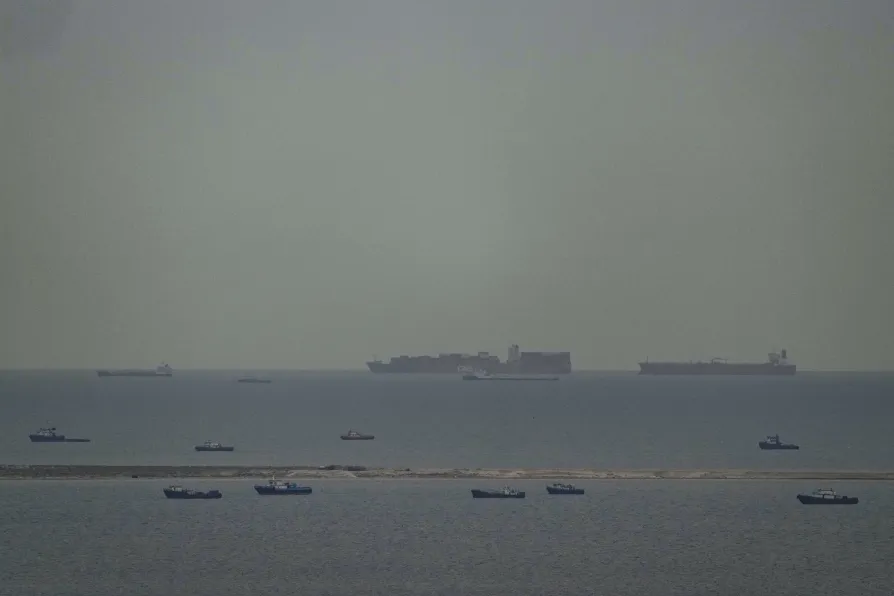
 CRISIS LOOMING: Fishing boats dot the sea as cargo ships, in the background, sail through the Arabian Gulf toward the Strait of Hormuz off the United Arab Emirates, Friday March 27 2026

It’s time to stop retreating and go on the offensive to promote working-class interests, argues DOUG NICHOLLS
Marco Rubio wants to defeat socialism in Nicaragua, not restore ‘democracy,’ writes JOHN PERRY
Believe it or not, there was a time when the US government built beautiful homes for working‑class Americans to deal with a housing shortage, writes ERAN BEN-JOSEPH
DIANE ABBOTT provides an analysis of the reasons for EU and British voters’ dramatic swing to the right
Train drivers’ union Aslef general secretary DAVE CALFE speaks to Ben Chacko about his hopes that Burnham’s devolution agenda will include the importance of the railway





THE ongoing US-Israeli war on Iran is triggering a silent, invisible crisis that threatens every person on the planet.
This devastating war, launched by the US and Israel with reckless disregard for global consequences, has not only killed thousands of civilians in Iran and Lebanon, but threatens a catastrophic shortage of something fundamental to our survival: fertiliser.
Without fertiliser, we cannot grow enough food to feed the world’s population. Right now, the global supply of this critical resource is under threat, setting the stage for a food crisis that will hit the poorest nations with the threat of starvation, and the wealthiest nations with crippling food price inflation.
To understand why this is happening, we have to look at where our fertiliser comes from. The Gulf region, specifically the area around the Strait of Hormuz, is the beating heart of global fertiliser production. This narrow waterway, which has been virtually shut down due to the conflict, is a vital artery for the world’s agricultural supply chain.
The Gulf accounts for nearly half of the world’s traded urea, the most widely used nitrogen fertiliser, and a significant portion of other essential nutrients like ammonia and sulphur.
These chemicals are the building blocks of modern farming. Nitrogen helps plants grow and boosts yields, while phosphate supports root development.
The US-Israeli military offensive has disrupted this supply chain in two major ways. First, the closure of the Strait of Hormuz means ships carrying fertiliser cannot get out to the farmers who desperately need it. The Fertilizer Institute reported that dozens of vessels loaded with vital supplies were left floating in the Gulf, unable to move.
Second, the soaring cost of natural gas — an essential ingredient in manufacturing fertiliser — has forced plants around the world to slash production or shut down entirely.
The timing of this crisis could not be worse. The disruption has hit right in the middle of the crucial spring planting season for the northern hemisphere. Farmers apply fertilisers just before or during planting. If the fertiliser arrives late, the crops miss key growth stages, and the final harvest is significantly reduced.
As the crisis unfolds, a dangerous chain reaction has begun. Fearing shortages and soaring prices at home, major producers like China, Russia and Turkey have restricted their own exports. China, which holds half of the world’s fertiliser inventory, has tightened its export curbs.
With close to 45 per cent of globally traded nitrogen cut off or at risk, prices have skyrocketed. Global urea prices surged by 60 per cent in a matter of weeks, and in places like Australia, farmers have faced costs up to four times higher than pre-pandemic levels.
The most devastating impact of this reckless US-Israeli military campaign will be felt in the developing world, where the threat is actual starvation. Poorer countries in Asia and Africa are highly dependent on fertiliser imports from the Gulf and lack the financial resources to outbid wealthier nations.
Countries like India, Pakistan and Bangladesh are facing massive shortfalls, losing millions of tonnes of urea each week. In Africa, where many farmers rely on imported fertiliser, the situation is equally dire. For smallholder farmers, the soaring costs are simply unaffordable.
When farmers cannot afford fertiliser, they use less of it, leading to lower crop yields and harvest failures. Even a short delay in applying fertiliser can reduce a maize harvest by 4 per cent, a loss that many communities cannot absorb.
World Trade Organisation deputy director Jean Marie Paugam has called the fertiliser shock the “number one alert today,” warning that there are countries where people will die of hunger if they cannot secure the imports they need.
Britain is deeply exposed to the fallout of this US-Israeli manufactured crisis, revealing severe vulnerabilities in our national food security. Currently, the UK is only about 62 per cent self-sufficient in food, meaning we rely on imports for nearly 40 per cent of what we consume. Our agricultural sector is also alarmingly dependent on foreign inputs; we import around 60 per cent of our nitrogen fertiliser, and the recent scaling back of Britain’s domestic manufacturing facilities has left us entirely at the mercy of volatile global markets.
The war has already caused the price of red diesel — essential for running farm machinery — to surge by 60 per cent, while fertiliser costs have skyrocketed by roughly £50 per tonne compared to early 2025. This double blow is squeezing British farmers who were already struggling with low margins.
We must demand accountability: the US and Israel launched this devastating war on Iran with absolute disregard for how it would destabilise global food production. To protect ourselves from the reckless aggressive actions of foreign powers, the Labour government must urgently implement plans to achieve food and fertiliser self-sufficiency.
We must rebuild our domestic fertiliser manufacturing capabilities, transition to sustainable farming methods that require fewer synthetic inputs, and drastically improve our own domestic energy production to insulate our food supply from global energy shocks.
The US-Israeli war on Iran has exposed a critical vulnerability in our global food system. It has shown us how fragile the supply chains are that keep the world fed, and how quickly an unjustified military conflict can translate into empty plates and soaring prices for working people everywhere.
The world cannot afford to be so heavily dependent on a single region for the resources that sustain life, nor can we allow aggressive military actions by the US and Israel to dictate the food security of billions. We must rethink how we produce food, moving towards more resilient, local, and sustainable agricultural practices.
But in the short term, the reality is grim. The longer this unjust war drags on, the deeper the fertiliser shortage will become, and the worse the resulting global food crisis will be.
The current Labour government must stop letting the US use British bases for carrying out bombing attacks on Iran. Besides this, it must demand that the US and Israel end their murderous war which threatens a major catastrophe over the next year.

Similar stories

Claiming to ease a fertiliser shortage, the Trump administration has suspended tariffs on Moroccan phosphate imports – deepening US support for the Morocco’s control over Sahrawi territory, writes LUKE ROTELLO
RAMZY BAROUD and ROMANA RUBEO analyse how the US has consistently negotiated in bad faith to secure the element of surprise in military attack