MARIA DUARTE recommends a remarkable study of the friendship between a Palestinian and a Pakistani, broken by a hostile state


 Latest editorial

A vision in verse of the English Revolution
CHRIS SEARLE relishes the relevance and sheer poetic dexterity of an excellent imagining of the divided destiny of the Levellers
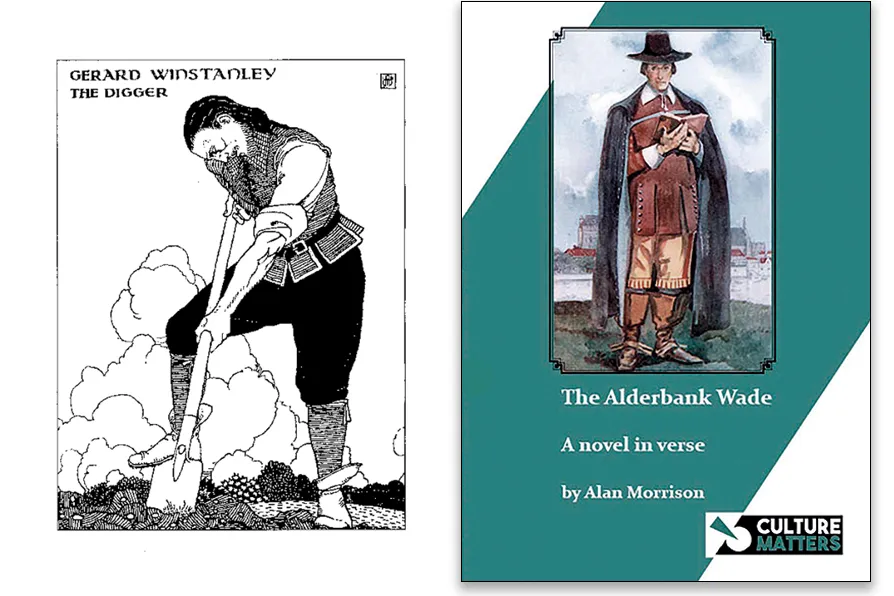 Gerrard Winstanley, 17th century radical [Pic: Public Domain]

MATTHEW HAWKINS rakes through un-fancy words and flair-free summaries to find who and what might be flamboyant
PETER MASON is exhilarated by an exciting, well-considered and historically minded tribute to the great Trinidadian instrument
Reducing historical lives to ‘male’ and ‘female’ roles, we lose the nuance of those lives and a clearer understanding of past societies, suggests CLAIRE ISABELLA GILMOUR
CHRIS SEARLE relishes the genius of pianist Alexander Hawkins, his many ensembles, and his new album





The Alderbank Wade: a novel in verse
Alan Morrison, Culture Matters, £12
IF you think that the rhyming couplet is a dry, tedious or anaesthetic form of poetry, you should read the 122 pages of Alan Morrison’s “novel in verse,” The Alderbank Wade. The wit, surprise, imaginative empathy, licence and sheer poetic dexterity of Morrison’s command of the form with the sharpest of now-times relevance, will make you think again. Full rhymes, half and quarter rhymes, phantom rhymes, visual rhymes and outrageously unlikely rhymes are fused with such poetic skill, as to prompt you to read the novel in one compelling session.
The Alderbank Wade is set in the era immediately following the English civil war, in the early years of the republic. With his wondrous rhyming artistry and powerful historical consciousness, Morrison relives the lives of a group of young revolutionaries, with “dreams of a levelled England,” who take over a captured Hampshire country mansion, Alderbank, and seek to create “common fellowship,” a Utopian community of “an Eden re-delved” in a “green Jerusalem” of egalitarian living. This is certainly an audacious undertaking as the restored landlordism promoted by the Cromwellian militias are attacking the new levelling communities and destroying them with scorched-earth brutality.
There are many interconnecting themes in Morrison’s work, but above all is the crisis of division — spiritual, political, personal and behavioural, that assails his novel’s two primary characters, protagonist and narrator, both victims of “a divided mind at a divided time.” At the story’s crux is Gideon Wade, from an Anglican family, who began the civil war as a royalist, before a “metamorphosis” of mind turned him towards the parliamentary forces. He changes to become an arch-desecrator, “smashing the statues and idols and ornaments” of local churches, and after the war leads the transformation of Alderbank into a levellers’ stockade.
His childhood friend — as boys they played Robin Hood games in the Hampshire countryside — is the narrator, Jared, who becomes Gideon’s secretary but is still “a prisoner in my own head,” unsure and beset with problematic thoughts about the present and the future, and struggling to find clarity in an “all-entangling tortuous thought tree.”
Both become trapped within “the grotesque contradictions and paradoxes of our time,” and as the hostile militias close in around their new home and its living symbolism of “equitable distribution of wealth and property/ Across the land” their “dreams of a levelled England” are mercilessly crushed.
The narrative moves swiftly, following Gideon’s further change from ardent revolutionary to one who “as sand on a riverbank” is “liable to change, shift, move imperceptibly” towards disbelief and despair.
“Gideon was losing his faith in humanity and himself,” declares his friend, and as the militia burns down Alderbank, killing and expelling its residents, like a ghost he disappears. As Jared returns to stare at the burnt wreckage, he can only lament in memorable lines: “When I woke cold and shivering it was green morning light/And down the hill before me Alderbank was anthracite.”
There are many points to ponder after reading The Alderbank Wade, and particularly for us in 2026. It took me back decades to the tragedy of Grenada. But now in Britain there is the need to understand and overcome the scourge of divisiveness, of sectarianism, still as blatant now as it was in Gideon and Jared’s time, in the challenge of unity that we must forge.
I read the conclusion of Morrison’s novel coming home on the tube from the huge and inspiring Together Alliance march of half a million through London: all races, all faiths, all of us from all over Britain together against the curse of impending fascism.
Perhaps our own cosmopolitan times have a great need of Morrison’s long poem, for it is a cogent and gripping tool of learning as much as a cultural artefact of true excellence. And with his words still zooming in my head: long live the rhyming couplet!
