Britain funds the policing of black culture 16 times better than the culture itself. The Diamond Jubilee is the moment to end that, argues CLAUDIA WEBBE


 Latest editorial

The US and the illusion of military mastery
Washington’s response to a downed jet shows a superpower still reaching for overwhelming force even as its wars repeatedly fail, says NICK WRIGHT
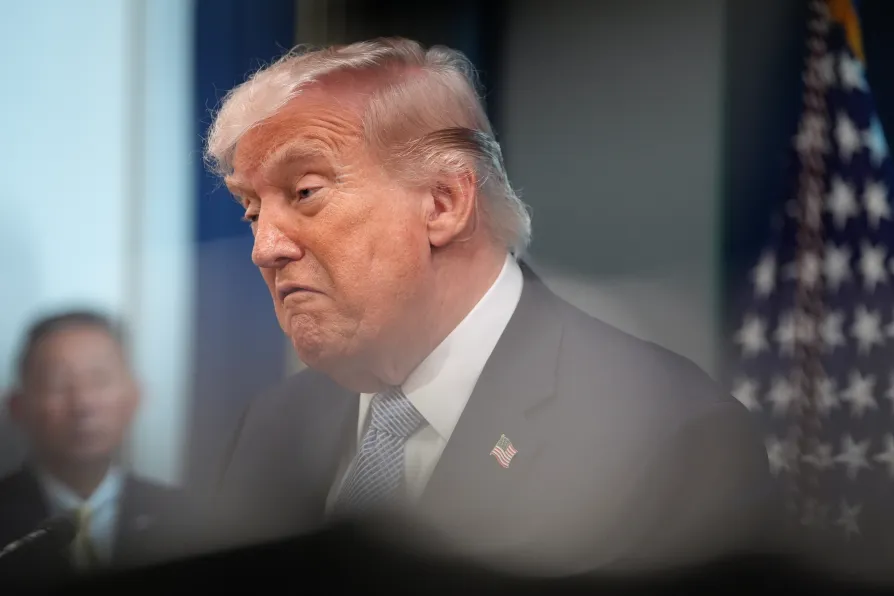 President Donald Trump speaks with reporters in the James Brady Press Briefing Room at the White House, April 6, 2026, in Washington

Growing instability in the US economy and financial markets could have serious consequences worldwide because of the central role of the US dollar and financial system, argues MICHAEL BURKE
Despite Andy Burnham’s declaration defending the continued partition of the island, all major international and internal trends are converging to make Irish reunification inevitable
Humans are part of the ‘animal kingdom’ – and of nature in general – but also distinct from it and labour (work) is part of what makes us unique, declared Engels. His insights 150 years ago into how our species came to be and how we differ from the rest of nature, are as important today as they were then, says the MARX MEMORIAL LIBRARY
Growing instability in the US economy and financial markets could have serious consequences worldwide because of the central role of the US dollar and financial system, argues MICHAEL BURKE
From Margate to Deal, mining memories are being kept alive. National co-ordinator for General Strike 100, HENRY FOWLER continued his nationwide tour of partner organisations in the Garden of England





IT IS A textbook definition of asymmetrical warfare. To recover one downed F-16 weapons officer and we might speculate why a full colonel was flying combat missions over hostile territory — it cost the United States hundreds of millions of dollars, two MC-130J special operations aircraft each costing $100 million, and several helicopters.
And in an inversion of the usual rules of war which see late teenage soldiers die while generals serve in safety, 12 generals were sacked.
In the contingent political processes, Donald Trump looked and sounded dafter than usual and his “Secretary of War” Pete Hegseth even more deranged than was evident from his Easter sermon which drafted God, Jesus and the Holy Ghost into military service.
Those deluded parts of the Iranian diaspora who hold to the illusion that the US and Israel were intent on bombing Iran into regime change are beginning to understand that the Pahlavi dynasty is not going to ride into Tehran on US tanks unless it can be arranged without significant US casualties.
The Trumpian version of this latest drama — faithfully reproduced by the BBC and most media outfits — is that the rescue of the hapless colonel was a demonstration of US military mastery.
This notion bears some examination.
If we work on the assumption that military commanders perfect their doctrines through lived experience, then we must assume that the senior figures in the US military machine like army Chief of Staff General Randy George, who saw service in Operation Desert Shield, Desert Storm, Operation Iraqi Freedom and Operation Enduring Freedom, might have drawn some conclusions from the consequences of these imperial wars of choice.
None of them were crowned with success when measured against the ostensible aims of each.
The 2001 to 2021 war on Afghanistan cost the US about $2.3 trillion while Britain spent just under $23 billion. The result of this effort was to replace the Taliban regime — which itself was the eventual beneficiary of the US-financed mojahedin war against Afghanistan’s socialist government — with another Taliban administration.
A congressional question elicited the intelligence that the total cost to the individual US taxpayer of these wars — excluding those that were coyly named as “non-Department of Defence classified programmes” was $8,278.
Aside from the admitted costs of the wars the innocent might conclude these other expenses were Peace Corps-type humanitarian programmes bringing enlightenment and democratic values to the peasantry of the region. The less charitable might suspect it was CIA dark money propping up compliant regimes and local warlords.
We don’t know for sure why the Trump administration purged its military command but it seems likely that the entire corps of senior officers were not unanimous in endorsing a military adventure where the outcome is so uncertain on terrain where technical superiority is not proven to be the decisive factor.
Presently, an enormous air armada of these ubiquitous US C-17 transport planes have been streaming towards western Asia and the Mediterranean interspersed with KC-135 air-to-air refuelling tanker aircraft.
C-17 transporters are the go-to aircraft for heavy lifting and will carry all the heavy-duty material that an expeditionary force requires.
The logistics of modern warfare, even if the deployment is only for show, are enormous.
Trump’s overblown rhetoric has some foundation in the extravagant “investment” made by the US as it compensates for its declining and challenged economic power by mobilising its military superiority.
The notion of full-spectrum dominance on the battle sphere is a constant no matter who occupies the White House. In fact it was Saint Obama of blessed memory who was most profligate in deployed the tactic of the sudden missile strike on rural Afghans whenever a wedding party or family funeral guest list had the misfortune to include someone on the president’s kill list.
That is a special kind of asymmetrical warfare when the technical superiority of 21st century capitalism over ex-colonial rural states lent Pentagon war gamers a false sense of the utility of their more sophisticated weaponry.
In the end both US public opinion and significant sections of the US military/intelligence sector each reached the conclusion that forever foreign wars are not working.
On this current war US opinion is roughly two to one against, with the people’s views largely skewed in line with opinions on Trump’s presidency.
Britain, of course, under governments of every different colour, is thoroughly complicit in this exercise in imperial power. Prince Harry set the standard when he spent his late adolescence playing computer games with the lives of Afghans. Sat in the safety of a British army base he worked out the military deployment obligatory to male royals crouched over a computer screen calling down RAF strikes on helpless villagers. His efforts notwithstanding, the asymmetry turned full circle and Nato retreated in defeat.
British complicity in US military adventures is routine and continuing. The F-16 currently smouldering on an Iranian hillside was based at the US airforce base at “RAF” Lakenheath and both the pilot and weapons officer might have been found drinking in an East Anglian pub the week before.
We still don’t know whether the military build-up is the precursor to a boots-on-the-ground full-scale invasion of Iran; or that the latest adventure was an attempt to secure a territorial platform for an more extensive ground operation. Or the whole shooting match a show of apparent strength by a president who always chickens out.
The present two-week ceasefire window suggests the latter but is clearly conditioned by the political and economic need to get the global oil price down and revive commercial confidence. Pakistan’s agency in the matter of the ceasefire meets the needs of the Gulf states.
What is apparent is that there is far from unanimity in the US security, intelligence and military “community.”
And if the sacking of a significant tranche of the US military leadership is merely an expression of Trump’s caprice or even of Hegseth’s pre-emptive purging of rivals it, nevertheless takes place in a context in which the split in the US ruling class — along similar lines to the divisions in our elite — finds a reflection at every level of society. And thus, inevitably, in the state apparatus.
Trump’s performative opposition to “foreign wars” — which won him a big chunk of working-class votes — and his open abandonment of this policy is a factor in the fragmentation of his electoral alliance hence the sense of disorder and indecision in his administration.
The layers of mystification now constructed around the rescue operation stretch credulity. The US fighter aircraft was shot down despite Trump’s boast that Iranian air defence was “100 per cent annihilated.” (As was the downing of an A-10 Warthog close support fighter at the Straits of Hormuz). The so far anonymous colonel was wounded but is supposed to have scaled a 7,000-foot mountain before his rescue.
In one sense it doesn’t matter whether a more ambitious goal has been dressed up as a rescue. It was a logistical disaster and an expensive operation and is now shown to be the precursor of a diplomatic initiative which has compelled the US to pause its military offensive and, in the process, narrow down Benjamin Netanyahu’s immediate options.

Similar stories
The US president’s adventurism in Iran began as a display of overwhelming force but has swiftly become a lesson in over-reach, says ANDREW MURRAY
The ghosts of Custer’s doomed campaign haunt a modern America still devoted to waging imperialist war, says STEPHEN ARNELL

As the government quietly upgrades the role of Britain’s special forces, their growing global footprint and near-total exemption from democratic oversight should alarm us all, says ROGER McKENZIE