The UK Prime Minister may have the regal touch in northern England, but he’s been wrong-footed on the constitutional challenges posed by the Celtic Alliance of first ministers from Scotland, Wales and Northern Ireland, argues KENNY MacASKILL

Uni students target fossil-based industry recruitment
As fossil fuels have had their day, JOSIE MIZEN makes it clear that it is now the government’s responsibility to initiate the transition to alternative employment in a manner that is organised, efficient and effective
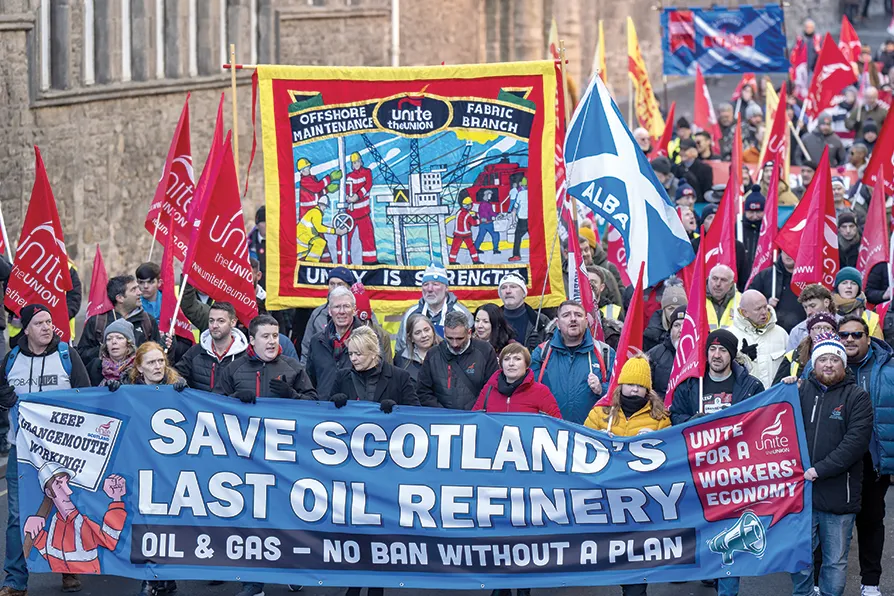
 EMPHASIS ON PLAN: Members of the Unite rally at the Scottish Parliament in November last year in protest at Petroineos plans to close Grangemouth oil refinery

NEIRLAY ANDRADE, a member of the Communist Party of Venezuela’s political committee, outlines her party’s position on the crisis facing the country
A look at Taylor Wimpey’s accounts shows why Labour’s market-led housing strategy won’t deliver more, cheaper homes, as promised, says SOLOMON HUGHES
DAVID HORSLEY remembers the remarkable life and death of US black revolutionary George Jackson, whose politically passionate prison letters were published as Soledad Brother
Cuban trade union federation CTC leader OSNAY MIGUEL COLINA speaks to Ben Chacko about life and work under a crippling US siege
A part of the British empire’s network of slavery, today the Caribbean island of Nevis faces a new form of exploitation in the form of crypto-colonialism, CLAUDIA WEBBE writes
Challenges from the unscrupulous misuse of AI to steal actors’ voice and physical likenesses is being met with a firm union response, writes LYNDA ROOKE





IF WE want a just transition, we need to stop the fossil fuel recruitment pipeline. The fossil fuel industry is a dead-end industry. Even the more conservative predictions make it clear that there can be no new oil and gas if we are to avoid the worst impacts of climate breakdown.
Just this month alone, extreme flooding exacerbated by global warming has claimed the lives of over 400 people in Indonesia and destroyed over 20,000 homes in Sri Lanka.
We know that the climate crisis is here — and that the fossil fuel industry is fuelling it.
Many organisations that work on a just transition — the idea that we need to urgently transition away from fossil fuels in a way that prioritises the needs of industry workers and front-line communities — understandably focus on supporting workers to leave this industry in favour of lower carbon alternatives.
Research from Greenpeace shows that over 80 per cent of offshore oil and gas workers would like to transition into new jobs, yet often lack the governmental or industry support to do so.
This is vital work, but a key — and often overlooked — aspect of the just transition is that we need to stop funnelling workers into the oil and gas industry to begin with.
Yet fossil fuel majors, from BP, to ExxonMobil, to Ineos, are doubling down on their efforts to recruit new workers. They know that recruitment is an area where they are highly vulnerable: without a steady stream of new recruits, workers will retire or move on from the industry and there will be no one to replace them.
Universities and educational establishments are key sites where the fossil fuel industry recruitment pipeline is established. Oil, gas and mining companies advertise prolifically at university careers fairs, host exclusive networking events, and pay careers services to promote their jobs.
This coveted advertising space allows them to greenwash their image, gloss over their harmful impacts, and wield power and influence over the workers of tomorrow.
We need to see this for what it is: an aggressive and manipulative strategy to funnel young people — often searching for work in a climate of soaring student debt and spiralling costs of living — into jobs that don’t serve them, their communities, or the planet.
But students are fighting back. Standing in solidarity with workers and communities on the front lines of the climate crisis, students are campaigning for fossil fuel industry recruiters to be excluded from university spaces.
From passing students’ union motions that ban fossil fuel companies from students’ union buildings, to challenging industry representatives at careers fairs, to even chasing fossil fuel recruiters off campus themselves: students won’t tolerate their educational institutions being used as fertile recruitment ground for some of the world’s most harmful companies.
Eighteen universities have already listened to student demands, and committed to cutting their recruitment ties with the fossil fuel industry.
From Bradford to Aberystwyth to Bath Spa, there are now 18 UK universities that have decided to no longer advertise fossil fuel industry jobs, and the campaign is gaining momentum.So why does all of this matter to the just transition?
Put simply, a corporation cannot exist without its workers. Even the biggest of the fossil fuel supermajors simply cannot maintain — let alone expand — its operations if there’s no-one to run the machines, survey the sites, or crunch the numbers.
And the fossil fuel industry knows that recruitment is an area where it’s vulnerable.
With an ageing workforce and myriad jobs that require highly specialist skills, fossil fuel companies know that it’s young people — and young graduates, in particular — that they need to target as new workers.
A 2022 report by Energy Outlook says that, in Europe, almost half of fossil fuel industry recruiters view the ageing workforce and associated skills shortages as the biggest challenge facing the industry.
One in 10 industry jobs, the report continues, are vacant for three months or more, leading to key positions going unfilled and operational capacity being reduced.
Moreover, the industry knows it has a reputational problem. Rather than deal with this by actually transitioning away from oil and gas and paying reparations to the communities they’ve devastated, fossil fuel companies instead use the smiling faces of young graduates — combined with an increasingly slick social media operation — to manufacture legitimacy for their destruction.
Young people, who sometimes take jobs in the industry out of a genuine belief that they’ll be furthering the transition to renewable energy, are pinned up as propaganda for the business-as-usual extractivism of an industry whose social licence is in tatters.
By denying fossil fuel companies platforms from which to advertise their jobs, we can start to dismantle their recruitment pipeline.
In doing so, we diminish not only their operational capacity, but also their reputation.
If done systematically, this is a way of genuinely weakening the industry’s influence over our society, while also avoiding funnelling young people into jobs without a future.
Because sadly, the job losses that come as a result of a poorly planned version of the energy transition are only too familiar.
When Ineos announced the closure of its Grangemouth oil terminal earlier this year, over 140 jobs were immediately put at risk. The closure of Tata Steel’s blast furnaces in Port Talbot in 2024 tell a similar story.
With a lack of proper planning and government support, we know what happens next: multi-generational unemployment, families struggling to stay afloat, and communities decimated.
The necessity of rapidly dismantling the fossil fuel industry is undeniable — but it must be done in a way that puts workers first. It’s the duty of our universities, our government, and any climate campaigner serious about putting the “just” in just transition, not to send today’s young workers-to-be down a similar path.
The fossil fuel recruitment pipeline has to end — for the sake of our workers, our communities, and our planet.
Josie Mizen is co-director for Climate Justice at People & Planet.

Similar stories