


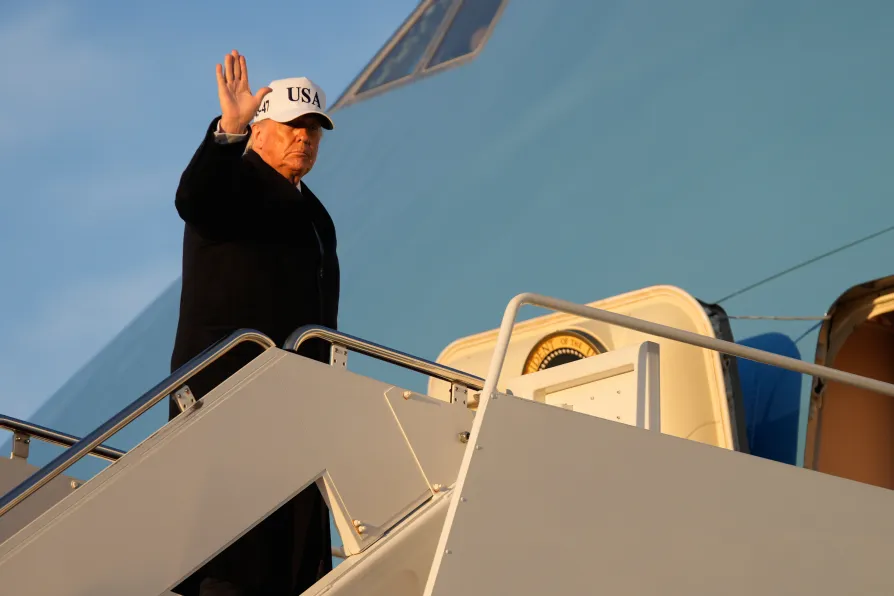
 President Donald Trump boards Air Force One, March 13, 2026, at Joint Base Andrews, Md., for a trip to Florida





DONALD TRUMP’S war is not going to plan.
That’s a good thing — successful US-Israeli aggression would encourage both states to start more wars and keep wrecking what remains of an international legal order.
They have form. The “Greater Israel” demanded by Israeli ministers like Bezalel Smotrich involves territorial expansion, which as we have seen in Syria Israel will pursue whenever regional chaos permits it.
Trump has bombed seven countries so far in his second term, and threatened Canada, Mexico, Cuba, Greenland, Colombia and more. His aggression will escalate until it is checked.
In Iran it is, so far, being checked, in that the easy win he appears to have counted on eludes him.
The first casualty of war is the truth. Trump says Iranian claims of significant damage to US assets in the region are fake news and that images showing that damage are AI-generated.
Doubtless Iran does exaggerate its successes, but so, it is clear, do Israel and the United States.
The reality that the aggressors are struggling is shown by the hasty redeployment of South Korea-based US anti-air defence systems to the Middle East — a sign US military resources are not limitless, as War Secretary Pete Hegseth keeps claiming, and one that calls into question a core concept of US strategic thinking — “global power parity,” the notion that the United States should be able to match any adversary anywhere in the world simultaneously.
It’s shown too in the attempts to draw others into the conflict. Hegseth has claimed Gulf Arab states are going “on the offensive” against Iran; they were swift to deny it, just as the United Arab Emirates angrily denied Israeli claims it had fired on an Iranian desalination plant.
The Gulf states condemn Iran for firing at targets on their territory — they could hardly do otherwise — but they show a deep unwillingness to be dragged into a war they always opposed.
Longer term, this too may presage a shift away from US influence, as its bases have been shown not to protect their hosts but to make them targets, and Washington’s decision to ignore their interests when starting the war undermines the idea they are in a mutually beneficial relationship.
Now Trump calls on a range of countries, from Europe to China, to help open the Strait of Hormuz to international shipping by sending warships.
China, whose ships have been promised safe passage by Iran anyway, is unlikely to help the US avoid the consequences of a war Beijing condemns. But even US allies in Europe are making their reluctance clear.
It should stay that way. Sending warships would be to join the US-Israeli war: the government must be left in no doubt of the scale of opposition to any such step.
For British and European governments also flirt with escalation. Defence Secretary John Healey claims the “hidden hand” of Putin lies behind accurate Iranian strikes; Germany links its reluctance to join the conflict to prioritising the Ukraine war, condemning Washington for suspending sanctions on Russian oil.
Tying the two wars together could hardly be more dangerous. To suggest the US is really fighting Russia in Iran is to promote US-Russia conflict, which could spiral into world war.
We cannot trust our governments on this. As long as the war continues the prospect of our being drawn in remains. An appalling regional conflict that has claimed thousands of innocent lives could become a global conflict killing millions.
European leaders raced to Washington last year when Trump appeared to cool on the Ukraine conflict, pleading with him to keep it going.
When it comes to ending war on Iran they show no such urgency. Keir Starmer is right to say the best way out of this crisis is de-escalation. He should be pressed to follow through on that and demand the US and Israel stop attacking Iran.
