

 Latest editorial

Government must ‘ensure those with the deepest pockets shoulder the cost,’ TUC says
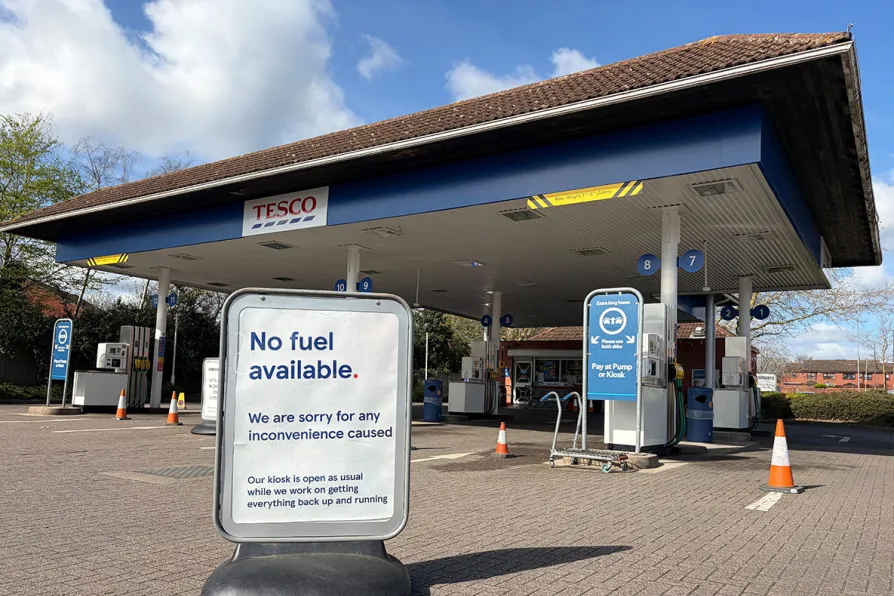 A sign informing customers that there is no fuel available to purchase at the entrance to the filling station at Tesco Superstore in Worcester, March 26, 2026





PROFITEERING companies benefiting from the US-Israeli war on Iran must be taxed to help with the soaring cost-of-living, campaign groups and unions demanded today.
They urged PM Sir Keir Starmer to “pull out all the stops” to mitigate the crisis as the OECD warned that Britain will be hardest hit by disruptions in oil shipments of all 38 countries in the organisation.
An open letter, signed by more than 40 non-governmental organisations, demanded that Chancellor Rachel Reeves implement an excess profits tax on windfall revenues which many firms are expected to make as a result of the war in Iran.
They have asked that revenue from the levy be used to provide direct cost-of-living support to those hit hardest, while investing in building Britain’s long-term resilience to make the country less vulnerable to fuel price shocks.
TUC general secretary Paul Nowak joined the call today for government officials to heed the warnings from the OECD and explore all options to mitigate the devastating effects the war is having on the cost of living.
Mr Nowak said: “The longer this war goes on, the bigger the threat to our economy and to living standards.
“Low-income families and already-struggling sectors will need the greatest protection most rapidly.
“That’s why de-escalation must be the priority. But the government must stand ready to pull out all the stops to protect the country from a sustained Trump-slump — and ensure those with the deepest pockets shoulder the cost.”
Britain is set to face significantly weaker economic growth this year and will experience surging inflation, the OECD forecast showed.
It predicted prices to shoot up due to diminished oil and gas supplies, which could notably cause fertiliser shortages, leading to soaring food prices.
Ms Reeves responded, saying the war in the Middle East “is not one that we started, nor is it a war that we have joined,” adding: “But it is a war that will have an impact on our country.”
Signatories to the open letter to Sir Keir and Ms Reeves include Greenpeace UK, Tax Justice UK, 38 Degrees, Global Witness, Women’s Budget Group and Patriotic Millionaires UK.
They wrote that the shock in oil prices should be a “turning point” for British leadership as “energy bills, fuel costs and essentials are set to increase in costs for households and businesses already struggling with affordability after years of a cost-of-living crisis.
“It is not right that extraordinary profits, generated off the backs of ordinary people during periods of crisis, are siphoned off into private hands and corporate bank accounts.”
Recent data from the End Fuel Poverty Coalition (EFPC) found that for each month that energy prices remain at levels seen in March, an energy profits levy could raise over £200 million in taxed revenue, an annual income of £2.4 billion of annual income.
Combined with additional offshore corporations tax on profits generated by energy firms, campaigners estimate the state could take in £427m a month or £5.1bn a year.
The EFPC called for these measures as an effective countermeasure to an expected sharp rise in bills from July 1.
Tax Justice UK executive director Faiza Shaheen said: “Too often UK governments have failed to protect households and small businesses from the profiteering corporates and super-rich individuals who circle around crises like vultures.
“Spain has already frozen rents, yet our government fails to show urgency. The Chancellor needs to get a grip on the situation to help people already struggling, and show that this will not be yet another crisis where the rich get richer, while everyone else foots the bill.”
Greenpeace UK co-executive Areeba Hamid said: “The oil-majors are set to make gargantuan profits from global instability while ordinary people pay the price of Trump’s war in Iran.
“The fossil fuel industry should be contributing more tax, not less.”
EFPC co-ordinator Simon Francis said: “Gas prices have more than doubled since late February, and households are already struggling with energy bills that have been stuck at elevated levels for five years.
“The latest global disruption is a stark reminder of the cost of our dependence on imported fossil fuels. Every time conflict or instability strikes overseas, ordinary households pay the price through their energy bills.”
