Labour must deliver its manifesto promises in full and begin the bigger task of restoring workers’ collective power, says MATT WRACK


 Latest editorial
Socialism’s biotechnology success
The growth of Cuba’s biotechnology sector is an example of how socialism can prioritise scientific innovation, write ROX MIDDLETON, LIAM SHAW and MIRIAM GAUNTLETT
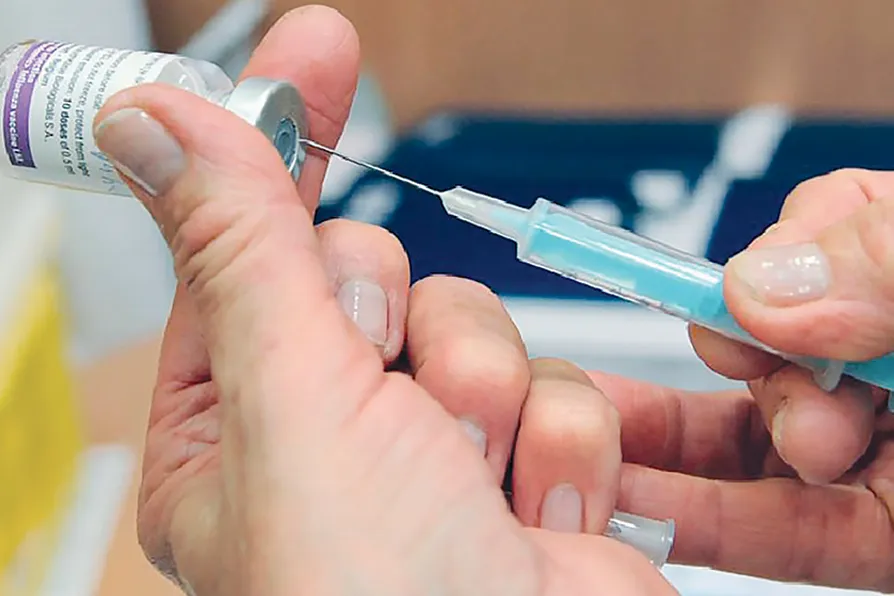 A vaccination campaign targeting those born in 2022 who have reached the age of 2, who will be given a single dose of the Cuban vaccine Quimi-Vio - it protects against meningitis, pneumonia, and acute otitis media / Pic: https://www.radiorebelde.cu

This summer’s fire outbreaks highlighted once again the deadly cost of job, equipment and funding cuts to the fire service. Ten years after the Grenfell tragedy, serious lessons still need to be learned, says STEVE WRIGHT
Live music and musical education are both under attack and threaten to impoverish our culture. The Musicians’ Union seeks allies in the fightback, writes NAOMI POHL
The TUC fell for the illusion of a ‘Social Europe’ in 1988 and backed single-market membership. DOUG NICHOLLS argues that dramatic changes in the EU prove the need for an independent economic policy
As Cuba faces an unprecedented US energy siege and growing threats of military intervention, TUC Congress must stand unequivocally with Cuban workers and their right to determine their own future, writes STEVE GILLAN, POA general secretary and TUC president
By organising for boycotts, divestment and sanctions, trade unionists can turn solidarity into action, writes JESS BARNARD





CUBAN scientist Agustin Lage Davila writes: “[Science] can be a threat to development and social justice aspirations, as capitalism tries to privatise knowledge, but it also can be an instrument of liberation and development insofar as the attempt to privatise knowledge makes capitalism’s contradictions more evident.”
This idea was first theorised by Marx and Engels; in their understanding of political economy, capitalism will fall to socialism once the system becomes an obstacle to the development of the productive forces.
A transition to socialism will thus enhance innovation in technological and scientific progress. The rapid industrialisation of the USSR and the People’s Republic of China following the communist revolutions in these nations exemplifies this.
Economic planning and a focus on technological development transformed them from agrarian, technologically weak countries to global leaders in scientific research and industry.
Another example of such a transformation is Cuba. Fidel Castro stated as early as the 1960s that Cuba’s future was “a future of men of science”; a sentiment he would later emphasise during Cuba’s economic crisis following the collapse of the USSR.
These years, known as the Special Period, were a time of economic depression after Cuba lost its primary source of imported goods, leading to extreme shortages in energy, medicine and food.
Castro’s statement in 1993, during the height of this crisis, that “science and scientific productions should someday occupy first place in the national economy,” is an indication of the importance placed on scientific innovation as a way to support and strengthen Cuba’s sovereignty and lead it out of economic deficit.
Indeed, by the early years of the 21st century, biotechnological and pharmaceutical products (such as vaccines and medicines) reached the second material exports tier in the Cuban economy.
Pharmaceutical products are known as “high-technology exports,” meaning that they are manufactured products with high research and development (R&D) intensity, indicating Cuba’s strength in this field.
Cuban biotechnology products are currently registered in 66 countries, and exported to more than 50 countries. In Cuba itself, over 20 different medicines and vaccines have been incorporated into the national health system.
Drugs have been created for cholesterol reduction and heart attack treatment, and novel vaccines developed for meningitis, hepatitis B, diphtheria, tetanus and whooping cough. Cuban scientists developed a Covid-19 vaccine, inoculating 90 per cent of the population by the end of 2021, which was also exported for emergency use in other countries including Vietnam, Venezuela and Iran.
Some Western scientists have voiced scepticism of Cuba’s medical research claims, some of which are not supported by the usual array of papers in the most prestigious Western scientific journals. But Cuba’s research takes place in a country that is internationally isolated, subjected by the US to the longest and most intensive economic blockade in history.
For example, a therapeutic vaccine for a form of lung cancer has been available to the Cuban population since 2011, and costs just £0.73 per shot to manufacture. However, as pointed out in a review of Cuban biotechnology published in Nature in 2019, the US embargo has led to delays in clinical trials of this vaccine being conducted on US soil.
The embargo also forbids US citizens from seeking medical treatment in Cuba, and continues to have “detrimental effects on such factors as scientific collaboration, intellectual property, and import and export of Cuban products.”
Still, it is undoubtedly the case that Cuba’s commitment to medical research has led to improved health outcomes within this developing country: for example, the incidence of meningitis and hepatitis B and A has been reduced, reaching zero in the population under 15.
Cuba’s meningitis B vaccine was awarded a UN gold medal for global innovation. In 2015, the World Health Organisation announced that Cuba was the first country in the world to eliminate mother-to-child HIV transmission; this was achieved through the distribution of domestically produced anti-retroviral medicine to halt patient transmission.
Cuba’s success in the biotechnology sector is even more remarkable when we examine the full context under which the industry has been operating: in the 1980s, when Cuba’s Centre for Genetic Engineering and Biotechnology (CIGB) was founded, Cuba lacked a base for industrial development. It was without supply chains, had no history of exporting medicines, no established commercial channels, and its internal market was very small — and it had been under the US embargo for over 20 years. Despite this, the biotechnology sector emerged as a profitable part of the Cuban economy.
Capitalism’s contradictions mean that the social character of production is constantly warring with the private nature of profit accumulation. Under these circumstances, vaccines are simply another commodity to extract exchange-value from for the shareholders of pharmaceutical companies. In socialist Cuba’s publicly owned biotechnology sector, the situation is a little different.
As explained by Lage Davila in his book The Knowledge Economy and Socialism, the main biotechnology centres in Cuba are built to carry out research, production and commercialisation, all under the same administration.
There are no barriers between scientific innovation and production in the factory, nor between these and the commercial negotiations that distribute the products. Each institution takes on responsibility for the success of the entire cycle: research, obtaining new products, assembling the productive process, production itself, and distribution in Cuba and abroad.
Contrast this to the behaviour of biotechnology companies in North America and Europe, which do not have any productive capacity and instead must obtain it through outsourcing the manufacturing.
In the pharmaceutical sector elsewhere, the largest firms now generally acquire innovation from smaller biotechnology companies rather than doing it in-house. More than 80 per cent of biotechnology companies are not profitable. They persist due to venture capital injections or shares sold on the stock market, or through military financing.
The use of state military funds to support scientific research and technological development, as well as being morally indefensible, is another indication that scientific knowledge does not advance within a purely capitalist system of political economy. These state funds are then funnelled to big pharma when they buy up start-ups.
Recently, the US has intensified its decades-long war on Cuba by strengthening the economic blockade. An executive order threatens tariffs on any country on Earth that sells Cuba a single barrel of oil, and a US naval deployment in the Caribbean is targeting any shipments of oil bound for Cuba.
The country seems set for another economic crisis, with the President Miguel Diaz-Canel announcing a long list of measures being taken to minimise the fuel shortage’s impact on hospitals and nursing homes.
Still, Fidel Castro’s words from the Special Period of “Resist, Overcome, and Develop” show how Cuban scientists persist through material difficulties, as well as the empty lie of a global scientific community that exists free of politics.
